June 8, 2026
The Mystery of Symbolic Marginal Notes in Old Books
Marginal notes in old books reveal how readers left symbols, doubts, jokes, and private traces that still reshape the history of reading and memory today.
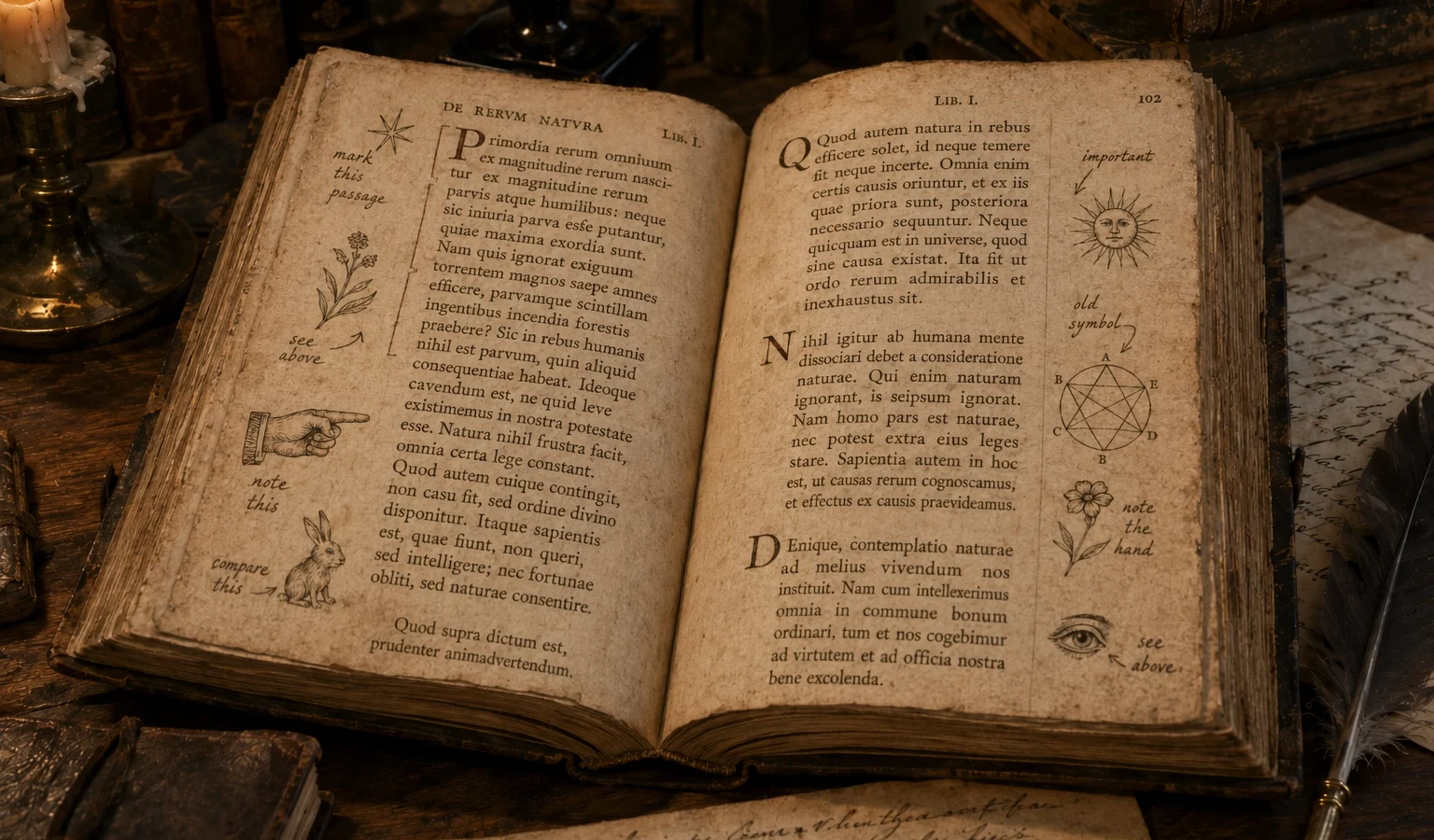
An old book is rarely silent.
Even when its printed text remains unchanged, other voices may have gathered around it. A sentence is underlined in faded ink. A word is corrected. A small hand points toward a passage from the edge of the page. A question mark stands beside a confident argument. A name appears on the flyleaf. Someone has drawn a face, a bird, a flower, a ladder, a cross, an eye, a star, or a shape whose meaning has become impossible to recover.
The book was read before it reached us.
That fact changes everything.
A clean page presents the official text. A marked page reveals an encounter. The author wrote one book. The reader, without asking permission, began another in the margins.
This is the quiet fascination of marginal notes in old books. They are often small, but they disturb the illusion that reading is passive. A book does not merely travel through time as an object. It passes through hands, rooms, households, institutions, arguments, griefs, classrooms, journeys, and private seasons of attention.
Some annotations explain.
Some correct.
Some argue.
Some remember.
Some only prove that a bored human being once sat beside the page and allowed the mind to wander.
And some remain more mysterious.
A symbol appears several times beside certain passages. A word is written in a different hand. A strange diagram interrupts a theological text. A flower blooms beside a warning. A pointing finger insists that one sentence matters, but gives no reason. The original reader is gone. The private system has survived without its key.
The margin becomes an archive of attention.
The printed page tells us what the book was meant to say. The margin tells us where another mind stopped breathing for a moment and leaned closer.
The Book Beneath the Book
Every old book contains at least two histories.
The first is visible and official. It belongs to the author, printer, scribe, publisher, binder, illustrator, institution, edition, and date. It can be catalogued. It can be described in a library record. It can be placed within the history of literature, religion, science, law, philosophy, or art.
The second history is more fragile.
It belongs to the people who encountered the object after it was made.
They may have written their names inside the cover. Added family births and deaths to a Bible. Corrected a translation. Marked a passage for a sermon. Questioned an argument. Practiced handwriting on a blank page. Pressed a plant between chapters. Folded a corner. Left a stain. Drew a line beneath a sentence and returned to it often enough that the paper thinned.
Old marginalia belongs to this second history.
It reveals the book beneath the book: not the stable work imagined by the author, but the living object altered by use.
This distinction matters because books are often treated as finished things. A text is written, printed, bound, shelved, sold, inherited, collected, digitized, and preserved. But reading is not always respectful in the museum sense. Readers interfere. They leave pressure behind.
The margin records this interference.
It is where the authority of the printed word meets the stubborn presence of another mind.
What Counts as Marginalia?
Marginalia is a broad term.
It can include annotations written beside the text, corrections, glosses, underlining, symbols, sketches, pointing hands, ownership inscriptions, dates, genealogical notes, personal reactions, quotations, indexing marks, references to other books, and doodles drawn during lapses of attention.
Not every mark carries equal weight.
A scholar may write several lines explaining a difficult phrase. A student may underline half a chapter without discrimination. A preacher may mark passages for later use. A child may draw an animal. A collector may note where the book was purchased. A grieving family member may record a death on a blank page because the book felt safer than a loose sheet of paper.
These traces form a spectrum.
| Type of Mark | Possible Purpose | What It May Reveal |
|---|---|---|
| Gloss or explanation | Clarifying a difficult word or passage | How the text was understood in another period |
| Underline or vertical line | Marking importance | Where attention gathered |
| Question mark or objection | Disagreement, doubt, intellectual resistance | The reader arguing with the text |
| Pointing hand or manicule | Directing the eye toward a passage | A personal map of importance |
| Ownership inscription | Recording possession or provenance | Who held the book and where it travelled |
| Family record | Preserving births, marriages, or deaths | The book as domestic archive |
| Doodle or grotesque figure | Play, distraction, satire, imagination | The human life surrounding formal reading |
| Symbolic mark | Private notation, emphasis, memory aid | A system whose key may have been lost |
This table is not a hierarchy.
A careless doodle may tell us as much about a reader as a learned gloss. A name may matter more than an argument. A single inked hand pointing toward one sentence may preserve the emotional center of a reading experience more clearly than pages of commentary.
The margin does not separate the important from the trivial as neatly as an archive would prefer.
That is part of its honesty.
The Reader Who Refused to Remain Invisible
A printed book invites obedience.
The lines move in order. The page directs the eye. The author speaks first. The reader is expected to follow.
Marginalia interrupts this arrangement.
The reader speaks back.
This may be one reason marginal notes in old books feel so intimate. They reveal a moment when reading became too active to remain silent. Someone agreed so strongly that a line was drawn beneath the sentence. Someone doubted enough to write a question. Someone disliked the argument enough to challenge it in the narrow space available beside the text.
The margin becomes a small chamber of resistance.
It may contain admiration.
It may contain irritation.
It may contain boredom.
It may contain the first trace of an idea that later became something larger.
Readers often appear strangely alive in their notes because the margin preserves reaction before reaction has been polished into formal prose. A published essay has been edited. A handwritten trace may not have been. It retains urgency, impatience, surprise, and private tone.
The reader is no longer an abstract figure.
A hand appears.
A voice leans into the page.
The Symbolic Power of the Pointing Hand
Among the most memorable marginal symbols is the pointing hand, often called a manicule.
It may be elaborate or crude. Some resemble carefully drawn hands with cuffs, fingers, and decorative flourishes. Others are little more than a quick gesture in ink: a finger reaching from the edge of the page toward a line that mattered.
The symbol is simple.
Look here.
Do not pass too quickly.
This sentence deserves another moment.
The pointing hand is powerful because it makes attention visible. It turns reading into a physical gesture. A reader who vanished centuries ago still reaches toward the words.
This is one of the deeper mysteries of annotations in old books. The body survives in reduced form. Not the whole body. Not the face. Not the voice. Only the gesture.
A finger remains.
The person does not.
There is something almost ghostly in this.
The mark does not tell us why the passage mattered. It may have supported an argument, corrected a misconception, inspired a sermon, disturbed a belief, or simply seemed beautiful. The symbol directs attention without explaining the emotion behind it.
The reader becomes a guide who has forgotten to leave instructions.
A pointing hand in the margin is a small ghost of attention: the reader is gone, but the gesture still insists that we stop.
Glosses, Corrections, and the Architecture of Understanding
Not every annotation is mysterious.
Much of it is practical.
Readers have long used margins to explain difficult passages, translate words, compare authorities, summarize arguments, record variants, and correct errors. In manuscripts, glosses may stand beside the main text or gather around it so densely that the page begins to resemble a city built around an older monument.
This architecture matters.
The central text may remain visually dominant, but the margins reveal that understanding is rarely simple. A page can contain layers: author, scribe, commentator, teacher, student, later reader, owner, librarian. Each approaches the same sentence from a different angle.
Surviving annotations therefore challenge the fantasy of a single final reading.
A text enters history and becomes surrounded by interpretation.
This is especially visible in religious, philosophical, legal, and scholarly books, where one sentence may attract correction, expansion, caution, and dispute over generations. The page becomes an arena of inherited attention.
Some notes serve knowledge.
Others reveal uncertainty.
Both matter.
A book covered in marginalia may look damaged to one eye and alive to another.
When the Margin Becomes a Private Symbol System
Some readers developed personal systems of marks.
A star beside a passage of unusual importance.
A cross beside a spiritual question.
A flower beside an image worth remembering.
Parallel lines beside an argument.
A circle, triangle, ladder, eye, hand, or unfamiliar sign repeated throughout the volume.
At the time, the reader may have understood the code perfectly.
Later, the code becomes opaque.
This is where symbolic marginalia acquires its particular atmosphere. A repeated sign suggests intention, but the original key has disappeared. The marks are not random enough to dismiss and not clear enough to decode with certainty.
The temptation is immediate.
One wants to solve them.
To declare that the star means revelation, the eye means secrecy, the ladder means ascent, the circle means completion, the flower means beauty, the cross means devotion.
But symbolic restraint matters.
The same sign may have served a practical function. A star may have meant “quote this later.” A flower may have been a mnemonic device. A triangle may have indexed a theme. A hand may have pointed toward a legal principle rather than a mystical truth.
The unknown symbol does not need to become an occult message.
Sometimes it is enough to know that a reader once built a private map through the text and failed to leave us the legend.
Doodles, Grotesques, and the Life Beyond Serious Reading
Old books are not always solemn.
The margins of medieval manuscripts may contain animals, hybrid creatures, comic figures, impossible battles, rabbits behaving violently, knights confronting snails, faces emerging from vines, and scenes whose original meanings remain debated.
These images disturb the modern assumption that historical readers lived permanently inside reverence.
They did not.
They joked.
They became distracted.
They enjoyed absurdity.
They allowed strange creatures to inhabit the border between sacred text and ordinary imagination.
This matters for the symbolic reading of marginalia. The margin is not only the place of hidden wisdom. It is also the place where form loosens. The central page may demand seriousness. The edge permits play.
A knight fighting a snail may invite scholarly theories, but it also preserves the pleasure of uncertainty. A rabbit preparing to strike a man with a club does not become less fascinating because no single interpretation has conquered it.
The margin becomes a threshold between discipline and wandering thought.
Not every mystery should be forced into clarity.
Some deserve to remain peculiar.
The Book as a Family Archive
Some books outlive their original purpose.
A Bible, prayer book, almanac, legal volume, or household text may become more than reading material. Blank leaves and margins begin to collect family history: names, births, marriages, deaths, journeys, purchases, addresses, and short notes made because the book was expected to remain when loose paper might disappear.
In such cases, the book becomes a domestic archive.
The printed text continues, but another chronology grows around it.
A child is born.
A marriage takes place.
A parent dies.
A house changes hands.
A name is added in ink darker than the one above it.
This gives handwritten traces another emotional weight. The book no longer holds only ideas. It holds continuity. Its pages carry a family’s attempt to remain visible to itself.
The object becomes a witness.
It may pass from hand to hand long after the meanings of certain entries have faded. A name remains, but the face is lost. A date remains, but the grief surrounding it has dissolved into silence. The handwriting grows smaller, shakier, or more formal across generations.
The book contains lives it cannot explain.
The Difference Between a Mark and a Message
Modern readers are often drawn to old marginalia because the marks feel like messages.
Sometimes they are.
A note may address a future reader directly. An owner may record a name. A scholar may explain an argument. A family member may leave information intended to survive.
But not every mark was written for us.
This distinction matters.
A note in the margin may have been private shorthand. A doodle may have been boredom. A symbol may have been obvious only within a local system. A correction may have been temporary. A line may have been drawn without any expectation that another reader would see it centuries later.
The mark survives.
The intended audience does not.
This creates a peculiar form of intimacy. We encounter traces that were not necessarily meant to become historical evidence. The page allows us to stand too close to another person’s attention.
There is beauty in this, but also responsibility.
Marginal notes in old books should not be romanticized into secret messages whenever their meaning is unclear. The unknown deserves more respect than projection.
Sometimes the honest reading is simple:
someone was here.
Marginalia as Evidence of Provenance and Movement
A book can travel farther than the person who first owned it.
It may move through homes, monasteries, schools, courts, libraries, shops, inheritances, sales, wars, migrations, and collections. Its marks can preserve fragments of this movement.
A signature identifies an owner.
A stamp identifies an institution.
A note identifies a place.
A date anchors the book to a moment.
A language shift suggests another reader.
A change in ink reveals another period of use.
A book may become layered with hands so different that it resembles a conversation conducted across generations by people who never met.
This is one of the practical values of marginalia. It can help reconstruct provenance: where a book has been, who used it, and how its role changed over time.
But provenance is not only a technical concern.
It is a narrative.
A clean copy tells us about an edition.
A marked copy may tell us about a life.
The Ethical Problem of the Beautifully Marked Book
There is a tension in every annotated old book.
The marks may increase historical value while decreasing visual purity. They may help scholars while frustrating collectors who prefer clean pages. They may preserve memory while also altering the original object.
A pristine book can feel beautiful.
An annotated book can feel alive.
Neither condition is automatically superior.
The responsible approach depends on age, rarity, provenance, condition, and context. Modern readers should not imitate historical marginalia carelessly inside rare or valuable books. Conservation matters. Fragile objects should be handled according to archival guidance. Ink, adhesive notes, pressure, humidity, and careless storage can cause harm.
Symbolic fascination should not become damage.
This is an important boundary for The Hidden Archive.
To love old books is not to romanticize careless handling.
It is to preserve the possibility that another reader may encounter the object after us.
A Quiet Method for Reading Marginal Notes
When encountering marginalia in an old book, begin slowly.
Do not assume that every mark belongs to one hand or one period. Do not force symbolic meaning before observing material details. Let the page remain partly unknown.
- Notice the position of the mark: outer margin, inner margin, top, bottom, flyleaf, title page, or blank leaf.
- Compare handwriting, ink color, pressure, and style across the book.
- Ask whether the mark explains, corrects, indexes, questions, remembers, jokes, or simply accompanies the text.
- Look for repetition: the same sign may form a private system.
- Notice which passages attracted attention and which remained untouched.
- Separate what can be supported from what remains speculation.
- Record the page carefully rather than tracing, erasing, or adding new marks.
- Allow uncertainty to remain part of the encounter.
This is not a ritual of decoding.
It is a discipline of attention.
The aim is not to turn every old mark into a secret.
The aim is to recognize when another mind has left a door slightly open.
When Symbolic Marginalia Becomes Too Easy
Old books invite fantasy.
A faded symbol. A handwritten note. A pressed flower. An unfamiliar diagram. A page darkened by time. These details can make almost any object feel mysterious.
But atmosphere should not replace honesty.
Cheap mysticism turns every annotation into a hidden code, every stain into ritual evidence, every diagram into forbidden knowledge, every anonymous hand into a secret initiate.
The Hidden Archive requires more restraint.
Some handwritten traces can be explained. Some can be dated. Some can be linked to known readers. Others remain unresolved.
The unresolved notes do not need exaggerated claims.
Their quiet power is already sufficient.
A mark survives.
The reason does not.
That is mystery enough.
Symbolic Observations ✦
- Marginal notes in old books reveal reading as an active encounter rather than a passive act.
- A clean page preserves the official text; a marked page preserves a relationship with the text.
- Pointing hands, stars, lines, flowers, and other signs may form private maps of attention.
- Not every repeated symbol has a mystical meaning; some served practical systems of reading and memory.
- Glosses reveal the architecture of understanding built around a central text.
- Doodles and grotesques preserve humor, distraction, and imagination beside serious reading.
- Ownership inscriptions and family records turn books into domestic archives.
- Annotations may reveal provenance, movement, and the history of a specific copy.
- The meaning of a mark may disappear while the gesture remains.
- The most honest reading allows mystery to survive without forcing certainty.
The Margin as a Hidden Archive
The center of a page carries authority.
The margin carries survival.
It holds what did not fit comfortably inside the official text: correction, memory, doubt, boredom, devotion, irritation, ownership, humor, indexing, grief, and the stubborn evidence of use.
This is why marginal notes in old books belong so naturally to The Hidden Archive.
The reader has disappeared, but the reaction remains.
The household has vanished, but the family dates remain.
The argument is forgotten, but the question mark remains.
The system is lost, but the symbol remains.
The body is gone, but the pointing hand remains.
The margin keeps what history almost discarded.
Not the grand statement.
Not the polished biography.
The pause.
The objection.
The small human insistence that one line mattered enough to mark.
The Reader Who Still Waits Beside the Page
The mystery of symbolic marginalia is not that every mark hides a secret.
It is that every mark reveals an absence.
Someone once sat with this book beneath another quality of light.
Perhaps beside a window.
Perhaps in a library, classroom, monastery, study, shop, hospital, or household room after others had gone to sleep.
They read slowly enough to stop.
The hand moved.
Ink touched paper.
A line, symbol, word, date, or small figure entered the margin.
Then the reader continued.
Years passed.
The book changed hands.
The room disappeared.
The original question may no longer be recoverable.
But the page still bears the pressure of attention.
This is what makes marginal notes in old books so moving. They do not return the past completely. They return it incompletely, which is often more powerful.
A complete explanation would close the page.
The surviving mark leaves it open.
The book rests on the table.
The printed sentence remains where it always was.
Beside it, a faded hand points inward from the edge.
The reader is gone.
The gesture waits.
Continue Through the Archive
Why Forgotten Manuscripts Fascinate Human Imagination
A reflective exploration of old paper, lost voices, damaged records, hidden histories, and the fragile survival of human memory.
The Symbolism of Silence in the World of Lucifer Heritage
A cornerstone essay on quiet, restraint, atmosphere, and the refusal to explain every mystery into exhaustion.
Why Humans Attach Meaning to Ritual Objects
A symbolic study of touch, memory, attention, grief, and the human need to give invisible experience a material anchor.
The Mystery of Pressed Flowers Inside Old Books
An atmospheric essay on botanical traces, private memory, fading color, and the intimate objects readers leave between pages.
Why Old Libraries Feel Like Threshold Spaces
A quiet reflection on shelves, silence, inherited knowledge, forgotten readers, and the peculiar weight of rooms built to preserve memory.
Further Reading & Sources
- Library of Congress — Who’s or Whose Book Is This?
A Library of Congress essay on ownership inscriptions, provenance, bookplates, marginalia, and the history of individual copies. - Bodleian Libraries — Notes in the Margin
Examples of annotations, doodles, jokes, and manicules: pointing hands used for centuries to direct attention toward important passages. - Harvard Library — Reading: Harvard Views of Readers, Readership, and Reading History
A digital collection exploring the intellectual, cultural, and political history of reading through personally annotated books, commonplace books, and archival records. - Harvard University — Take Note
A digital exhibition on annotations, marginalia, commentary, note-taking, metadata, and the many ways readers write around texts. - British Library — Ludicrous Figures in the Margin
A British Library exploration of playful medieval marginalia, grotesques, animal musicians, fighting snails, and recurring visual themes whose meanings remain debated. - British Library — Knight v Snail
A closer look at the famous and still-debated medieval motif of armed figures confronting snails in manuscript margins. - Library of Congress — Behind the Rabbit: A Short Tale
A Library of Congress essay on a fifteenth-century manuscript containing an armed marginal rabbit and the still-unresolved tradition of medieval killer bunnies. - British Library — Medieval Killer Rabbits: When Bunnies Strike Back
A visual collection of violent, comic, and strangely memorable rabbit imagery in medieval manuscript margins. - History of the Book at Harvard — Take Note Site Visit Write-Ups
Material on student annotations, sermon notes, critical commentary, and historical note-taking practices. - British Library Archives — Harley MS 2493
A catalogue example of a manuscript partly copied and annotated by Petrarch and later annotated by Lorenzo Valla.