June 25, 2026
The Symbolism of Abandoned Churches
Abandoned churches reveal how sacred spaces become symbols of faith, ruin, memory, silence, and the uneasy beauty of devotion after community fades.
The Symbolism of Abandoned Churches
An abandoned church is never only an empty building.
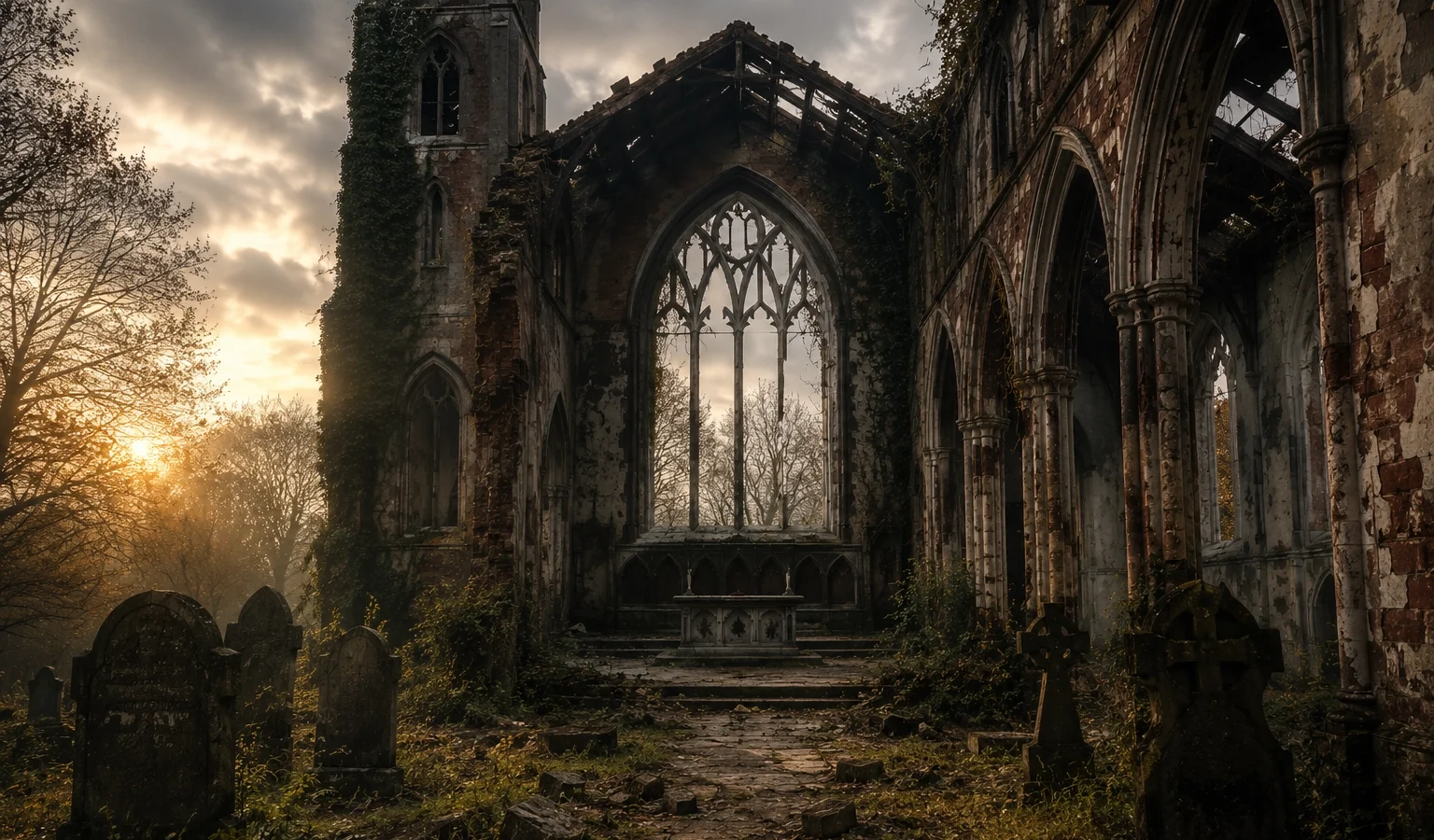
Even when the roof has failed, the windows are broken, the pews are gone, and weeds have entered through the floor, something of the original intention remains in the shape of the place. The aisle still leads forward. The nave still gathers the eye. The tower still rises above ordinary rooflines. The doorway still suggests entry into a different order of space.
Silence behaves differently there.
It is not the silence of a warehouse, barn, school, or abandoned house. It is a silence formed by former speech: prayers once said aloud, hymns once carried into rafters, footsteps once softened by reverence, names once read from registers, grief once brought before an altar, vows once spoken under stone and timber.
This is why abandoned churches feel so emotionally charged. They are not simply ruins. They are sacred spaces after interruption.
A ruined factory suggests labor that ended. A deserted station suggests travel that ceased. A neglected mansion suggests private life emptied of wealth or family. But a closed church suggests something more difficult: a community’s former architecture of meaning.
The building may no longer serve worship. The congregation may have moved, aged, dissolved, or disappeared. The village may have changed. The city may have shifted. Faith may remain elsewhere, but not here, not in this room, not under these beams.
And yet the room does not become neutral immediately.
The walls remember arrangement.
The windows remember light.
The floor remembers gathering.
The sacred may no longer be formally active, but the form of sacred attention remains visible.
An abandoned church is a prayer whose voice has left, but whose architecture has not yet forgotten how to listen.
Why Abandoned Churches Feel Different from Other Ruins
Not all ruins carry the same emotional weight.
A ruined cottage may feel intimate. A broken castle may feel political. A derelict mill may feel industrial. A collapsed theatre may feel theatrical even in decay. Each ruin preserves the memory of its former purpose.
But churches were not built only for use.
They were built for orientation.
They placed ordinary human life inside a larger frame: birth, baptism, marriage, confession, mourning, seasonal ritual, weekly gathering, sacred music, moral instruction, remembrance of the dead, and the repeated attempt to understand life under the presence of something greater than the individual.
This is why abandoned churches disturb the imagination so deeply. Their decay is not only architectural. It appears to touch faith, community, memory, and time itself.
A broken window in an ordinary building may suggest neglect.
A broken stained-glass window suggests interrupted symbolism.
A roofless room may suggest exposure.
A roofless nave suggests heaven and weather entering the same place.
A cracked wall may suggest structural failure.
A cracked church wall suggests that even spaces built for permanence can be wounded by rain, poverty, demographic change, policy, indifference, or history.
The ruin does not prove that faith has vanished.
It proves only that buildings, like bodies and communities, require care to remain inhabited.
The Sacred Shape That Remains
A church is not sacred only because religious words are spoken inside it.
Its architecture often teaches the body how to behave before thought begins. A doorway slows entry. A nave gathers movement. An altar or sanctuary draws attention forward. A tower lifts the eye. Stained glass filters light into story. Stone holds coolness. Timber holds age. Echo changes the human voice.
Even after closure or abandonment, these forms continue to act.
The space still invites a certain posture. One lowers the voice, even when no service is taking place. One steps more carefully. One notices the center of the room. One feels that the building was made for more than storage, shelter, or display.
This is one reason former places of worship are symbolically powerful: they preserve sacred grammar after sacred use has ceased.
The grammar may be damaged.
The roof may be open.
The floor may be unsafe.
The altar may be gone.
But the sentence is still partly readable.
A sacred building arranges space around meaning. When the meaning becomes uncertain, the arrangement remains as evidence. The church becomes a visible question: what happens to a sacred form when the living community no longer gathers around it?
The answer is never simple.
Faith After the Congregation Has Gone
An abandoned church is often described as if faith itself has failed.
This is too crude.
A church may close for many reasons: population decline, changing settlement patterns, financial pressure, structural damage, denomination decisions, shrinking congregations, urban redevelopment, or the merging of parishes. A building may be abandoned even while belief continues elsewhere. A congregation may move into a newer structure. A sacred object may be transferred. A community may continue without the old walls.
Still, the closed church carries the emotional force of absence.
It shows where faith once had a visible address.
The building says: people came here. They returned here. They organized time around this place. They marked the seasons here. They carried the dead through this door. They brought children to this font. They stood under this roof when joy or grief needed witnesses.
This is why sacred ruins often feel closer to memory than to theology.
The visitor may not share the faith that built the church. They may know little of its liturgy. They may not understand its denominational history. Yet the emotional structure remains legible: this was a place where human beings brought what ordinary life could not contain by itself.
Faith may have moved.
The building remains as its shadow.
The Beauty and Danger of Sacred Decay
Ruined churches are beautiful in a dangerous way.
Ivy climbs through stone. Light enters through broken windows. Birds nest where music once gathered. Rain darkens the floor. Grass grows between tiles. A tree may rise through the nave, turning architecture into a strange collaboration between devotion and earth.
The image is powerful because it combines opposites.
Human order and natural return.
Prayer and weather.
Stone and leaf.
Silence and memory.
Ruin and beauty.
But beauty can become dishonest if it erases the cost of decay.
A collapsing church may be visually compelling, but it may also represent loss: of community, maintenance, heritage skill, religious continuity, funding, local identity, or safety. A roof failure is not only atmospheric. It allows water to enter. Water damages timber, plaster, wall paintings, memorials, floors, and records. Neglect is not poetry to those trying to save a building from irreversible damage.
This is why the symbolic reading of abandoned churches must remain restrained.
Decay can be beautiful.
Decay can also be failure.
To love the image of a ruined church while ignoring the labor of preservation is to mistake melancholy for responsibility.
Common Symbols Inside an Abandoned Church
A deserted church building gathers symbols even when its religious use has ended.
Some symbols are original to the building: cross, altar, font, pulpit, aisle, bell, window, memorial, choir, tower, rood screen, graveyard. Others arise through abandonment itself: broken glass, moss, dust, birds, weeds, cracked stone, rainwater, fallen plaster, locked doors, missing bells.
Together they create a layered symbolic field.
| Element | Former Function | Symbolic Meaning in Abandonment |
|---|---|---|
| Altar or sanctuary | Center of worship and sacred attention | A focal point after the voice has gone |
| Font | Baptism, entry into religious life | Beginnings remembered by an empty vessel |
| Pews | Gathering, listening, communal worship | The absent body of the congregation |
| Stained glass | Story, light, doctrine, beauty | Fragmented meaning when broken or faded |
| Tower or bell | Calling the community, marking time | A voice no longer heard across the village |
| Graveyard | Burial, memory, continuity of generations | The dead remaining after the living have left |
| Roof opening | Protection of sacred interior | Weather entering the room of prayer |
| Locked door | Boundary and protection | The sacred made inaccessible or unsafe |
This table is not a fixed code.
It is a way of noticing how architecture continues to speak through use, damage, absence, and memory.
The Abandoned Church as a Threshold Space
Churches have always been threshold spaces.
They stand between ordinary time and sacred time, between daily life and ritual life, between public community and private conscience, between the living and the dead, between the visible world and what a tradition understands as holy.
Abandonment intensifies this threshold quality.
The building is no longer fully active, but not fully erased. It belongs neither completely to worship nor completely to ruin. It may be locked, unsafe, preserved, sold, repurposed, forgotten, or waiting for a decision. It stands between meanings.
This is why abandoned churches often feel like places where categories blur.
Is it still sacred?
Is it only heritage?
Is it a ruin?
Is it a memory object?
Is it a danger?
Is it a future home, gallery, archive, community centre, or protected monument?
The former church holds these questions at once.
A threshold is powerful precisely because it has not yet chosen one side.
Silence After Worship
The silence of a closed church is not empty silence.
It is post-liturgical silence.
It comes after speech, song, bell, footstep, sermon, confession, prayer, and communal response. The room has been trained by sound. Its acoustics were shaped for voices. Its surfaces once received repetition. Even if the visitor knows nothing of the specific hymns or prayers once spoken there, the building carries the memory of gathered sound.
This is one of the strangest qualities of sacred ruins: they can feel as though they are listening.
Not because the building is alive in a literal sense.
Because its form was made for address.
A courtroom hears argument. A theatre receives performance. A home receives daily life. A church receives invocation. When that invocation ceases, the form remains open, as if waiting for a voice that no longer arrives.
The visitor may experience this as peace, grief, discomfort, reverence, or unease.
The room has not forgotten the shape of listening.
The Graveyard That Still Belongs
Many abandoned churches are surrounded by graves.
This changes the symbolism completely.
A church without a congregation may still have the dead. Names remain on stone. Dates remain. Families may still visit. Local history may survive more clearly in the churchyard than in the building itself. Even when worship has ceased, the site may continue as a landscape of memory.
The graveyard prevents the abandoned church from becoming only aesthetic ruin.
It reminds the visitor that the place belongs to real lives.
The dead were not placed there as scenery.
Their names are not props for atmosphere.
The churchyard carries continuity even when the interior has fallen silent. Generations may be gathered there: infants, farmers, soldiers, mothers, unknown relatives, local figures whose importance once mattered intensely to a small community and now survives in stone.
This is why visiting such places requires restraint.
One may admire the building.
One should not forget the ground.
Repurposed Churches and the Ethics of New Use
Not every closed church becomes a ruin.
Some are preserved for occasional worship, heritage access, concerts, community gatherings, exhibitions, or educational use. Others become homes, libraries, theatres, studios, restaurants, offices, archives, climbing centres, or cultural spaces. Some transformations are careful and dignified. Others feel harsh, careless, or commercially uncomfortable.
The question is not simple.
A building without use may decay. A new use may protect it. Yet a new use can also flatten or exploit the sacred character of the place if it treats inherited symbols as mere style.
This is one of the central tensions around redundant churches.
Is reuse a form of rescue?
Sometimes, yes.
Is reuse a form of desecration?
Sometimes, perhaps.
The difference lies in sensitivity: what is preserved, what is removed, what is explained, how the graves are treated, whether the community is included, whether memory is acknowledged, and whether the new function respects the building’s former life.
A church can become something else.
But it should not be forced to pretend it was never a church.
The Abandoned Church in Gothic Imagination
Gothic literature and visual culture have long loved abandoned sacred spaces.
A ruined abbey. A moonlit chapel. A broken crypt. A churchyard at midnight. A bell tower without a bell. A nave open to rain. These images offer immediate atmosphere because they unite spiritual architecture with loss, secrecy, and the fear that the sacred has been wounded or withdrawn.
But the gothic abandoned church can become too easy.
It may be used as shorthand for horror, curse, decay, forbidden ritual, or supernatural threat. A cross tilted in shadow, a cracked angel statue, and fog around graves can create instant mood, but not necessarily depth.
Lucifer Heritage needs a quieter approach.
The abandoned church should not be used only because it looks mysterious.
It should be approached as a place where spiritual intention, human maintenance, community memory, weather, and time have entered a difficult conversation.
Fear may be present.
But grief may be more important.
Beauty may be present.
But responsibility must remain nearby.
Why Abandoned Churches Attract the Imagination
People are drawn to abandoned churches for many reasons.
Some seek beauty. Some seek history. Some seek photographs. Some seek silence. Some seek evidence of decline. Some seek contact with the past. Some are drawn by the strange emotional mixture of holiness and neglect.
The attraction is understandable.
A closed place of worship holds contradiction in visible form.
It was built for continuity, yet it has changed.
It was built for gathering, yet it stands empty.
It was built for sacred attention, yet it may be visited by tourists, photographers, historians, vandals, preservationists, or strangers with no clear purpose.
It was built to lift the eye toward heaven, yet the roof may be gone and actual weather may be entering through the opening.
This contradiction gives abandoned churches their symbolic force.
They remind us that no human form of meaning is self-preserving.
Memory must be carried.
Buildings must be repaired.
Rituals must be repeated.
Communities must remain capable of gathering.
What is not cared for may become beautiful in decay, but beauty is not the same as survival.
Abandoned Churches and the Loss of Communal Time
A church does not only organize space.
It organizes time.
Weekly worship. Feast days. Fasts. Weddings. Funerals. Bells marking hours. Seasonal flowers. Christmas light. Easter morning. Harvest services. Remembrance. Ordinary Sundays that seemed unimportant until they became part of a life’s rhythm.
When a church is abandoned, this structure of time is interrupted.
The building no longer gathers the same bodies at the same hour. The bell no longer marks the village. The doors no longer open for the same sequence of rituals. The calendar may continue elsewhere, but the building has lost its role in holding it.
This is one of the quieter meanings of deserted church buildings.
They represent not only lost space, but lost rhythm.
The ruin asks: what happens when a community no longer shares the same moments of attention?
The answer may be practical, theological, sociological, or historical.
But it is also emotional.
Shared time is one of the ways a community becomes real to itself.
When shared time disappears, the room that once held it grows strange.
The Church as a Body
People often describe buildings as if they have bodies.
A roof is injured. A wall is wounded. A tower leans. A window is blinded. A door is sealed. A foundation weakens. A nave opens like a ribcage beneath the sky.
Church architecture invites this language because the building was designed to gather bodies into a larger symbolic body.
In abandonment, the metaphor becomes more visible.
The roof fails like skin no longer protecting what lies within.
The windows break like eyes that no longer filter light into meaning.
The bell tower stands like a throat that has lost its voice.
The pews, if they remain, resemble ribs of communal memory.
This bodily reading should not become melodrama, but it helps explain why derelict sacred spaces can feel wounded rather than merely damaged.
They were built to hold human vulnerability.
When they become vulnerable themselves, the reversal is difficult to ignore.
A Quiet Method for Reading an Abandoned Church
To read an abandoned church symbolically, begin with restraint.
Do not enter illegally. Do not damage. Do not remove objects. Do not treat graves, windows, hymn boards, broken fragments, or old inscriptions as props. Do not confuse danger with depth. Many derelict buildings are structurally unsafe, and no image is worth injury or disrespect.
Symbolic attention can begin from outside.
- Notice the building’s position: village edge, hilltop, city street, field, cemetery, crossroads, or hidden lane.
- Notice whether the church feels watched, forgotten, preserved, wounded, or waiting.
- Look for what still directs attention: tower, doorway, window, aisle, altar, font, graveyard, bell frame.
- Ask what kind of absence the place holds: lost congregation, lost maintenance, lost ritual, lost community, or simply changed use.
- Notice where nature has entered: grass, birds, rain, moss, ivy, roots, light.
- Distinguish beauty from neglect.
- Ask whether the building needs romantic interpretation or practical care.
- Leave the place more respectfully than you found it.
This method does not turn the church into a puzzle.
It treats the site as a layered object of memory.
The question is not only what the ruin means.
The question is what the ruin asks us to remember.
When Abandoned Churches Become Too Easy
The abandoned church is an easy image to exploit.
It can make anything look profound: a candle, a figure in black, a raven, a broken statue, a fogged doorway, a fallen cross, a stained-glass fragment on the floor. These elements carry strong atmosphere before any thought has occurred.
But atmosphere without responsibility becomes cheap.
Lucifer Heritage should not use abandoned churches as mere gothic decoration. A sacred ruin should not become a background for vague darkness, theatrical occultism, or empty mood.
The symbol deserves more.
An abandoned church should raise questions:
What happens to sacred architecture when community changes?
What remains of prayer after the voices leave?
When does preservation become a moral act?
How does beauty survive inside neglect?
What kind of silence belongs to a room once built for worship?
Who is allowed to decide the future of a sacred building?
If the image cannot carry such questions, it may not need to be used.
Symbolic Observations ✦
- Abandoned churches are not only ruins; they are sacred spaces after interruption.
- Their architecture preserves the grammar of worship even when worship has ceased.
- A closed church may represent demographic, financial, legal, structural, or community change rather than the simple failure of faith.
- Broken stained glass suggests interrupted symbolic light.
- A roofless nave allows weather to enter a room once built for sacred attention.
- Graveyards prevent abandoned churches from becoming mere aesthetic scenery.
- Repurposing can save a building, but only if memory and former sacred use are treated with care.
- The silence of an abandoned church is shaped by former speech, song, and communal gathering.
- Decay can be visually beautiful and historically tragic at the same time.
- The strongest reading of an abandoned church preserves both atmosphere and responsibility.
The Church That Still Holds Memory
Every abandoned church stands between disappearance and survival.
It may no longer hold worship. It may no longer hear bells. It may no longer open its doors every week. But it still holds traces of the people who once needed it.
A worn threshold.
A baptismal font.
A memorial tablet.
A carved name.
A path through the grass.
A tower visible from fields.
A line of graves leaning in weather.
These details matter because they resist total erasure.
The abandoned church is not only about what has ended. It is also about what remains legible after ending.
The building becomes an archive, though not a neat one.
Its records are not only written in documents. They are written in wear, orientation, local memory, repairs, cracks, objects removed, objects left behind, and the strange emotional pressure of a room whose purpose was once shared.
Some archives are made of paper.
Some are made of stone still trying to stand.
The Sacred Space After Certainty
The symbolism of abandoned churches is difficult because they do not offer one clean emotion.
They can be beautiful.
They can be sad.
They can be peaceful.
They can be unsafe.
They can feel holy, even when no service is held there.
They can feel wounded, even when nature has made them visually magnificent.
They can suggest loss without proving defeat.
This complexity is why the image endures.
A church was built to gather human beings around meaning. When it is abandoned, the meaning does not vanish in a single moment. It lingers in form, memory, habit, architecture, and silence.
The aisle still leads forward.
The tower still lifts the eye.
The graveyard still keeps names.
The broken window still remembers colored light.
The room still asks the visitor to lower their voice.
Perhaps this is the deepest symbolic force of abandoned churches.
They show that sacred space is not destroyed only by disbelief.
It can be weakened by neglect, poverty, rain, time, policy, migration, forgetfulness, and the failure of ordinary care.
But they also show that meaning can outlast formal use.
A building can fall silent and still speak.
A prayer can end and still shape the room where it was once spoken.
A community can disappear and still leave behind a threshold.
The door stands open, or perhaps it does not.
The floor is dusted with leaves.
Light enters differently now.
And in that altered light, the abandoned church remains what all sacred ruins become in the end:
a question made of stone, silence, and memory.
Continue Through the Archive
The Emotional Meaning of Darkness in Human Thought
A philosophical reflection on fear, uncertainty, shelter, symbolic darkness, and the difference between shadow and evil.
The Forgotten History of Candle Rituals
A cultural and symbolic study of fragile light, attention, remembrance, sacred time, and the quiet difference between ritual and decoration.
The Symbolism of Silence in the World of Lucifer Heritage
A cornerstone essay on restraint, atmosphere, memory, and the refusal to turn symbolic culture into loud occult spectacle.
The Mystery of Symbolic Marginal Notes in Old Books
A hidden archive essay on old books, handwritten traces, symbolic marks, vanished readers, and the private systems of attention left in the margins.
Why Forgotten Manuscripts Fascinate Human Imagination
A reflective exploration of old paper, lost voices, damaged records, hidden histories, and the fragile survival of human memory.
Further Reading & Sources
- Encyclopaedia Britannica — Religious Architecture
A general reference on temples, churches, mosques, synagogues, and sacred buildings as places of worship and symbolic religious space. - Encyclopaedia Britannica — Sacred Place
Context for sacred areas as symbolically marked spaces connected with worship, holiness, and religious meaning. - Historic England — Places of Worship at Risk
A heritage source on listed places of worship, their cultural and faith value, and common threats such as roofs, rainwater goods, and stonework. - Historic England — Closing Places of Worship
Guidance on closure, sale, reuse, denominational processes, and the legal and community context around closed worship buildings. - Historic England — Re-using Churches
A practical heritage source on adapting church buildings for new uses while respecting their architectural, historic, and community value. - The Churches Conservation Trust
A national charity preserving historic churches at risk and keeping hundreds of irreplaceable buildings accessible to visitors. - National Churches Trust
A UK charity supporting churches, chapels, and meeting houses as heritage sites, community places, and sacred spaces. - Historic England — Public Support for Historic Churches
Research and public-facing heritage context on why historic churches remain valued even by people who do not regularly attend services. - The Metropolitan Museum of Art — Gothic Art
Museum context for Gothic architecture, sacred visual culture, and the religious imagination of medieval Europe. - The Metropolitan Museum of Art — Stained Glass in Medieval Europe
A museum essay on stained glass as sacred image, filtered light, narrative, and devotional atmosphere.