May 13, 2026
Recurring Dreams: Why Some Dreams Return for Years
Some dreams disappear before morning has fully begun. A room, a face, or a sentence survives for a few minutes and then dissolves into the practical noise of the day. Other dreams behave differently. They return after weeks, months, or years. The setting may change slightly, but the emotional atmosphere is instantly familiar: the old corridor, the house with an extra room, the examination that has not been prepared for, the train that leaves too soon, the dead relative who appears as though absence were only a temporary misunderstanding.
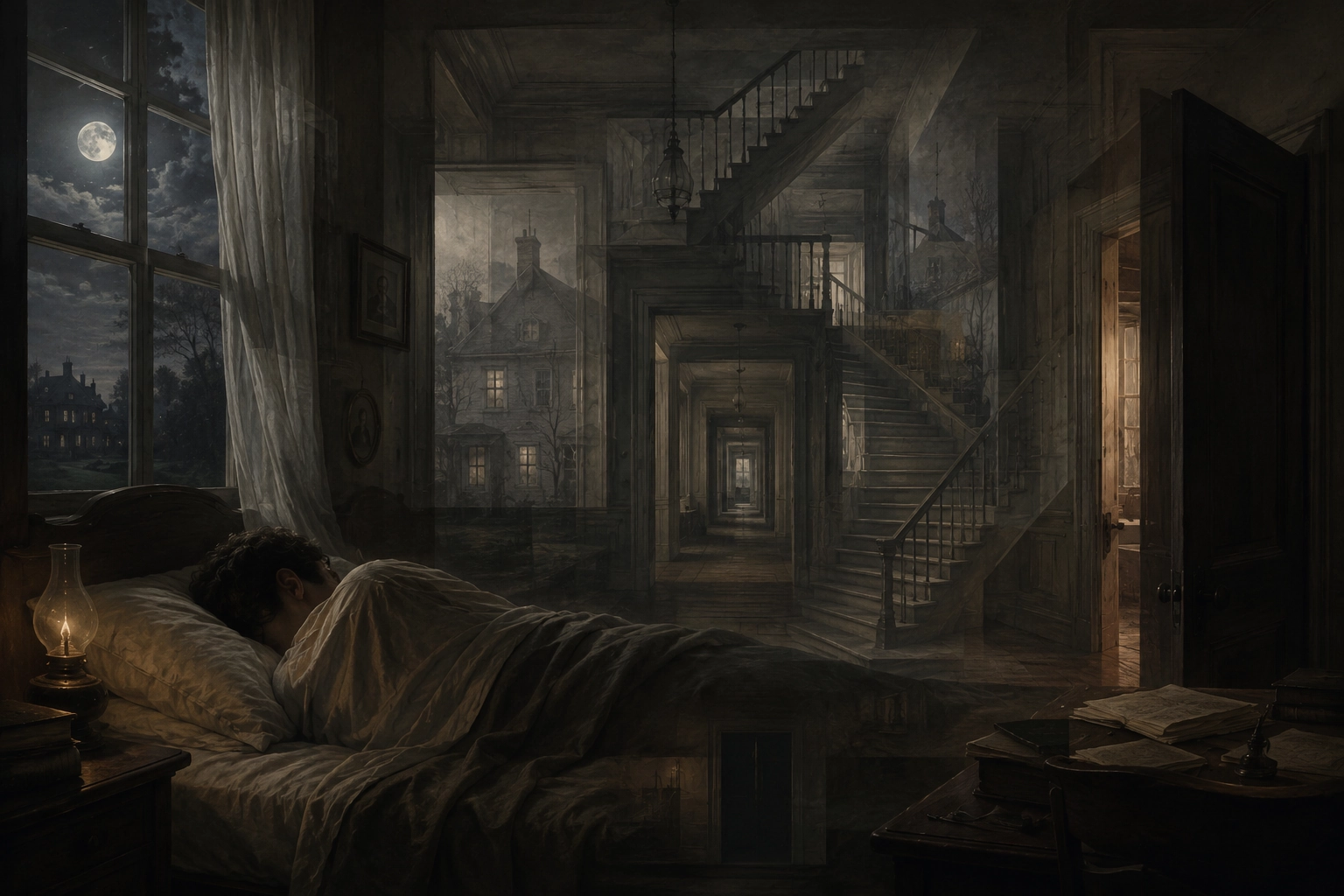
These are recurring dreams. Their persistence can feel uncanny because the dreamer recognizes the pattern before understanding it. The dream seems to remember something that waking life has not finished arranging.
Lucifer Heritage treats recurring dream imagery with caution. A dream that returns is not automatically a prophecy, warning, visitation, or secret message. Research on dreaming suggests continuity between waking concerns and dream content, while studies of recurrent dreams also point toward links with emotional concerns and psychological adjustment. The symbolic reading becomes strongest when it remains beside that evidence rather than replacing it.
A dream that returns for years may be less like a command and more like a question that has learned how to survive sleep.
What Makes a Dream Recurring?
A recurring dream does not have to repeat frame by frame. Some dreams return almost exactly. Others preserve only the structure: the same type of house, the same pursuit, the same sense of being late, the same impossible task, the same person appearing under different circumstances.
What often remains stable is the emotional climate.
The location may change from a school to an airport, yet the feeling of being unprepared survives. The pursuer may have a different face, yet the pressure of escape is unchanged. The childhood home may become larger, darker, or unfamiliar, while the sense of unfinished family history remains recognizable.
This is one reason recurring dreams are more useful to examine as patterns than as literal repetitions. The dream may be changing its scenery while preserving the same emotional problem.
Why Some Dreams Return for Years
Waking life contains themes that do not belong to one age or one situation. Fear of failure can begin at school and later reappear in work, parenthood, relationships, public exposure, or financial risk. Fear of abandonment can move from childhood into adult attachment. The feeling of being trapped may attach itself to a job, a home, a role, a debt, or a version of the self that no longer fits.
Because such concerns can persist or return, recurring dreams may outlive the event that first gave them form.
The exam dream is a good example. An adult who has not sat in a classroom for decades may still dream of discovering that an important test is beginning and nothing has been prepared. The literal setting belongs to the past, but the emotional structure may remain current: evaluation, inadequacy, exposure, or the fear of being found unready.
A repeated dream can therefore be old and current at the same time. It carries imagery learned earlier in life, but the present may reactivate it.
Dreams and the Continuity of Waking Life
Dream research has long examined the continuity between waking experience and dreaming. Michael Schredl’s work on the continuity hypothesis argues that waking activities and concerns can be reflected in dream content, although not all experiences are incorporated equally.
More recent research has also found that emotionally salient waking experiences can enter dreams in altered forms. Dreaming does not simply replay the day. Memory, emotion, and recent experience are recombined.
This helps place recurring dreams in a grounded framework. A repeated dream does not need to be a coded message from outside the self. It may be one way the sleeping mind repeatedly organizes concerns that remain emotionally active.
The wider relationship between dreams, memory, myth, and imagination is explored in Dreams and Imagination: Why the Night Mind Shapes Culture.
Repetition as Emotional Emphasis
Repetition changes the weight of an image.
A staircase in one dream may be incidental. A staircase that returns for ten years becomes part of a personal symbolic language. The dreamer may begin to notice where it appears, whether it rises or descends, whether another person is present, and what emotion occurs before the climb begins.
The repetition itself does not prove that the symbol has one fixed meaning. It shows that the mind has found the image useful enough to reuse.
For recurring dreams, this distinction matters. The repeated image is not necessarily the answer. It may be the container in which the same emotional pressure keeps returning.
Common Images in Recurring Dreams
No responsible dream interpretation should treat symbols as universal dictionary entries. A house does not always represent the self. Water does not always mean emotion. Teeth do not always signify anxiety. The same image can carry different histories for different people.
Still, some forms appear often enough to be useful starting points for observation.
| Recurring Image | Possible Emotional Context | What to Observe |
|---|---|---|
| House with hidden rooms | Memory, identity, family history, unexplored experience | Which rooms are accessible, forbidden, familiar, or changed? |
| Being chased | Fear, pressure, avoidance, threat | Who or what is pursuing you, and what happens if you stop? |
| School or examination | Evaluation, inadequacy, performance pressure | What are you expected to prove? |
| Missing a train or flight | Timing, transition, fear of lost opportunity | Where were you trying to go, and who was leaving? |
| Falling | Instability, bodily alarm, loss of control | What disappears beneath you, and how does the body react? |
| Teeth falling out | Vulnerability, bodily concern, exposure, loss | What emotion accompanies the image? |
| Speaking with the dead | Grief, memory, attachment, unresolved affection | What is said, avoided, or simply experienced? |
| Locked door | Uncertainty, privacy, unreadiness, withheld knowledge | Do you want to enter, fear entering, or know what is behind it? |
The table is not a decoder. Its purpose is to slow interpretation down. In recurring dreams, the most useful question is often not what the object means in general, but what happens around it repeatedly in one person’s dream life.
The House That Keeps Returning
Houses are especially powerful in recurring dream imagery because they can hold many layers of autobiographical experience. A dream house may be a childhood home, a completely invented building, or a mixture of several real places.
Some dreamers discover rooms that do not exist in waking life. Others return to basements, attics, staircases, or corridors that feel familiar only while dreaming.
These spaces can become emotionally dense because houses are tied to safety, family, privacy, inheritance, class, memory, and personal history. Yet none of those meanings should be assumed automatically.
When a house appears in recurring dreams, useful details include what has changed since the previous dream, which areas are avoided, whether the house feels inhabited, and what age the dreamer seems to be inside it.
Corridors, Stations, and Places of Transition
Corridors, railway stations, airports, bridges, elevators, roads, and staircases often carry a different quality. They are places of movement rather than settlement.
A corridor offers passage but not destination. A station is designed around arrival and departure. A bridge exists because two sides must somehow be crossed.
When such places dominate recurring dreams, the dream may be organizing experience around transition, delay, waiting, or the fear that movement will occur without control. The symbolic usefulness of the image comes from its structure, not from a universal rule.
Exam Dreams and the Fear of Being Unprepared
Exam dreams often survive long after formal education ends. The dreamer discovers a forgotten course, cannot find the correct room, arrives late, cannot read the questions, or realizes that an important test is beginning without preparation.
The school setting may be old, but evaluation is not. Adult life continues to create situations in which people feel judged, measured, exposed, or expected to perform.
This is why exam-related recurring dreams can remain relevant for decades. The classroom may be a familiar stage on which the mind rehearses newer forms of pressure.
Recurring Dreams of the Dead
Dreams involving people who have died can be among the most emotionally intense. A parent appears alive. A friend returns for an ordinary conversation. A grandparent sits at a table. The dream may feel peaceful, painful, confusing, or completely natural until waking restores the fact of loss.
Such dreams should be handled carefully. They may reflect grief, attachment, memory, guilt, longing, or the continued importance of the relationship. A symbolic journal should not convert them automatically into proof of visitation.
With recurring dreams of the dead, the emotional tone often matters more than the apparent message. Is the person distant or close? Silent or conversational? Does the dream repeat an unresolved scene, or does the relationship inside the dream gradually change?
Sometimes the dead return in dreams because memory still needs a face.
Stress, Emotion, and the Return of Old Dreams
Many people notice that old dreams return during demanding periods. A pattern that had been absent for years may reappear around grief, relocation, relationship change, illness, work pressure, financial uncertainty, or other transitions.
Research linking waking psychological need frustration with daily and recurrent dream themes supports the broader idea that waking emotional experience can be reflected in dream life. Other studies have also examined the incorporation of emotionally intense recent experiences into dreams.
This does not mean every recurrence has one psychological cause. It does suggest that recurring dreams should be considered beside current waking circumstances rather than interpreted in isolation.
Why the Same Feeling Can Wear Different Images
A recurring dream does not always keep the same setting.
One year, the dreamer is late for a train. Later, they cannot find a gate at an airport. Another time, they are trapped in traffic while everyone else has already arrived. The images differ, but the underlying experience may still involve time pressure, missed transition, or fear of exclusion.
This is why it can be useful to compare emotional structure rather than only visual content. Recurring dreams may repeat at the level of feeling before they repeat at the level of imagery.
When a Recurring Dream Begins to Change
One of the most interesting developments is a change inside a long-standing dream.
The locked room opens. The pursuer is farther away. The train still leaves, but the dreamer no longer panics. The house remains old, yet a window is open. The examination is unfinished, but the dreamer walks out of the room.
Such changes should not be treated as proof that an emotional problem has been solved. Human life is rarely that neat. They may, however, be worth recording because the dreamer’s relationship to the repeated scene has changed.
In recurring dreams, variation can be as informative as repetition.
Falling Dreams and the Body’s Role
Recurring dream imagery is not purely visual. The body can participate intensely through sensations of falling, pressure, immobility, acceleration, suffocation, or sudden bodily alarm.
Falling is a useful example because it can occur in longer dreams and can also be associated with the transition into sleep. The emotional interpretation should therefore remain separate from the physiology when necessary.
Lucifer Heritage explores this in more detail in The Meaning of Falling Dreams and Emotional Instability. The article treats the image symbolically without turning every bodily sensation into a prediction or fixed sign.
Recurring Dreams Are Not Automatically Nightmares
Some repeated dreams are frightening, but recurrence and nightmare are not identical.
A recurring dream may be sad, frustrating, strange, nostalgic, or even comforting. Nightmares are usually discussed in relation to distress and awakening from frightening dream content, while recurrent dreams refer more broadly to dream experiences that return over time.
This distinction matters because the appropriate response depends on the experience. A meaningful repeated house dream does not require the same approach as a severe recurrent nightmare that repeatedly disrupts sleep.
When Recurrent Nightmares Need More Than Interpretation
Symbolic reflection has limits.
If repeated nightmares cause substantial distress, frequent awakenings, fear of sleep, daytime impairment, or are connected with trauma, the priority should not be extracting a hidden symbol. Clinical approaches exist for chronic nightmares. Imagery rehearsal therapy, for example, has been studied as a method in which nightmare imagery is deliberately changed and rehearsed while awake.
This does not make the dream less meaningful. It simply recognizes that sleep and mental health deserve practical care alongside symbolic curiosity.
Lucifer Heritage should never use mystery as a reason to leave suffering untreated.
Myth, Folklore, and the Repetition of Dream Motifs
Dreams have held important places in mythology, religion, folklore, literature, and ritual across many historical settings. Modern readers do not need to accept every traditional interpretation to understand why a repeated dream can feel mythic.
Myth itself often works through return: the road must be crossed, the test repeated, the gate guarded, the forbidden room approached, the dead encountered, the descent survived.
This resemblance does not mean that recurring dreams are personal myths in a strict scholarly sense. It means that both myth and dream can organize difficult questions through repeated images rather than abstract explanations.
Why Universal Dream Dictionaries Fail
Fixed dream dictionaries are attractive because they remove uncertainty. A house is assigned one meaning, water another, death another, and the dream seems solved within minutes.
The problem is context. A dog can symbolize affection to one person and danger to another. A church can evoke faith, childhood, beauty, anger, grief, or architectural fascination. A railway station may be associated with opportunity for one dreamer and bereavement for another.
Recurring dreams make the weakness of universal dictionaries especially clear. The same image can change meaning across a person’s life, and the same emotional theme can move between different images.
A better interpretation begins with the dreamer’s history before reaching for cultural symbolism.
A Quiet Method for Reading Recurring Dreams
The most useful first step is documentation.
Write the dream down soon after waking, before it becomes a better story than the one actually remembered. Record the setting, people, strongest emotion, ending, and any detail that differed from previous versions.
| What to Record | Why It Matters |
|---|---|
| Date | Recurrence may cluster around seasons, anniversaries, or life transitions. |
| Emotional tone | The feeling may remain stable even when the imagery changes. |
| Repeated image | A recurring object or place may become part of a personal symbolic language. |
| Small changes | Variation can reveal a changing relationship to the dream. |
| Waking context | Current stress, grief, decisions, or relationships may be relevant. |
| Ending | The final scene may show where tension remains unresolved. |
After several entries, compare the emotional pattern. The aim is not to force recurring dreams into a theory. It is to see whether the same conditions tend to surround their return.
Questions Worth Asking
- What feeling is strongest every time the dream returns?
- What remains unchanged across different versions?
- What has begun to change?
- What waking situation carries a similar emotional atmosphere?
- Who appears repeatedly, and who is consistently absent?
- What are you trying to reach, avoid, protect, or escape?
- How old do you feel inside the dream?
- Does the dream return during stress, grief, transition, or evaluation?
- What personal associations belong to the central image?
- Would the dream still feel important without a supernatural interpretation?
These questions make recurring dreams easier to approach without pretending that one correct answer must exist.
The Dream Journal as a Private Archive
A dream journal becomes more useful over time because it preserves variation that memory tends to flatten.
After several months, the dreamer may discover that the “same dream” was never exactly the same. A room became lighter. One person disappeared. The route shortened. The ending moved. An object that seemed central turned out to appear only during a particular period of life.
This archive can show how recurring dreams change alongside waking experience.
The journal does not prove causation. It preserves evidence of the dreamer’s own pattern more reliably than retrospective memory alone.
Recurring Dreams and the Larger Dream Archive
Repeating dreams belong to a wider landscape of night imagery. They intersect with memory, imagination, bodily sensation, darkness, silence, and personal symbolism.
The pillar essay Dreams and Imagination: Why the Night Mind Shapes Culture places these experiences within a broader history of dream imagery, creative thought, science, myth, and cultural memory.
Silence can also matter inside repeated dreams. An empty city, a mute relative, or a house in which no expected sound occurs can intensify the emotional atmosphere. The wider role of quiet is explored in Symbolism of Silence: The Hidden Power of Quiet.
When the Dream Stops Returning
Some recurring dreams disappear without a dramatic final version.
The dreamer may notice only months later that the old school, corridor, station, or house has not returned. There is no reliable rule for what such disappearance means. It may coincide with reduced stress, changed circumstances, emotional adaptation, new sleep patterns, or simple variation in dream recall.
It is tempting to treat the ending as proof that an issue has been resolved. Sometimes that interpretation may feel personally appropriate, but it should remain an interpretation rather than a fact.
The disappearance of recurring dreams is worth noticing without turning it into another fixed code.
When the Dream Never Fully Leaves
Some themes remain for much of a person’s life.
This is not necessarily evidence of failure. Belonging, mortality, responsibility, attachment, shame, freedom, grief, identity, and uncertainty are not problems that human beings solve once and permanently leave behind.
A repeated dream may return because the same human question has appeared under new circumstances.
The dreamer changes. The dream changes. Sometimes the old image remains useful enough to accompany both.
Symbolic Observations ✦
- Recurring dreams often repeat an emotional pattern more reliably than an exact plot.
- A dream can survive the situation that first gave its imagery emotional force.
- Waking concerns and emotionally salient experiences can appear in dream content.
- Common recurring images are starting points for observation, not universal meanings.
- Changes inside a long-standing dream may matter as much as the elements that remain stable.
- Recurring dreams and recurrent nightmares overlap, but they are not identical categories.
- Dream journals help preserve small variations that retrospective memory may miss.
- Personal associations should be considered before generic symbolic dictionaries.
- Severe recurrent nightmares deserve practical attention as well as symbolic reflection.
- A dream does not need to predict the future in order to reveal a persistent concern in the present.
The Dream That Remembers Its Way Back
The most striking quality of recurring dreams is their persistence.
Years can pass. Houses change. Relationships begin and end. Work, age, family roles, grief, confidence, and identity all move. Then one night the old corridor returns with almost perfect familiarity.
The dream may not be carrying a secret instruction. It may be doing something quieter: preserving an emotional form that waking life has encountered more than once.
That is why the careful approach is neither blind belief nor automatic dismissal. Record the dream. Notice the feeling. Compare the waking context. Watch for change. Respect what remains uncertain.
The room may open one night. The train may leave without panic. The figure may finally speak, or no longer need to.
Sometimes nothing changes except the dreamer’s way of standing inside the scene.
That can be enough to make an old dream feel new.
Continue Through the Archive
Dreams and Imagination: Why the Night Mind Shapes Culture
A pillar exploration of dream imagery, memory, myth, creativity, science, and the strange worlds the sleeping mind continues to build.
The Meaning of Falling Dreams and Emotional Instability
A study of falling dreams, bodily sensation, unstable ground, stress, and the emotional meanings associated with descent.
Symbolism of Silence: The Hidden Power of Quiet
A reflection on silence, memory, fear, withheld meaning, and the ways quiet changes attention.
The Mystery of Symbolic Marginal Notes in Old Books
An archive essay on memory, private marks, incomplete explanations, and the traces people leave behind.
Further Reading & Sources
- Michael Schredl: Continuity Between Waking Activities and Dream Activities
A study of the continuity hypothesis and the ways waking activities can be reflected in dream content. - Weinstein, Campbell, and Vansteenkiste: Linking Psychological Need Experiences to Daily and Recurring Dreams
Research examining relationships between waking psychological need experiences, dream emotions, and recurrent dream themes. - Eichenlaub and colleagues: Incorporation of Recent Waking-Life Experiences in Dreams
Research on the incorporation of recent and emotionally intense waking experiences into dream reports. - Scarpelli and colleagues: The Functional Role of Dreaming in Emotional Processes
A review discussing dreaming, memory, emotional processing, and neurophysiological findings. - Gauchat and colleagues: The Content of Recurrent Dreams in Young Adolescents
An empirical study of recurrent dream themes and emotional content. - Gauchat and colleagues: Recurrent Dreams and Psychosocial Adjustment
Research examining associations between recurrent dreams and psychosocial adjustment. - Krakow and colleagues: Imagery Rehearsal for Chronic Nightmares
A controlled study of imagery rehearsal therapy for chronic nightmares in trauma-exposed participants.