May 27, 2026
The Meaning of Falling Dreams and Emotional Instability
Falling dreams reveal how emotional instability, stress, and loss of control can become night images of descent, shock, and inner groundlessness within.
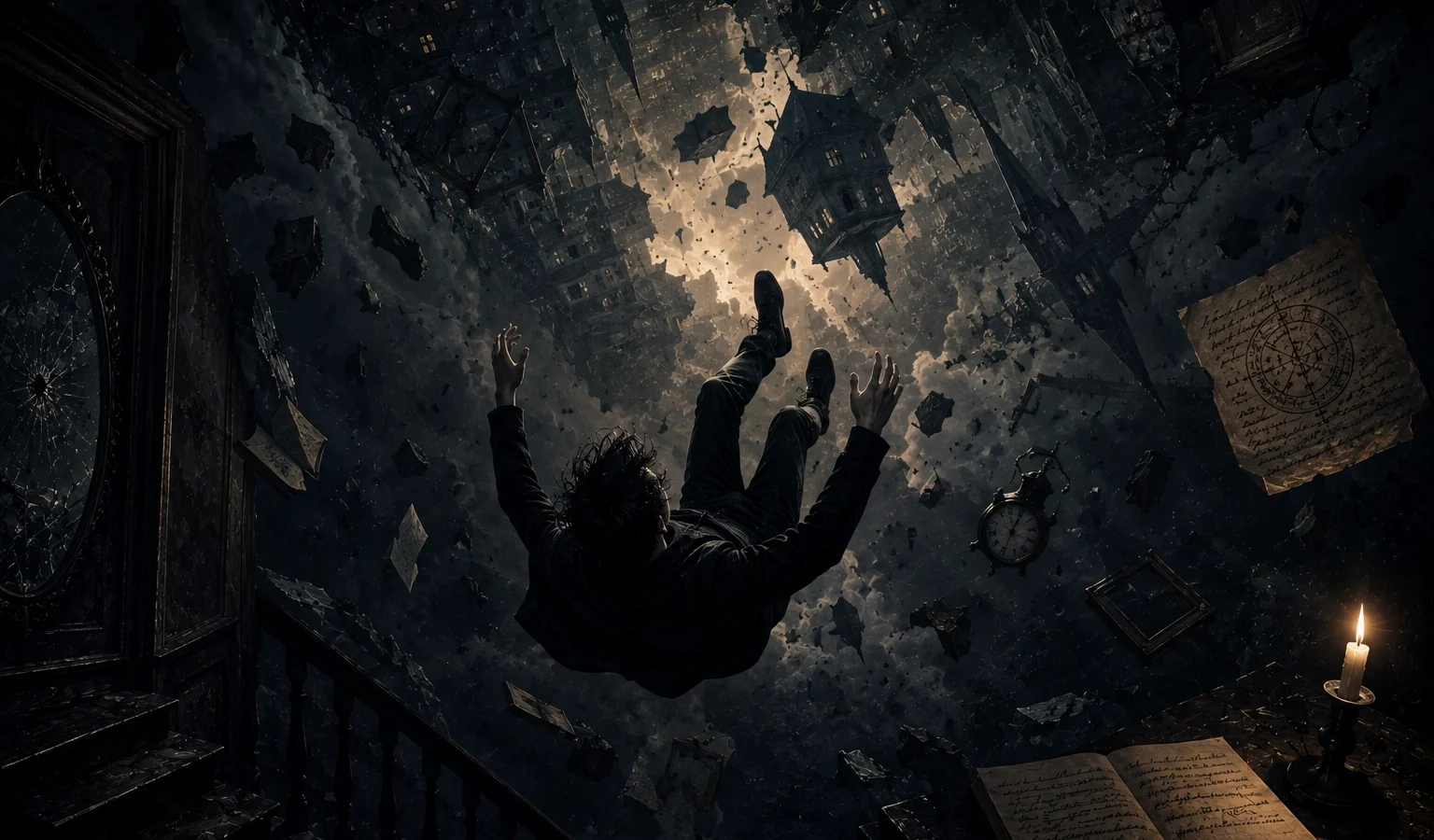
Some dreams do not begin with a story.
They begin with a drop.
The ground vanishes. The body loses its agreement with gravity. A staircase disappears beneath the feet. A cliff gives way. A building opens into air. A familiar floor becomes a depth. There may be no monster, no voice, no visible danger. Only the sudden knowledge that there is nothing solid beneath you.
Then the body jolts.
Sometimes the dream ends before impact. Sometimes the dreamer wakes with the heart racing, muscles tense, and the bed suddenly feeling too real. The fall may last only a second, yet it can leave behind a longer unease, as though the dream had not shown an event but exposed a condition.
This is why falling dreams feel so charged. They are among the most direct dream images of instability. They do not require complicated symbolism. The body already understands the meaning of losing ground. Long before the mind begins to interpret, the nervous system knows what it means to fall.
And yet these dreams are not always about physical danger.
They often appear when life feels emotionally unstable: during uncertainty, pressure, failure, grief, transition, exhaustion, loss of control, or the strange inner period when an old structure has collapsed but a new one has not yet appeared. The dream may not explain the feeling. It gives the feeling a body.
A dream of falling is not a prophecy. It is not a mystical warning that something terrible must happen. More often, it is the night mind giving form to a waking sensation: the sense that one’s footing has become unreliable.
A falling dream begins where the inner life can no longer pretend the ground is steady.
Why Falling Dreams Feel So Physical
Many dreams are visual before they are bodily.
A house appears. A person speaks. A road stretches ahead. A room opens. The dreamer sees first, then feels. Falling is different. It is often bodily before it is visual. The stomach tightens. The muscles react. The breath changes. The body seems to participate in the image as though the dream were not only being watched, but suffered.
This gives falling dreams their unusual force.
They are not subtle in the way a locked room or distant figure may be subtle. They speak in sensation. The body experiences loss of control directly, without waiting for a symbolic dictionary. One does not need to be told that falling means instability. The body already knows.
This may be one reason such dreams are so memorable. A sudden descent can cross the boundary between image and reflex. It may be connected to the transition into sleep, especially when the body produces a sudden twitch or jolt as one is falling asleep. Sleep Foundation describes hypnic jerks as involuntary muscle contractions that can happen during the transition into sleep and may be accompanied by a sensation of falling.
Still, not every falling image should be reduced to a sleep-start reflex. Some occur within longer dream narratives. Some repeat during emotionally difficult seasons. Some are attached to specific settings: stairs, windows, bridges, roofs, elevators, cliffs, holes, collapsing floors, or endless darkness beneath the feet.
The body may provide the sensation.
The psyche gives it a world.
The Symbolic Ground Beneath the Dream
Ground is one of the most basic symbolic realities.
To have ground beneath the feet is to have orientation. It means there is somewhere to stand, something to trust, some surface that answers the weight of the body. Ground may represent stability, belonging, identity, routine, family, money, faith, work, home, health, relationship, or the simple confidence that tomorrow will resemble today enough to be livable.
When the ground disappears in a dream, the image is rarely neutral.
It suggests that some foundation has become uncertain. The dreamer may still function by day, but something beneath the visible life may feel unreliable. A job may continue while trust in the future collapses. A relationship may remain outwardly intact while emotional footing is gone. A person may smile, answer messages, pay bills, and make plans while inwardly feeling as though the floor has thinned.
This is why falling dreams often belong to emotional instability.
They dramatize the failure of support.
The dream does not always say what has failed. It shows the sensation of failure itself: the sudden absence of holding.
Falling and the Loss of Control
Control is one of the great illusions of waking life.
People plan, schedule, insure, prepare, calculate, rehearse, organize, and build. These things matter. They are not foolish. But beneath them remains the truth that life can still move faster than intention. A body can become ill. A relationship can change. Work can disappear. A country can become unstable. A sentence can be spoken that cannot be unsaid. A decision can open a descent no one meant to begin.
Dreams of falling often appear when the illusion of control has been damaged.
The dreamer is not walking down a staircase by choice. They are falling. They are not descending with ritual dignity. They are losing command over direction, speed, and outcome. This is what makes the dream emotionally precise. It is not only about fear. It is about involuntary movement.
To fall is to be carried by consequence.
In waking life, emotional instability often has this same quality. A person may feel that events are pulling them downward faster than they can think. The mind wants to pause, but the situation continues. The body wants ground, but the future remains open. The dream becomes the image of this helpless acceleration.
The terror of falling is not only the fear of impact.
It is the fear of having no authority over the descent.
Common Forms of Falling Dreams
Not all falling dreams are the same.
Some are sudden and abstract: the dreamer falls through empty space and wakes before any setting becomes clear. Others are architectural: stairs collapse, elevators drop, balconies break, floors open. Some are natural: cliffs, mountains, ravines, ice, water, or dark forest ground giving way. Some involve public exposure: falling in front of others, losing composure, failing to appear controlled.
The form matters because it often reveals the emotional texture of the dream.
| Dream Image | Possible Emotional Core | Symbolic Texture |
|---|---|---|
| Falling from a cliff | Sudden exposure, risk, irreversible decision | The edge crossed before readiness |
| Falling through a floor | Broken trust, hidden instability, unsafe foundation | The familiar world becoming unreliable |
| Elevator dropping | Loss of control inside a system | Modern structure failing from within |
| Stairs collapsing | Failed progress, interrupted ascent or descent | The path of transition breaking |
| Falling into darkness | Unknown outcome, anxiety, emotional overwhelm | Descent without visible landing |
| Falling in public | Shame, exposure, loss of composure | The private collapse becoming visible |
| Falling into water | Emotional immersion, grief, surrender | Loss of ground into feeling |
This table is not a fixed interpretation system. A dream image lives differently in each person. Falling into water may feel terrifying to one dreamer and strangely peaceful to another. An elevator may represent a workplace, a social system, a body, or the modern fear of being carried by mechanisms one cannot control.
The symbolic method begins not with definition, but with atmosphere.
What kind of fall was it?
And what in waking life feels like that?
Emotional Instability and the Body’s Night Language
Emotional instability is not always visible from outside.
A person may continue to speak normally, work normally, care for others, maintain a household, answer obligations, and appear competent. But internally, the sense of ground may be shifting. The smallest event may feel larger than it should. Decisions may feel dangerous. Rest may feel impossible. The future may feel too open, too fragile, too full of possible collapse.
The night mind often translates this into bodily imagery.
A dream of descent can become the body’s way of saying what the day has not allowed. It may appear when the dreamer is under stress, emotionally exhausted, caught between decisions, or living through change that has not yet found language.
Dream research does not offer one final explanation for why dreams exist. But several scientific discussions have connected dreaming with emotion, memory, and the processing of affective experience. Research available through PMC has explored the possible role of dreaming in emotional processes, including how sleep and dream activity may relate to emotional regulation.
Symbolically, this matters because the falling image can be understood as both psychological and poetic.
The brain may be processing emotion.
The psyche may be staging descent.
The body may be warning of exhaustion.
The image may be doing all three.
Falling Dreams During Times of Transition
Transitions often produce falling imagery because transition interrupts ground.
Leaving a job, ending a relationship, moving to another country, becoming a parent, losing a familiar role, beginning public work, aging, grieving, recovering, or changing one’s identity can all create an interval in which the old life is gone but the new one has not yet become stable.
During such periods, falling dreams may become more frequent or more vivid.
This does not mean the transition is wrong. It means the psyche is experiencing the loss of former supports. Even a desired change can feel like falling at first. Freedom can feel like falling if the old cage was also the old floor.
This is an important distinction.
Not every falling dream means failure. Sometimes it marks the frightening beginning of movement. A person who has left an unhealthy life may dream of falling because the familiar structures are gone. A person beginning a creative path may dream of cliffs because visibility and risk have increased. A person approaching emotional truth may dream of collapsing floors because denial once served as architecture.
The dream may be frightening because change is real.
Not because change is wrong.
Sometimes the fall begins where the old structure finally stops pretending to be a home.
The Elevator, the Staircase, and the Modern Descent
Some falling dreams occur in natural landscapes, but many modern versions occur inside architecture.
Elevators drop. Staircases collapse. Balconies break. Floors open. Buildings tilt. Glass walkways crack. These are not ancient cliffs. They are modern structures of movement, progress, height, and control.
An elevator is especially powerful because it is a machine of trust. The person inside does not climb. They enter, press a button, and surrender movement to a system. When that system fails in a dream, the emotional meaning can be sharp.
It may suggest dependence on structures one cannot control: workplace systems, financial mechanisms, institutions, social roles, family expectations, medical processes, technology, or the machinery of daily life.
The staircase is different.
Stairs imply effort, progress, ascent, descent, transition. If they collapse, the dream may suggest that the path itself has become unstable. The dreamer may be trying to move between levels of life, but the structure that should make movement possible is breaking.
In this way, falling imagery reveals not only fear of descent, but fear that the systems meant to carry us are no longer trustworthy.
Falling Without Landing
Many falling dreams end before impact.
This detail matters.
The dreamer wakes during the descent, suspended between danger and conclusion. The fall has begun, but its consequence is unknown. The impact never arrives. The body returns to the bed before the dream resolves.
Symbolically, this may reflect emotional situations where outcome remains uncertain. The person is not yet at the end of the crisis. They are still falling through possibility. The mind cannot stage resolution because waking life has not provided one.
This is why such dreams can leave a lingering mood. The dream does not frighten only because something bad happened. It frightens because nothing finished.
The unfinished fall resembles anxiety itself.
Anxiety often lives in suspended consequence. Something may happen. Something may fail. Someone may leave. The decision may be wrong. The body may not be safe. The future may not hold. The mind falls through imagined outcomes without landing in fact.
The dream gives that suspension a single image.
When Falling Feels Like Surrender
Not every dream of falling is terror.
Some carry a strange release. The body drops, but the fear softens. The dreamer may fall into water, darkness, air, or light without panic. They may wake not terrified, but emptied, altered, or calm.
This form of descent suggests another layer of meaning: surrender.
There are moments when holding control becomes more painful than losing it. A person may fight too long to preserve an identity, argument, relationship, belief, role, or version of the future that has already become unsustainable. The dream of falling may then carry the frightening relief of no longer gripping the edge.
This does not mean surrender is always wise. It does not mean passivity is always healing. But symbolically, some falling dreams may indicate that the psyche is experimenting with release.
The fall becomes a descent from tension.
A refusal to keep standing on a surface that has already broken.
Sometimes falling is not the collapse of the self.
Sometimes it is the end of pretending one was still standing.
The Mythological Descent
Falling is not only a psychological image.
It belongs to mythology.
Many traditions contain descents: into the underworld, the cave, the sea, the night, the grave, the hidden chamber, the belly of a beast, the lower world, the kingdom of the dead. The descent is often frightening because it moves the hero or seeker away from ordinary light and into a realm where familiar identity no longer rules.
A falling dream may carry a private version of this mythological pattern.
The dreamer descends not by choice, but by rupture. The surface breaks. The self is taken downward. The ordinary world no longer holds. What begins as panic may become initiation if the dreamer learns what the descent reveals.
This does not mean every such dream is sacred or profound. Some are brief bodily shocks. Some are stress dreams. Some are sleep-transition phenomena. But when the image repeats during important life changes, the mythic pattern may be worth noticing.
Descent often appears before transformation.
Not because suffering is noble in itself, but because some forms of knowledge can only be reached after the old surface gives way.
Falling Dreams and Shame
There is a particular kind of falling that belongs to shame.
It is not only the fear of physical descent, but the fear of being seen losing composure. Falling in public, stumbling on a stage, slipping before an audience, dropping from a high place while others watch — these dreams may carry the emotional texture of exposure.
Shame is a vertical emotion. It lowers the body. It makes the face burn. It makes the person want to disappear downward, beneath the gaze of others.
In this sense, some falling dreams are not about danger but humiliation. The fall becomes the image of losing status, dignity, control, or the carefully maintained public self.
This is especially common when a person is under evaluation: work pressure, social judgment, creative exposure, public responsibility, family expectation, or fear of failing a role others believe they can handle.
The dream may ask quietly:
Where do you feel that one visible mistake would make you less worthy of standing?
The Difference Between Falling and Flying
Falling and flying are close images.
Both involve leaving the ground. Both disturb ordinary human movement. Both can begin with height, air, and loss of familiar support. Yet emotionally they are almost opposites.
Flying usually implies agency, freedom, expansion, control, or release. Falling implies helplessness, descent, exposure, instability, or surrender. The difference is not the air. The difference is relationship to movement.
This distinction helps clarify falling dreams.
If the dreamer moves through air by choice, the image may lean toward freedom. If the dreamer is carried downward against their will, the image leans toward instability. If the dream shifts from falling into flying, that shift may be important. It may suggest that the psyche is transforming fear into agency.
Likewise, if flying turns into falling, the dream may reveal fear hidden beneath apparent freedom.
The question is not simply: am I in the air?
The question is: do I have any relation to where I am going?
| Dream Movement | Emotional Quality | Symbolic Meaning |
|---|---|---|
| Falling | Fear, helplessness, instability | Loss of ground or control |
| Flying | Freedom, expansion, agency | Movement beyond ordinary limits |
| Floating | Suspension, detachment, uncertainty | Between control and surrender |
| Falling then flying | Recovery, adaptation, transformation | Fear becoming movement |
| Flying then falling | Loss of confidence, exposure, collapse | Freedom interrupted by instability |
A Quiet Method for Reading Falling Dreams
A falling dream should not be interpreted too quickly.
It may be a brief bodily event. It may be related to stress. It may be a symbolic image of emotional instability. It may be all of these at once. The best approach is not certainty, but careful attention.
After a falling dream, write down what can be remembered before the day repairs the mind’s surface.
- Where did the fall begin?
- Was there a visible edge, floor, staircase, elevator, cliff, or unknown space?
- Did the dreamer fall alone or in front of others?
- Was the fall sudden, slow, endless, violent, or strangely calm?
- Did the dream end before impact?
- What emotion remained after waking: fear, shame, relief, confusion, sadness, release?
- What in waking life currently feels unstable, unsupported, or beyond control?
This method keeps the dream grounded. It does not turn the fall into prophecy. It treats the dream as an image carrying emotional information.
The aim is not to stop every falling dream immediately.
The aim is to understand what kind of ground the inner life is missing.
When Falling Dreams Become Distressing
Most falling dreams are not dangerous.
They may be startling, unpleasant, or memorable, but they often pass without lasting harm. However, repeated disturbing dreams, frequent nightmares, severe sleep disruption, panic around sleep, or dreams connected to trauma should be taken seriously.
There is no need to romanticize distress.
If falling dreams become frequent, terrifying, or interfere with rest, practical care matters. Sleep habits, stress levels, caffeine, late-night stimulation, emotional overwhelm, anxiety, trauma, and medical issues may all be worth considering. The American Psychological Association has discussed how nightmares can interfere with healthy sleep and relate to emotional and mental health concerns.
Symbolic reflection can be valuable, but it should not replace care. A dream can be meaningful and still require support. A nightmare can be symbolically rich and still be harmful to sleep.
Lucifer Heritage explores night images.
It does not ask anyone to suffer for atmosphere.
Symbolic Observations ✦
- Falling dreams often carry the feeling of losing ground, support, or control.
- The body may understand the dream before the mind interprets it.
- A falling dream can be connected to emotional instability, stress, transition, or exhaustion.
- Falling through a floor may suggest hidden instability in a familiar structure.
- An elevator dropping may symbolize dependence on systems that no longer feel trustworthy.
- Falling in public may carry shame, exposure, or fear of visible failure.
- Falling without landing often resembles anxiety: consequence suspended but not resolved.
- Some falling dreams may carry surrender rather than terror.
- A shift from falling to flying may suggest fear becoming agency.
- The dream should be read through atmosphere, context, and waking emotional ground.
The Dream as a Loss of Inner Architecture
A falling dream is often an architectural dream, even when no building appears.
It asks what structure has failed.
Sometimes the failed structure is practical: work, money, health, home, relationship, routine. Sometimes it is psychological: confidence, identity, belief, trust, emotional regulation. Sometimes it is moral or spiritual: the sense that one knows what kind of life one is standing inside.
When these structures weaken, the inner world may not say, “I feel emotionally unstable.”
It may say: the floor opened.
This is why falling dreams belong so naturally to the symbolic language of night visions. They do not explain instability. They stage it. They turn a state of mind into a physical law. They show the dreamer that the self is not floating in abstraction; it lives in rooms, on thresholds, beside stairs, above depths, under roofs that may or may not hold.
The dream becomes an image of inner architecture losing its agreement with the body.
The Ground That Must Be Found Again
The opposite of a falling dream is not always flying.
Sometimes it is standing.
Not triumphantly. Not dramatically. Simply standing again. Feeling the floor. Knowing where the body is. Letting the room return. Letting morning, water, breath, and ordinary light remind the dreamer that the bed did hold, the walls did remain, the body did wake.
This small return matters.
After emotional instability, the first task is often not to solve the whole life. It is to recover one piece of ground. One honest conversation. One clear task. One boundary. One night of better sleep. One meal. One page. One small act that proves the self has not disappeared into the descent.
Falling dreams may reveal where ground has been lost, but they may also invite the dreamer to ask where ground can be rebuilt.
Not all at once.
Not through denial.
Not by pretending the fall did not happen.
But by noticing what still holds.
The Descent That Becomes Meaning
Falling dreams endure because they express one of the oldest human fears: that the world beneath us may fail.
They also express one of the oldest human truths: that stability is not permanent. The ground changes. Identities change. Relationships change. Bodies change. Homes change. The future changes its shape before the mind is ready.
To dream of falling is to meet this truth without decoration.
The dream removes the polite language of transition and gives the body the raw image: descent, shock, air, loss of control, the unknown below.
But the meaning is not only fear.
Sometimes falling reveals where waking life has become too unstable to ignore. Sometimes it reveals where control has become impossible. Sometimes it shows the collapse of a false structure. Sometimes it marks the frightening interval before a new ground can be found.
A falling dream is not a sentence passed over the dreamer.
It is an image asking to be held carefully.
The floor gives way.
The body drops.
The heart wakes first.
And in the silence after waking, the question remains:
what, in this life, no longer feels able to hold you?
Related Symbolic Essays
Why Do Certain Dreams Repeat for Years?
A reflective exploration of recurring dreams, emotional patterns, memory, and the images that return when waking life has not finished speaking.
The Symbolism of Houses in Dreams
A quiet study of hidden rooms, old corridors, family memory, and the strange architecture of the dreaming self.
The Meaning of Water in Dreams
A symbolic essay on emotion, depth, drowning, cleansing, reflection, and the many ways water appears in night visions.
Why Silence Feels Uncomfortable to Modern People
A psychological and symbolic reflection on quiet, restlessness, attention, and the modern fear of being alone with thought.
The Door, the Gate, and the Threshold
A study of passages, hesitation, forbidden rooms, and the symbolic moment before crossing into another state of life.
Further Reading & Sources
- Sleep Foundation — Hypnic Jerk: Why You Twitch When You Sleep
A sleep-health explanation of hypnic jerks, the falling sensation during sleep onset, and possible links with stress, caffeine, and fatigue. - Encyclopaedia Britannica — REM Sleep
A reference overview of REM sleep, dreaming, atonia, sleep cycles, and brain activity during sleep. - Scarpelli et al. — The Functional Role of Dreaming in Emotional Processes
Academic research discussing dreaming, REM sleep, emotional memory, and possible emotion-regulation functions. - Conte et al. — The Effects of Sleep Quality on Dream and Waking Emotions
Research review connecting sleep quality, dream emotions, and waking emotional regulation. - American Psychological Association — Nightmares in Adults
A psychological overview of disturbing dreams, nightmares, sleep disruption, and emotional health. - American Psychological Association — Dreams, Nightmares, and Sleepwalking
A discussion with dream researcher Antonio Zadra on vivid dreams, dream recall, nightmares, and sleep phenomena. - Sleep Foundation — Recurring Dreams
Accessible information on repeated dream patterns, emotional themes, and when dreams may relate to stress or distress. - Sleep Foundation — Nightmares
A practical overview of nightmares, distressing dreams, sleep disruption, and when recurring disturbing dreams may need support. - Library of Congress — American Folklife Center Collections
Folklore and cultural memory collections useful for studying dream imagery, symbolic descent, thresholds, and traditional meanings.