August 26, 2026
Psychology of Archives and Memory: Why Records Feel Alive
An archive is supposed to store the past, but people rarely enter one for the sake of the past alone. They arrive with questions that belong to the present. Who were we? What happened here? Why did this family leave? Which version of the story can the evidence support? What did an institution know, record, hide, misunderstand, or forget?
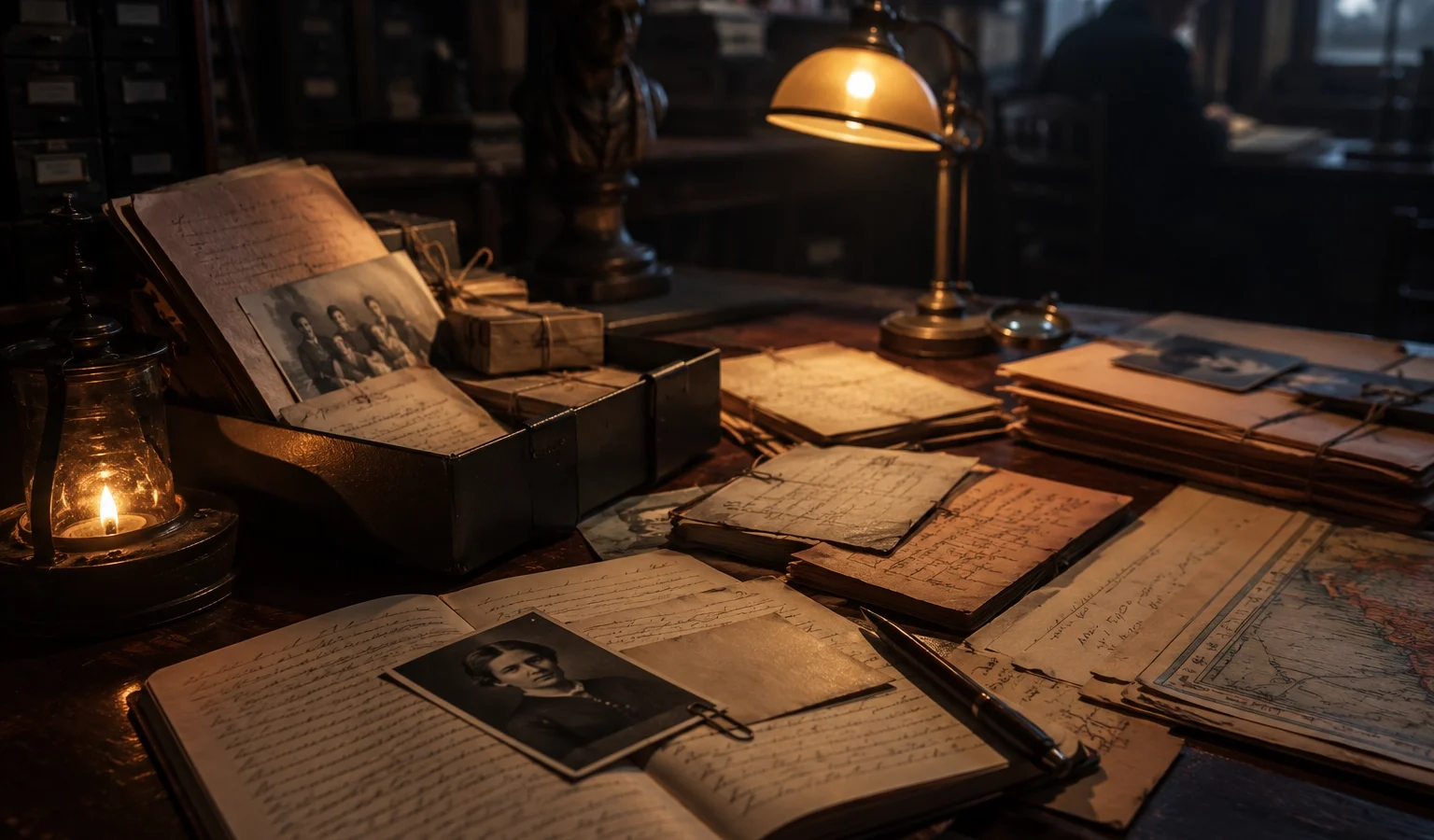
This is the psychology of archives and memory: records remain materially still while their meanings change according to who returns to them, what they are looking for, and what they already believe they might find.
An old file does not remember anything by itself. A photograph does not grieve. A handwritten note does not know that the person reading it is a descendant. The emotional force comes from contact between surviving evidence and a living observer.
Lucifer Heritage approaches archives through that contact. The archive is neither a perfect memory machine nor a neutral vault of truth. It is a system of preservation, selection, classification, access, omission, interpretation, and return.
An archive becomes psychologically alive when a surviving record meets a question that still matters.
Archives Are Not Memory Itself
Memory belongs to minds, communities, practices, institutions, and cultures. Archives preserve records that memory can use.
The distinction matters because the two can support one another without becoming identical.
A document can survive after everyone forgets why it was created. A community can remember an event even when documents are missing. Personal memory can contradict official records. A government file can preserve what an institution claimed while failing to preserve what actually happened outside the office that created it.
The archive preserves evidence. Memory organizes significance.
Within the psychology of archives and memory, tension between those two functions is one of the most important sources of meaning.
Archives and Memory: Different Systems of Remembering
| System | What It Preserves | How It Changes | Main Risk |
|---|---|---|---|
| Personal memory | Experienced and autobiographical material | Reconstruction, retelling, emotion, later knowledge | Distortion, omission, overconfidence |
| Family memory | Stories, names, photographs, objects, repeated narratives | Inheritance, silence, conflict, reinterpretation | Myth replacing evidence |
| Institutional archive | Records created or preserved through organizational activity | Appraisal, description, access rules, preservation | Bias in what was created or kept |
| Public or collective memory | Selected events, symbols, anniversaries, monuments, narratives | Politics, education, commemoration, cultural change | Exclusion of inconvenient evidence |
| Digital archive | Files, images, messages, databases, scans, metadata | Migration, indexing, deletion, software change | Invisible loss through obsolete systems or poor description |
The table shows why the psychology of archives and memory cannot be reduced to a simple conflict between fact and feeling. Each system preserves differently, forgets differently, and creates different forms of authority.
Memory Is Reconstructive
Human memory is not a recording played back unchanged.
Autobiographical memory research treats remembering as reconstructive. Retrieval depends on cues, present context, later knowledge, emotion, identity, and the purpose of remembering. A person can sincerely remember an event differently years later without consciously inventing the difference.
This does not make memory useless. It makes memory dynamic.
Archives become valuable because external records can provide traces against which remembered experience can be compared. This is where archives and memory become useful to one another without becoming the same system. The record may confirm, complicate, narrow, or contradict the story that survived in the mind.
Yet documents also require interpretation. Neither memory nor record explains itself automatically.
Objects Trigger Memory Differently From Facts
A date on a certificate informs. A handwritten note may suddenly restore a voice.
A photograph can bring back the arrangement of a room more powerfully than a paragraph describing it. A familiar signature can produce recognition before the reader has consciously processed the words.
Memory research shows that retrieval is strongly influenced by cues. Different cues can bring different parts of autobiographical memory into reach.
This is one reason archives and memory can feel so closely connected despite the archive itself containing inert material.
The object activates a network of meaning in the observer.
Original Documents Create Material Continuity
A scan can communicate text perfectly and still feel different from the original document.
The original has scale, texture, damage, fold lines, ink variation, pressure marks, repaired edges, paper weight, and other traces that a digital image may flatten.
Most importantly, the original carries provenance. This specific object passed through the historical moment being studied.
That continuity can create a strong sense of contact across time.
The effect does not make the object magical. Its force comes from material history.
Why Handwriting Feels So Personal
Handwriting records language and movement at once.
A typed sentence preserves words. A handwritten sentence also preserves pressure, speed, correction, hesitation, spacing, and the habits of one hand.
When a reader recognizes a parent’s handwriting or sees a dead relative’s signature for the first time, the emotional reaction may be far stronger than the informational content alone would predict.
This is one reason the archival pages explored in Forgotten Manuscripts: Why Lost Texts Fascinate Us feel more intimate than an abstract summary of the same information.
The page contains evidence that a body once moved across it.
Family Archives Organize Identity
People often turn to records when identity becomes uncertain.
Migration, inheritance, bereavement, adoption, name changes, family conflict, citizenship questions, and curiosity about ancestry can all transform ordinary documents into emotionally important evidence.
Names, addresses, photographs, marriage records, school documents, letters, passports, and maps can place one person inside a sequence longer than one lifetime.
In this sense, archives and memory give identity an external structure that can be reassuring.
It can also be destabilizing when the archive contradicts the story the family preferred to tell.
The Archive Does Not Always Return the Ancestor We Wanted
Family research is often approached with hope.
A descendant may expect courage, persecution, migration, military service, religious devotion, artistic talent, or a dramatic family secret.
The archive may return something more complicated.
A person remembered as a victim may also have harmed others. A heroic story may turn out to be partly invented. A family name may have changed for ordinary administrative reasons rather than hidden political ones.
The psychology of archives and memory becomes most difficult when identity depends on a story that evidence no longer fully supports.
Forgetting Is Not Always Failure
Memory culture often treats forgetting as an enemy.
Human beings need to forget enormous amounts of ordinary information in order to function. Institutions also cannot preserve every record indefinitely.
The more difficult question is what gets forgotten, who decides, and what the consequences will be.
Archives are systems for making forgetting more selective, which is why archives and memory are always connected with decisions about loss as well as preservation.
That selection can be careful, legal, professional, political, accidental, or unjust.
Archives Preserve Selectively
No archive contains everything.
Records are shaped before archivists ever see them. Institutions create documents according to their own functions. Families keep some photographs and discard others. Governments establish retention schedules. Digital users save thousands of images but name almost none.
Professional archives add another layer through appraisal, transfer, description, conservation, and access decisions.
The US National Archives defines appraisal as the process of determining whether records should be temporary or permanently preserved. That means preservation itself includes structured decisions about future memory.
Absence is part of every archive even when no empty folder marks it. Any serious study of archives and memory has to examine what disappeared as carefully as what survived.
Provenance Protects Context
Archival practice has long emphasized provenance because individual records can lose meaning when separated from the process that created them.
A letter in isolation may appear straightforward. Its meaning can change when placed beside earlier drafts, replies, related files, or the office procedure that produced it.
The National Archives describes provenance as a way of protecting the integrity and significance of records by preserving their relationship to the creator and original context.
This principle matters psychologically too because archives and memory both depend on context if isolated fragments are not to be mistaken for complete stories.
People often want one document to answer a complete question. Archives repeatedly remind us that evidence usually belongs to systems rather than isolated fragments.
Catalogues Shape What We Discover
Archives are not experienced directly as endless rooms of material.
Researchers usually encounter a catalogue first.
Search terms, titles, descriptions, dates, names, record groups, subject headings, and metadata determine what becomes visible.
A record that exists but cannot be located is preserved materially and absent practically.
This is why catalogues participate in the psychology of archives and memory. Classification influences discovery, and discovery influences which versions of the past receive attention. In digital and physical systems alike, archives and memory are shaped by what can actually be found.
Old Descriptions Can Carry Old Prejudices
Archival description is historical too.
Older catalogues may use obsolete, offensive, colonial, medical, racial, political, or administrative terminology. Those terms can be important evidence of how institutions once classified people while also creating harm or confusion for modern users.
Archives therefore face a difficult task.
They must preserve historical context while improving access and description for present researchers.
Changing a catalogue entry can increase visibility. Preserving the earlier language can preserve evidence. Good archival work may need to do both.
The Archive Creates Authority
A document inside an archive acquires institutional context.
Reference numbers, controlled storage, cataloguing, conservation, and formal access procedures can make a record feel authoritative.
Yet archival status does not guarantee truth.
Officials can lie. Witnesses can misunderstand. Clerks can make errors. Governments can produce propaganda. Records can reflect institutional bias or incomplete knowledge.
The archive preserves evidence of what was recorded.
Critical reading is still required. The authority of archives and memory depends on distinguishing preserved evidence from automatic certainty.
Official Records and Private Memory Can Conflict
A family may insist that an event happened one way while an official record describes another version.
Neither source should be accepted automatically.
An official document may have been written by someone with limited knowledge. Family memory may have changed through retelling. The contradiction may reveal different perspectives rather than one simple lie.
The strongest research question is often not “Which source is true?” but “What exactly can each source establish?”
This is one of the most useful disciplines inside the psychology of archives and memory.
Collective Memory Uses Archives Selectively
Nations, institutions, religious communities, political movements, and families all select material through which they remember themselves publicly.
Anniversaries, photographs, quotations, monuments, school narratives, ceremonial documents, and famous names become repeated points of reference.
Research on collective memory shows that public remembering is not simply the sum of individual memories. It is shaped through social systems, narratives, institutions, and repeated acts of retrieval.
The archive may contain far more contradiction than the public story uses. This gap between archives and memory becomes especially visible when public narratives select only a narrow part of the surviving record.
What a society remembers depends partly on what it repeatedly returns to.
Political Conflict Often Begins With Retrieval
An excluded document can change a public argument simply by returning to attention.
A forgotten report is digitized. A suppressed photograph becomes accessible. A court record contradicts a commemorative narrative. A private letter changes the interpretation of a public figure.
The record may have existed for decades.
What changes is retrieval.
This is why archives can become politically sensitive without producing any new evidence. Old evidence can become newly active.
Silence in the Archive Is Not Empty
Missing records do not all mean the same thing.
A file may never have been created. It may have been destroyed legally. It may have been lost accidentally. A community may have relied on oral transmission rather than written documentation. Authorities may have deliberately excluded certain people from record-making systems.
Silence therefore requires context.
The article Symbolism of Silence: The Hidden Power of Quiet explores silence as a symbolic condition. Archives add another layer: silence can be produced institutionally.
Digitization Changes Remembering
Digitization makes archives available across distance and time.
A family researcher can access records from another country at night. A rare manuscript can be examined without physical handling. Search can move across thousands of descriptions in seconds.
This is an enormous expansion of access.
It also changes the experience of context.
A scan may appear alone on a screen without the box, neighboring documents, physical sequence, reverse side, original scale, or filing structure that surrounded it.
Access improves while another kind of context can weaken. Digitization therefore changes the relationship between archives and memory rather than simply making the old relationship faster.
Digital Abundance Creates New Forms of Forgetting
Digital preservation is not simply a problem of storage space.
People can save tens of thousands of photographs and still lose the ability to retrieve the one that matters. File names become meaningless. Cloud accounts disappear. Passwords are lost. Formats become obsolete. Drives fail.
The Library of Congress personal digital archiving resources emphasize preservation, file organization, description, and active management because digital material can become inaccessible even while technically still existing.
Digital abundance therefore creates a paradox for archives and memory.
We can preserve more and remember less precisely where anything is.
Search Results Can Become Memory
Digital archives introduce another psychological effect.
What appears first in search can begin to feel representative of the whole collection.
Users may stop after the first page of results. Indexed material becomes more visible than poorly described material. Records with good metadata are retrieved repeatedly, while equally important but badly described records remain practically silent.
Search ranking can influence historical attention even when nobody intended to rewrite history.
Trauma and the Archive
Records of violence, genocide, abuse, forced removal, war, persecution, institutional care, surveillance, disaster, or family separation can affect researchers, survivors, descendants, and archivists emotionally.
Archival scholarship has increasingly developed trauma-informed approaches that consider safety, collaboration, access, emotional response, and vicarious trauma among archival workers.
This does not mean every difficult record causes trauma.
The term should remain precise.
It does mean repeated contact with records of suffering is not always psychologically neutral.
Archivists Are Not Invisible Machines
Professional ideals often encourage careful distance, consistency, and evidence-based description.
Those ideals remain important, but archivists are still human beings.
They read testimonies, death records, abuse files, private letters, photographs, police documents, and descriptions of events that may resemble their own family histories.
Research on emotional response in archival work has examined empathic engagement and the effects difficult records can have on the people responsible for arranging and describing them.
The archive affects more than the visitor. The emotional relationship between archives and memory also includes the people who preserve, arrange, describe, and provide access to difficult records.
The Emotional Shock of Finding Yourself in a Record
An archive feels different when the search becomes personal.
A grandparent’s immigration form. A parent’s school record. A family address on an old map. A court file containing a familiar name. A photograph in which the face resembles your own.
The record may be bureaucratically ordinary and emotionally extraordinary.
Nothing in the paper changes when the descendant recognizes the name.
Relationship changes the meaning.
The document becomes personal at the exact moment the reader realizes that the past has left a record of someone who belongs to their own story.
Archives Externalize Memory
Human beings constantly move memory outside the mind.
Calendars remember dates. Photographs preserve appearances. Notebooks hold plans. Messages preserve conversations. Receipts record transactions. Cloud storage remembers what the user no longer needs to hold mentally.
Institutions do the same at larger scale.
Archives externalize organizational memory so that knowledge can survive staff turnover and individual death.
This creates continuity beyond one mind and dependence on retrieval systems. The link between archives and memory therefore depends as much on access as on preservation.
Personal Archives Build an Extended Self
A person’s documents, photographs, books, messages, objects, and files can become part of how identity is maintained.
The relationship is similar to what Lucifer Heritage explores in Psychology of Sacred Objects: Memory, Ritual and Belief. Material things can stabilize continuity because they remain available when internal memory changes.
A life becomes partly external.
Delete the files, burn the letters, lose the photographs, and the person may still remember. Yet the routes back into memory become fewer.
Marginal Notes Show Memory in Motion
Official documents preserve one layer of history. Handwritten additions can preserve another.
Annotations, ownership marks, family dates, corrections, doodles, comments, and symbols show how later readers interacted with a text.
The Lucifer Heritage essay The Mystery of Symbolic Marginal Notes in Old Books treats these traces as a secondary archive created by use.
Memory does not only preserve documents.
It changes them.
Everyday Rituals Create Informal Archives
Not every archive begins with a box or catalogue.
Repeated domestic acts leave records: calendars, shopping lists, recipes, notebooks, photographs, saved messages, school papers, objects, and routine correspondence.
The pillar essay Everyday Rituals: The Quiet Power of Repeated Acts explores how repetition gives ordinary life structure. Archives preserve some of the traces left by that structure.
What looks trivial in the present can become valuable evidence later.
Dreams and Memory Build Different Archives
Dreams preserve no official record unless someone writes them down.
Yet they reorganize memory, emotion, familiar places, people, and impossible combinations into scenes that can remain vivid for years.
The contrast is useful.
The archive tries to stabilize records outside the mind. Dreams reveal how unstable and associative internal memory can be.
This relationship is explored more broadly in Dreams and Imagination: Why the Night Mind Shapes Culture.
Why Archives Feel Connected to Mortality
Archives repeatedly place fragile material beside human death.
The writer is gone. The document remains.
A signature outlives the hand. A photograph outlives the face. A bureaucratic form survives the institution that produced it.
This can create the illusion that preservation defeats disappearance.
It does not.
Archives preserve traces, not complete persons.
That limitation is part of their emotional power.
Preservation Is Not Resurrection
A preserved letter can reveal vocabulary, relationships, concerns, handwriting, dates, and decisions.
It cannot return the full consciousness of the writer.
Archival fascination becomes sentimental when fragments are treated as complete survival.
The more honest view is quieter.
A record is partial, but partial does not mean insignificant.
UNESCO and the Idea of Documentary Memory
UNESCO’s Memory of the World Programme uses the language of documentary heritage to describe records whose preservation and accessibility matter across generations.
The programme was created partly in response to the risk of collective amnesia and the vulnerability of archives and library collections to neglect, conflict, displacement, and disaster.
This language is useful because it connects preservation with public responsibility rather than private nostalgia alone.
The world does not remember through one archive. Documentary memory is distributed across institutions, communities, technologies, and countries, making archives and memory a network rather than a single storehouse.
The Ethics of Keeping and Forgetting
Preservation can be valuable and still create ethical problems.
Private letters become public collections. Medical records survive beyond the patient’s life. Family photographs circulate online. Surveillance files preserve information the subject never wanted created.
The idea that all preservation is good becomes difficult to defend once privacy, consent, power, and harm enter the question.
Archives need memory.
They also need limits.
The Right Record Can Change a Life
For some people, archival research is not intellectual curiosity.
A birth record can establish identity. An immigration file can support a legal claim. A care record can explain childhood separation. A court document can clarify inheritance. A photograph can establish family connection.
The archive becomes practical evidence in the present.
This is the clearest reminder that the psychology of archives and memory is not only about nostalgia.
Records can affect belonging, rights, responsibility, and self-understanding now.
A Quiet Method for Reading an Archive
An archive becomes more trustworthy when the reader notices their own role in interpretation.
- What kind of record is this?
- Why was it created?
- Who created it and for what institutional or personal purpose?
- What does the record establish directly?
- What am I inferring from it?
- What related records should exist if this interpretation is correct?
- Whose perspective is missing?
- What happened to records that were not preserved?
- How does family or collective memory compare with the document?
- What emotional expectation am I bringing to the search?
- Has digitization separated the item from useful context?
- Which gaps should remain unresolved rather than filled by imagination?
The method does not remove emotion from research. It prevents emotion from quietly becoming evidence.
Symbolic Observations ✦
- Archives preserve records that memory can use, but archives are not memory itself.
- Autobiographical memory is reconstructive and influenced by retrieval cues, present context, and later knowledge.
- Original documents can feel powerful because material continuity connects the present object with a past event.
- Family archives can stabilize identity and destabilize inherited stories at the same time.
- Archives preserve selectively, so absence is part of every collection.
- Provenance protects context by preserving the relationship between records and the processes that created them.
- Catalogues shape discovery because what cannot be found is practically absent.
- Collective memory depends on repeated public retrieval, not simply on what archives contain.
- Digitization expands access while sometimes weakening physical and contextual relationships among records.
- Trauma-informed archival practice recognizes that some records can affect users and archival workers emotionally.
- Documentary preservation supports memory without preserving complete persons or complete versions of the past.
- The most responsible archival reading distinguishes what the record proves from what the reader hopes it means.
The Archive Opens in the Present
The deepest psychology of archives and memory lies in a paradox.
The record belongs to the past.
The encounter belongs entirely to now.
A box can remain closed for eighty years and become meaningful in one afternoon because someone finally asks the question for which it contains evidence.
The archive is therefore never only storage.
It is potential memory waiting for attention.
The old page does not wake by itself. A living person opens the folder, recognizes a name, notices a contradiction, remembers a story, or discovers that the story was incomplete.
For a moment, past and present occupy the same table.
Continue Through the Archive
Forgotten Manuscripts: Why Lost Texts Fascinate Us
A study of handwriting, missing context, fragments, preservation, provenance, digitization, and the emotional pressure created by records that survive incomplete.
The Mystery of Symbolic Marginal Notes in Old Books
An exploration of annotations, family records, corrections, private symbols, reader traces, and the unofficial archives created inside books.
Psychology of Sacred Objects: Memory, Ritual and Belief
A pillar essay on autobiographical memory, touch, ownership, provenance, grief, belief, and the way material objects become difficult to treat as ordinary.
Everyday Rituals: The Quiet Power of Repeated Acts
A study of habit, routine, domestic memory, relationship, grief, attention, and the small repetitions that leave traces across ordinary life.
Symbolism of Silence: The Hidden Power of Quiet
A reflection on absence, memory, restraint, grief, fear, attention, and the meanings that become visible when speech or evidence is missing.
Dreams and Imagination: Why the Night Mind Shapes Culture
A pillar exploration of memory, emotion, impossible imagery, storytelling, creativity, and the unstable internal archive built during sleep.
Further Reading & Sources
- Wheeler and Gabbert: Using Self-Generated Cues to Facilitate Recall
A review of retrieval cues, encoding-retrieval specificity, cue distinctiveness, and the way different cues can make different memories available. - Collective Memory: Between Individual and Social Systems
A conceptual review of collective memory, individual remembering, social systems, and the different levels at which memory operates. - US National Archives: Principles of Arrangement and Provenance
Professional archival context for provenance, original order, the integrity of records, and the importance of understanding records within the systems that created them. - US National Archives: Records Scheduling and Appraisal
An explanation of how records are evaluated for temporary disposal or permanent preservation. - Library of Congress: Personal Digital Archiving
Resources on preserving personal and family digital material, organizing files, describing collections, and maintaining access over time. - Wright and Laurent: Safety, Collaboration, and Empowerment
Research and professional discussion of trauma-informed archival practice, user safety, emotional response, and the impact of difficult records. - UNESCO: Memory of the World Programme
International context for documentary heritage, preservation, access, public awareness, and the protection of records against loss and collective amnesia.