May 18, 2026
Why the Moon Became a Symbol of Transformation
Moon symbolism reveals why the Moon became a mirror of transformation, reflecting change, time, memory, fear, and renewal across human imagination today.
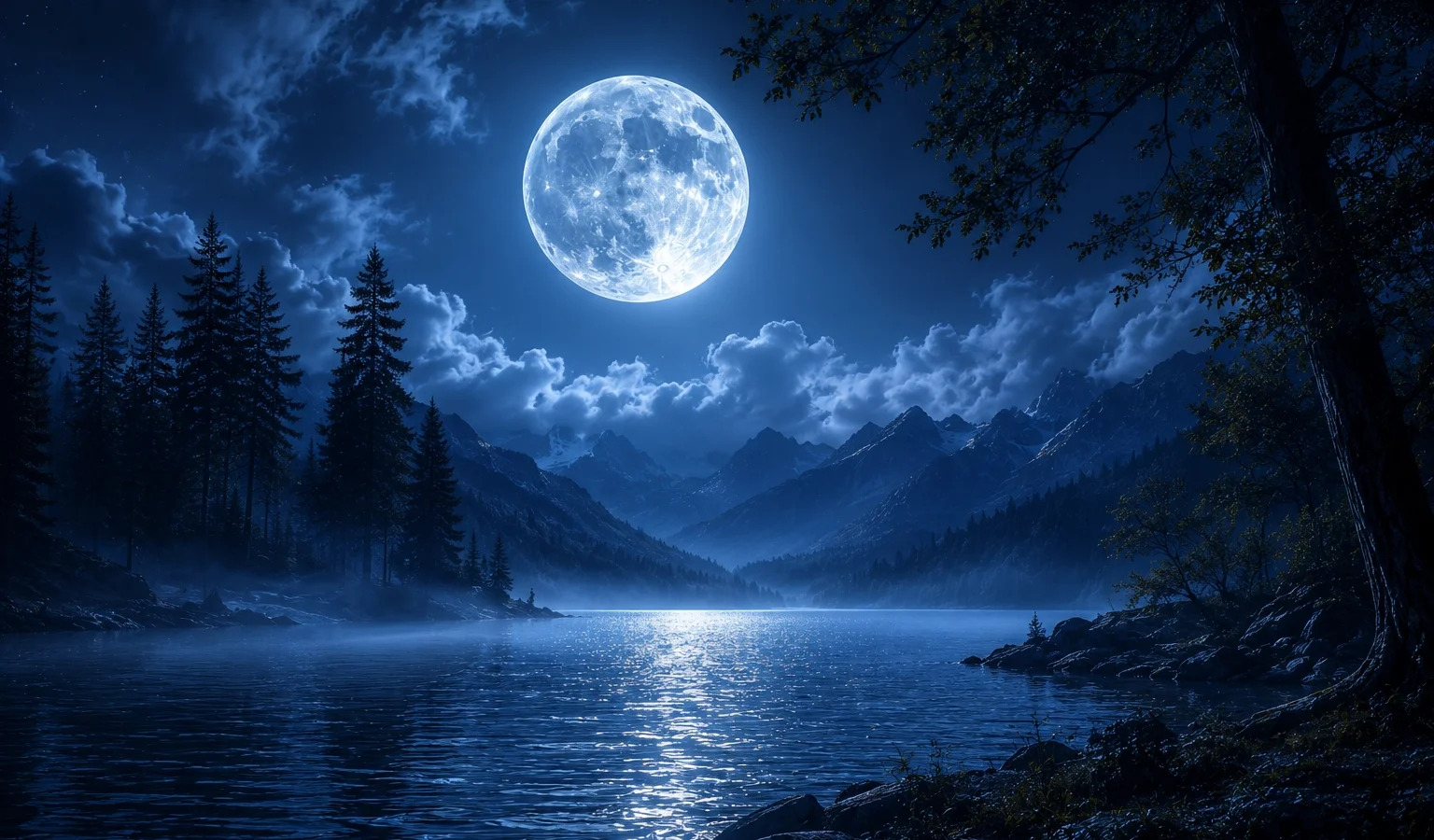
The Moon never looks finished.
Even when it appears full, bright, and complete above the roofs, fields, waters, or winter branches, its fullness is already temporary. The perfect circle is not a final state. It is a passing arrangement of light. Soon the edge will begin to darken. Soon the face will thin. Soon what seemed whole will become partial again.
This is one reason the Moon has always felt different from the stars.
The stars appear distant and fixed. The Moon changes in front of us. It does not merely occupy the night sky; it performs time. Night after night, it alters its visible form, vanishes, returns, grows, opens, diminishes, and begins again.
That visible rhythm is at the heart of moon symbolism. Long before scientific explanation separated lunar phases from mythic imagination, human beings watched the Moon as a body of transformation. It seemed to die without dying. It seemed to return without being new. It offered the oldest possible image of change that does not become chaos.
The Moon became a symbol of transformation because it made change visible, cyclical, and strangely calm. It showed that disappearance was not always destruction. It showed that darkness could be a phase rather than an ending. It showed that becoming was not a straight road, but a recurring motion between presence and absence.
For this reason, the Moon still carries symbolic force today. It belongs to astronomy, but also to poetry, ritual, memory, art, folklore, love, grief, and the private language of the inner life.
The Moon became a symbol of transformation because it teaches the eye that change can have rhythm.
The Moon as the Visible Shape of Change
Transformation is often difficult to understand while it is happening.
Inside a life, change rarely feels elegant. It may feel like loss, confusion, fatigue, waiting, uncertainty, or the strange humiliation of no longer being who one was, while not yet knowing who one is becoming.
The Moon gives this condition a visible form.
Its changing appearance is not random. The crescent grows. The half-light widens. The full Moon opens. Then it decreases, thins, disappears, and begins again. Science explains these phases through the Moon’s orbit around Earth and the changing amount of its sunlit half visible from our position. Yet the symbolic power remains: the Moon changes without losing continuity.
This is why moon symbolism became so closely tied to transformation. The Moon does not remain one thing. It also does not cease to be itself. It offers an image of identity in motion.
Human beings need such images. A person moving through grief, aging, recovery, creative work, motherhood, migration, illness, spiritual doubt, or emotional change may not feel “new.” They may feel partial, hidden, unfinished, or temporarily dark. The Moon suggests that partial visibility is not failure.
Not everything real is fully illuminated at every moment.
Why Lunar Phases Became Emotional Language
The phases of the Moon are among the most ancient visual metaphors available to human beings.
Waxing suggests increase, gathering, preparation, appetite, emergence. Fullness suggests presence, exposure, culmination, intensity. Waning suggests release, decline, surrender, return. Darkness suggests hiddenness, rest, uncertainty, gestation, or absence before renewal.
These meanings are not fixed laws. They are symbolic tendencies. But they have endured because they are easy to feel.
Modern life often describes transformation through achievement: progress, growth, improvement, success, becoming better. Lunar language is gentler and more complicated. It allows decrease to matter. It allows retreat to have dignity. It allows absence to belong to the cycle.
This is one reason moon symbolism remains useful in a culture that often fears slowing down. The Moon does not grow forever. It does not remain full forever. It does not apologize for waning.
| Lunar Image | Symbolic Mood | Inner Meaning |
|---|---|---|
| New Moon | Darkness, beginning, hidden seed | What is forming before it can be seen |
| Waxing Crescent | Emergence, fragile hope | The first visible sign of change |
| Half Moon | Tension, balance, division | The self between two states |
| Full Moon | Culmination, revelation, exposure | What can no longer remain hidden |
| Waning Moon | Release, decline, reflection | The art of letting form dissolve |
| Dark Moon | Absence, silence, unseen renewal | The necessary privacy before return |
This table is not a doctrine. It is a symbolic map. The Moon does not impose meaning. It offers a language through which change can be contemplated rather than merely endured.
The Moon and the Fear of Disappearance
Human beings are frightened by disappearance.
A person disappears from a life. A role disappears. Youth disappears. Certainty disappears. Love changes form. A home is left behind. A face in the mirror becomes unfamiliar. A former self loses its authority.
The Moon’s disappearance is different. It vanishes in a way that carries return inside it.
This is why ancient and modern imaginations have found comfort in lunar cycles. The dark Moon is not the destruction of the Moon. It is a phase in which visibility has withdrawn. The Moon remains present even when it is not seen.
In symbolic terms, this is a profound idea.
It suggests that absence is not always emptiness. A feeling may be hidden and still alive. A person may be changing invisibly. A period of silence may be forming something beneath the surface. A life may appear paused while deeper rearrangement is taking place.
Moon symbolism became associated with transformation because the Moon teaches that disappearance and renewal can belong to the same pattern.
This does not erase grief. It does not pretend that all losses return. Some absences are final. But the Moon gives the imagination a way to distinguish between what is dead and what is merely hidden.
The Moon as a Mirror of the Inner Life
The Moon shines by reflected light.
This scientific fact carries symbolic power. Unlike the Sun, the Moon does not blaze from itself. It receives, reflects, softens, and transforms light into a gentler visibility. It does not reveal the world with the authority of day. It reveals in fragments, outlines, silvered edges, and partial forms.
This is why the Moon so easily becomes a mirror of the inner life.
Interior change rarely arrives like noon. It arrives like moonlight: indirect, uneven, quiet, suggestive. One does not always know immediately what has changed. A room feels different. A memory returns with another tone. A desire weakens. A fear loses some of its force. A person once central begins to belong to the past.
Moon symbolism gives image to this kind of transformation — not the public transformation of announcement, but the private transformation of atmosphere.
The Moon does not explain. It alters the way things appear.
Sometimes that is what inner change does first.
Why the Moon Became Connected with Time
To watch the Moon is to watch time become visible.
Days can blur, especially in modern life. Weeks disappear into calendars, work, messages, errands, repetition. But the Moon makes time look different. It gives the night a face that changes slowly enough to be noticed and regularly enough to be remembered.
Many cultures used lunar cycles in calendars, religious observances, agriculture, navigation, and seasonal imagination. The Moon’s phases offered a natural rhythm by which human communities could mark return, absence, ripening, and renewal.
This historical relationship deepened moon symbolism. The Moon was not merely an object in the sky. It became a clock of transformation. It taught that time was not only linear but cyclical.
Linear time says: what is gone is behind you.
Lunar time says: some things return, but not in the same way.
This distinction matters. A person may revisit grief years later, but differently. A place may be returned to, but not as the same self. A question may come back after long silence, carrying new weight. Lunar time does not deny change; it shows that recurrence and transformation can coexist.
The Mythological Moon
Across cultures, the Moon has been associated with deities, fertility, death, resurrection, madness, dreaming, tides, animals, women, hunters, calendars, travelers, and the hidden life of night. Britannica notes that moon worship has appeared widely across eras and cultures, often connected with basic rhythms of life and the universe.
Such symbolic richness did not emerge by accident.
The Moon is visible, changeable, distant, and intimate at once. It belongs to the sky, yet seems to follow ordinary human nights. It appears above palaces and fields, over graves and roads, over lovers and soldiers, over seas and deserts. It is universal enough to become myth, yet personal enough to feel private.
This is why moon symbolism became so fertile. The Moon can hold many meanings without collapsing into one. It can be mother, mirror, witness, hunter’s lamp, mourner’s companion, goddess, clock, omen, pearl, eye, wound, bowl, gate, or mask.
Different cultures gave it different names and stories. The symbolic pattern remained: the Moon was never merely there. It was watched, interpreted, feared, loved, invoked, painted, sung to, and used as a way of thinking about human change.
The Moon became mythic because it changes visibly while remaining beyond possession.
The Moon and the Feminine Symbol
In many traditions, the Moon became associated with feminine figures, cycles, fertility, pregnancy, mystery, and bodily rhythm. This association is old, widespread, and culturally varied. It should be approached carefully, without reducing women to biology or turning symbolism into a narrow rule.
The symbolic connection is understandable: the Moon changes cyclically, returns in phases, governs night rather than day, and has often been linked to fertility, water, growth, and hidden processes. In myth and art, lunar figures often appear as goddesses, queens, mothers, huntresses, or veiled presences.
Yet the deeper value of this aspect of moon symbolism is not that the Moon “belongs” only to women. It is that the Moon preserves a language of transformation that is receptive, cyclical, hidden, embodied, and non-linear.
This language matters for everyone.
Modern culture often privileges visible production: achievement, announcement, acceleration, conquest, expansion. The Moon offers another grammar: gestation, reflection, retreat, renewal, hidden growth, return.
It reminds us that not all power looks like force.
The Moon in Art, Poetry, and the Human Gaze
Artists have returned to the Moon because it changes the emotional temperature of a scene.
A landscape under moonlight is not the same landscape under sun. A face lit by the Moon carries ambiguity. A city under moonlight becomes less practical and more dreamlike. Water under the Moon looks like memory moving. A road beneath moonlight suggests departure, longing, secrecy, or return.
The Moon often appears in art not as decoration, but as atmosphere.
This is why moon symbolism survives so well in painting, poetry, theatre, film, photography, and music. The Moon allows ordinary scenes to become inward. It turns space into mood. It creates the feeling that something visible is also concealing something else.
The Metropolitan Museum of Art has explored lunar imagery across cultures, including mythological associations from Roman Diana to the Japanese moon rabbit. Such examples show how the Moon became an artistic vessel for imagination, longing, divinity, distance, and reflection.
Art understands what literal language sometimes misses: the Moon is not only seen. It changes the way seeing feels.
The Moon as a Symbol of Emotional Change
Emotional transformation is rarely clean.
People do not simply move from sorrow to wisdom, fear to courage, confusion to clarity. They move unevenly. They return to old feelings. They become clearer, then obscure again. They forgive, then remember. They release, then grieve another layer. They feel strong by day and uncertain by night.
The Moon gives this unevenness dignity.
It does not demand constant brightness. It does not treat waning as failure. It does not remain exposed after fullness. It withdraws, changes, and returns.
This is why moon symbolism continues to resonate in personal reflection. It allows people to imagine emotional life as cyclical rather than defective. A dark period may not be the end of growth. A return of sadness may not mean healing has failed. A need for solitude may not mean regression.
The Moon offers a gentler understanding of becoming.
It suggests that transformation may include brightness, shadow, return, disappearance, and partial light.
The Shadowed Side of Lunar Symbolism
The Moon is not only gentle.
Its symbolism also carries fear. Moonlight can distort. It can make the familiar uncertain. It can be associated with madness, danger, wildness, night journeys, hidden acts, secrecy, wolves, ghosts, and the unstable border between reason and imagination.
This darker side should not be ignored.
Transformation is not always peaceful. Sometimes change arrives as disorientation. A person may not know whether they are becoming freer or losing structure. A life may feel dreamlike in the wrong way. Old certainties may dissolve before new meaning appears.
Moon symbolism includes this ambiguity because the Moon itself is ambiguous. It lights the night, but does not abolish darkness. It reveals, but partially. It beautifies, but can also make the world uncanny.
This is precisely why it became such a powerful symbol of transformation. True transformation is rarely pure comfort. It often includes a period in which the world is visible, but not in the old way.
Moonlight and the Half-Seen World
Moonlight changes places without changing their structure.
A room becomes softer. A forest becomes older. A road becomes more uncertain. A face becomes more inward. Water becomes almost unreal. The landscape remains itself, but the quality of recognition changes.
This is one of the most subtle aspects of moon symbolism: transformation does not always require the object itself to change. Sometimes transformation begins when perception changes.
What was ordinary becomes mysterious.
What was familiar becomes distant.
What was avoided becomes visible.
What was too bright to understand becomes approachable in softer light.
Moonlight is symbolic because it does not dominate. It allows ambiguity to remain. It lets the world appear without fully surrendering itself.
In this way, the Moon teaches a kind of knowledge different from daylight knowledge. Daylight names. Moonlight suggests.
A Quiet Method for Reading the Moon Symbolically
The Moon does not need theatrical interpretation.
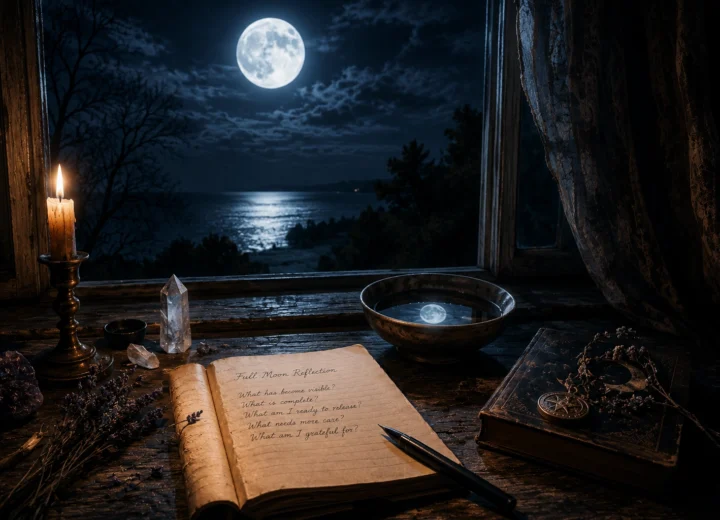
To read it symbolically, begin with simple attention. Look at the Moon not as an instruction, but as an image. Notice its phase. Notice the emotional atmosphere of the night. Notice what in your life feels full, partial, hidden, waning, returning, or not yet visible.
A quiet method may look like this:
- Observe the Moon without trying to force meaning from it.
- Name its visible phase: new, crescent, half, full, waning, hidden.
- Ask what in your life currently shares that quality.
- Write one sentence beginning with: “Something in me is…”
- Write one sentence beginning with: “Something in my life is changing by…”
- Let the reflection remain open rather than turning it into a rule.
This is not prophecy. It is symbolic literacy.
Moon symbolism is most useful when it sharpens attention rather than replacing judgment. The Moon does not tell a person what to do. It gives the changing self a mirror that is old enough to be patient.
When Moon Symbolism Becomes Too Easy
The Moon is so symbolically rich that it can easily become decorative.
It appears on jewelry, tattoos, journals, candles, social media graphics, tarot decks, posters, cosmetics, and countless spiritual products. There is nothing wrong with beauty or ornament. But when a symbol is repeated too casually, it can lose gravity.
To treat the Moon seriously is to resist turning it into a vague sign of mystery.
Moon symbolism is not powerful because the Moon is fashionable. It is powerful because the Moon has helped human beings think about time, change, darkness, return, fertility, fear, longing, and renewal for thousands of years.
A crescent is not only an aesthetic curve.
A full Moon is not only a dramatic background.
A dark Moon is not only mood.
These images endure because they belong to deep patterns of human perception. They should be handled with some restraint, as all old symbols should.
Symbolic Observations ✦
- The Moon became a symbol of transformation because its phases make change visible.
- Its disappearance suggests hiddenness rather than simple destruction.
- Its return gives cyclical time a visible form.
- Moonlight transforms perception without changing the object itself.
- The Moon reflects rather than produces light, making it a natural mirror of inward life.
- Lunar symbolism often carries both tenderness and unease.
- The full Moon represents exposure and culmination, but not permanence.
- The waning Moon gives dignity to release and decline.
- The dark Moon suggests the unseen work before renewal.
- Moon symbolism remains powerful because human transformation is rarely linear.
The Moon as a Living Archive of Human Change
The Moon has watched human beings change their languages, cities, gods, calendars, sciences, maps, instruments, and explanations.
It has been seen by hunters, farmers, sailors, poets, prisoners, astronomers, lovers, mourners, soldiers, children, and those who could not sleep. It has appeared above rituals, wars, births, migrations, harvests, and graves. It has been explained with myth, mathematics, devotion, superstition, art, and physics.
And still it rises.
This continuity is part of its symbolic force. The Moon changes, but it also returns. It belongs to transformation and repetition at once. It is never the same in appearance, yet never wholly other.
In this way, moon symbolism becomes a kind of living archive. It preserves humanity’s long attempt to understand change without being destroyed by it. Every culture that watched the Moon added another layer of meaning. Every artist who painted it, every poet who addressed it, every traveler who navigated by it, every child who looked up at it with quiet fear or wonder, entered that archive.
The Moon is not only a celestial body in this symbolic sense.
It is one of humanity’s oldest shared images of becoming.
Why the Moon Still Means Transformation
Moon symbolism endures because transformation remains one of the central facts of human life.
People change. Bodies change. Homes change. Loves change. Grief changes. Faith changes. Fear changes. The self that once seemed certain becomes partial, hidden, bright, diminished, and renewed in ways that cannot always be explained while they are happening.
The Moon gives this instability a form that is neither chaotic nor simplistic.
It shows fullness without permanence.
It shows darkness without disappearance.
It shows return without repetition being identical.
It shows that change can be cyclical, quiet, severe, beautiful, and incomplete.
This is why the Moon became a symbol of transformation. It does not merely shine above change. It embodies change in a way the eye can follow.
The modern world may explain the Moon with precision, and that explanation is valuable. But explanation does not empty the symbol. Knowing why the Moon changes its visible shape does not erase the old human feeling of looking up and recognizing oneself in the partial light.
The Moon waxes.
The Moon wanes.
The Moon disappears.
The Moon returns.
And somewhere in that slow silver rhythm, the human imagination continues to find a language for all it has lost, all it has hidden, and all it is still becoming.
Related Articles
Why Moonlight Changes the Meaning of a Place
An atmospheric essay on half-seen landscapes, shadow, memory, and the symbolic language of light after sunset.
The Symbolism of Night in Human Imagination
A reflective exploration of darkness, silence, fear, privacy, dream, and the meanings that appear after daylight withdraws.
Why Forests Feel Spiritually Different at Night
A symbolic study of moonlit paths, listening, fear, humility, and the strange presence of trees after dark.
The Candle as a Symbol of Memory and Witness
A meditation on small light, vigil, grief, attention, and the quiet dignity of symbols that do not overpower darkness.
Why Humans Seek Signs During Emotional Change
A calm exploration of pattern, uncertainty, attention, and the human desire to read meaning into changing seasons of life.
Further Reading & Sources
- NASA — Moon Phases
A clear scientific explanation of why the Moon appears to change shape throughout its cycle. - Encyclopaedia Britannica — Moon
A general reference on Earth’s natural satellite, its physical features, phases, and cultural significance. - Encyclopaedia Britannica — Moon Worship
Historical background on lunar worship, lunar deities, and the Moon’s symbolic connection with life rhythms. - Encyclopaedia Britannica — Lunar Deity
A concise reference on gods and goddesses associated with the Moon and its cycles. - The Metropolitan Museum of Art — Moon Art
Museum material exploring lunar imagery and mythological associations across cultures. - The Metropolitan Museum of Art — Roundel with a Personification of the Moon
An example of the Moon represented as a female sky figure in medieval art. - Library of Congress — Peoples & Creatures of the Moon
A cultural history resource showing how people imagined life and meaning on the Moon. - Library of Congress — What Is a Blue Moon?
A useful source on lunar expressions, rare full moons, and the cultural language around the Moon. - Library of Congress — One Hundred Aspects of the Moon
A visual collection connected with Japanese and Chinese stories, mythology, and lunar imagery. - JSTOR — Moon Symbolism, Mythology, and Art
Academic search entry point for scholarship on lunar symbolism, mythology, art history, and cultural imagination.