May 18, 2026
Why Forests Feel Spiritually Different at Night
Forests at night feel spiritually different because darkness alters sound, perception, fear, memory, and the symbolic presence of trees.
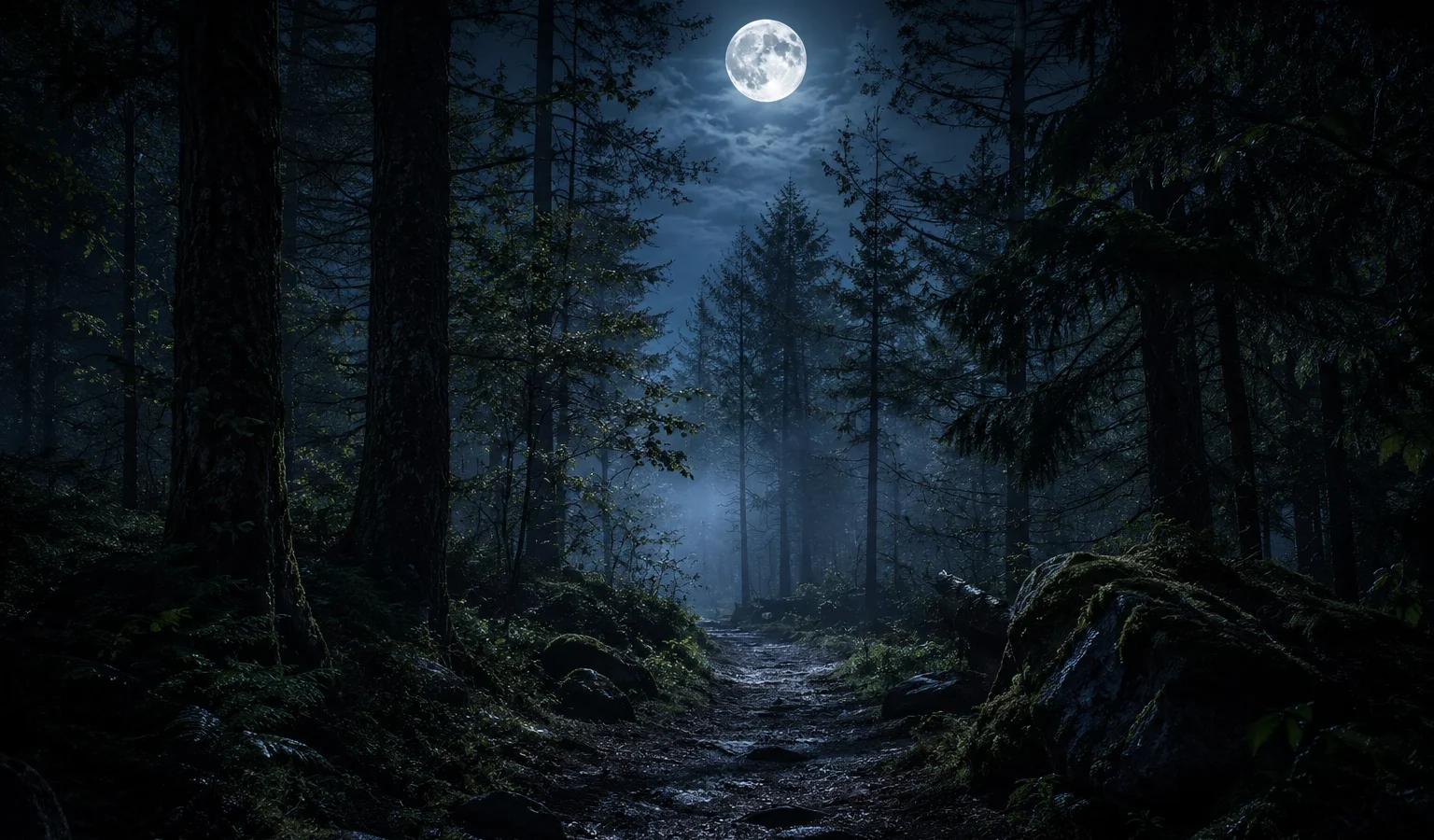
A forest does not become another place when night falls.
The trees remain where they stood in daylight. The path has not moved. The moss still covers the stone. The roots still hold the ground with the same patient pressure. Nothing has been replaced.
And yet everything feels altered.
At night, the forest withdraws from easy recognition. Distances become uncertain. Familiar trunks become figures before they become trees again. The path narrows not because it has changed, but because the eye can no longer claim it with confidence. Sound travels strangely. A twig breaking somewhere beyond the visible edge can feel more important than a whole conversation in daylight.
This is why forests at night feel spiritually different. They alter the relationship between perception and imagination. They remove the confidence of sight. They make the human being aware of entering a world that was never arranged around human comfort.
In daylight, the forest may feel restorative, beautiful, ecological, green, breathing. At night, it becomes older. Not because the trees have aged in a few hours, but because darkness restores something archaic in the way we meet them.
The night forest is not merely scenery. It is threshold, mirror, boundary, and witness.
A forest at night does not need to speak in order to become a question.
The Day Forest and the Night Forest Are Not the Same
In daylight, a forest often invites movement. The eye follows branches, ferns, clearings, birds, bark, mushrooms, insects, light, the shape of the path. The mind organizes what it sees. It names the place. Pine, oak, birch, moss, ravine, trail, stream. Naming creates comfort.
At night, naming becomes slower.
The same forest stops offering itself so easily. The trees become vertical presences before they become species. The distance between trunks becomes less measurable. The canopy becomes a dark ceiling. The ground demands more care. The body listens before the mind interprets.
This change is one reason forests at night feel spiritually different. Daylight allows the person to observe the forest. Darkness makes the person feel observed by it.
This sensation does not require belief in spirits. It arises from altered perception. When sight weakens, the imagination becomes more active. When the familiar becomes partially hidden, the mind fills the missing portions with possibility. The forest is not necessarily more dangerous than before, but it becomes less available to control.
And where control weakens, symbolic feeling often deepens.
Darkness Changes the Human Body Before It Changes the Mind
The spiritual feeling of the night forest begins partly in the body.
Darkness changes posture. The pace slows. Breathing becomes more noticeable. The ears widen their attention. The skin seems to listen. The body becomes aware of being an animal among other animals, even if the modern mind would prefer a more civilized description.
In a lit room, a person can forget the body. In forests at night, the body returns as interpreter. It notices ground, temperature, dampness, sound, the pressure of unseen space. It understands that vision is no longer enough.
This bodily awareness can feel spiritual because it is older than explanation. It brings a person back to a form of perception that modern life often suppresses. In cities, the human being is surrounded by surfaces built for human use: doors, lights, roads, signs, windows, screens. The night forest offers fewer assurances.
There is no promise that everything will be visible.
There is no promise that every sound belongs to something harmless.
There is no promise that the path will remain psychologically simple.
What returns is humility.
The Forest After Dark Is Alive in Another Register
A forest at night is not asleep.
It is active in ways daylight visitors may not notice. Many animals are nocturnal or crepuscular. Bats identify and track flying insects by echolocation, while moths are primarily nocturnal and search for food at night. Artificial light can disrupt natural night conditions and affect species that depend on darkness, a point emphasized by the National Park Service in discussions of night skies and ecological protection.
This matters symbolically because forests at night remind human beings that the world continues beyond human schedules.
The night does not wait empty until morning restores usefulness. It belongs to other forms of life, other rhythms, other senses. The bat does not need the same world the human eye needs. The owl, moth, fox, insect, root, fungus, and sleeping bird inhabit a reality arranged differently from human habit.
To enter that world is to become a guest.
This guesthood can feel spiritual because it corrects the modern illusion of centrality. The human being is not the measure of the forest. The night makes this clear without argument.
The forest continues.
We are the temporary ones passing through.
Sound Becomes a Symbolic Language
In daylight, vision often dominates the forest. At night, sound takes authority.
A branch moves. Leaves answer a wind too soft to feel directly. Something small crosses dry ground. A distant bird calls once, then does not call again. Water sounds closer than it is. The silence between sounds becomes part of the listening.
This is one of the deepest reasons forests at night feel spiritually different: they turn sound into a form of invisible writing.
The mind wants to know what made each noise. Was it an animal? A falling twig? A footstep? A bird? The forest rarely clarifies immediately. Its sounds arrive without captions.
That uncertainty gives them symbolic force.
A sound in the night forest is not only sound. It is presence without image. It asks the listener to accept partial knowledge. It teaches that not everything real becomes visible at once.
The night forest teaches the ear what daylight allowed the eye to forget.
The Old Human Fear of the Tree Line
Forests have long held an uneasy place in human imagination.
They offer shelter, food, timber, medicine, shade, mystery, and beauty. They also hide danger, disorientation, predators, thieves, spirits, exile, and the unknown. In folklore and fairy tale, the forest often marks the space beyond ordinary social order. A child enters the woods and leaves the known world. A traveler loses the path. A hermit waits. A witch lives at the edge. A god, animal, or stranger appears where the road disappears.
This symbolic inheritance still affects how forests at night are felt.
Even a modern person who does not believe in forest spirits may feel an older pressure at the tree line after sunset. The imagination recognizes the pattern: beyond this point, ordinary rules become less certain. The village, house, streetlamp, road sign, and screen are behind you. Ahead is shadow, depth, and the possibility of being changed by what you cannot fully see.
The forest has always been a place where the human world thins.
Night makes that thinning visible.
Why Trees Feel Like Witnesses in the Dark
A tree in daylight can be admired as part of landscape.
A tree at night can feel like a witness.
This is not because the tree has changed its nature. It is because darkness alters the human relation to stillness. A standing figure in darkness becomes charged. The trunk is vertical. The branches reach outward. The leaves move without walking. The tree does not speak, but it holds position with a patience the human body cannot imitate.
In forests at night, thousands of such presences surround the walker.
The result can feel solemn. The forest no longer seems like a collection of objects. It becomes an assembly. The human being passes through something older, quieter, and less hurried than personal thought.
This sensation belongs partly to symbolism and partly to scale. Trees often outlive individual human concerns. They stand through seasons, storms, nesting, rot, renewal, disease, cutting, regrowth. They hold time differently.
At night, when visual detail fades, this endurance becomes more apparent. The tree becomes less botanical and more archetypal: pillar, witness, ancestor, gate, shelter, warning, memory.
The Forest as a Threshold Between Worlds
Many symbolic landscapes are thresholds: doors, rivers, bridges, mountains, caves, deserts, shorelines. The forest is one of the most enduring because it is not a single line to cross. It is a world one enters.
At night, this quality intensifies.
The edge of the forest becomes more dramatic. Outside may be road, field, town, house, or open sky. Inside is enclosure, shadow, scent, root, sound, and depth. Crossing into forests at night can feel like moving from one order of reality into another.
This is why the night forest appears so often in stories of initiation and transformation. The person who enters may not be the same person who leaves. Not because the forest performs a miracle, but because darkness and depth strip away the illusion of certainty.
The threshold asks: what do you bring with you when visibility is reduced?
Fear becomes clear. Trust becomes clear. Imagination becomes clear. The body’s knowledge becomes clear. A person may discover that they are less rational than they believed, or more attentive than they knew.
Every threshold reveals the one who crosses it.
Spiritual Feeling Without Supernatural Certainty
To say that forests at night feel spiritually different is not to claim that they contain supernatural proof.
Lucifer Heritage is not interested in turning atmosphere into certainty. A dark forest can feel sacred, haunted, watchful, ancestral, or charged without requiring any crude declaration about what is “really” there. The spiritual feeling may arise from perception, ecology, memory, myth, fear, beauty, and humility at once.
That does not make the feeling false.
Human beings often experience meaning before they can explain it. A cathedral, a grave, a sea cliff, a hospital corridor, a childhood house, an archive, a battlefield, a forest after dark — these places may carry symbolic pressure because they gather vulnerability, scale, memory, and silence.
The night forest belongs to this order of experience.
It is not an argument.
It is an encounter.
The Psychology of Darkness and Imagination
Darkness does not merely hide objects. It changes the way the mind works.
When less information is available, the imagination becomes more active. This can produce fear, but also wonder. The mind begins to complete what vision cannot finish. A stump becomes a crouched figure for one second. A moving branch becomes a gesture. A distant animal call becomes a question.
This is why forests at night can feel alive with meanings that would seem excessive in daylight. The imagination is not necessarily deceiving the person. It is doing what imagination does: working at the edge of incomplete knowledge.
Modern life often treats imagination as entertainment, something used for stories, design, games, or fantasy. The night forest restores imagination to its older function: survival, orientation, caution, reverence, pattern recognition, and symbolic thought.
The mind asks: what is here?
The deeper mind asks: what does this place awaken in me?
Both questions matter.
The Restorative Forest and the Unsettling Forest
Forests are often associated with healing, and this association is not only romantic. Research on forest bathing and forest therapy has explored possible psychological and physiological benefits of time spent in forest environments, including stress reduction and improvements in mood or anxiety-related measures. Reviews in medical literature discuss Shinrin-Yoku and forest-based interventions as areas of growing research, while also noting that effects, methods, and evidence quality can vary.
But the forest is not only restorative. It can also be unsettling.
This is especially true at night. The same qualities that heal in daylight — enclosure, organic complexity, distance from human noise, sensory richness — may become intense after dark. The forest’s otherness is no longer softened by sun. The human being cannot simply consume the place as wellness. The forest resists becoming a product.
This double quality is important.
Forests at night may calm one person and frighten another. They may comfort someone who seeks solitude and overwhelm someone who feels exposed. They may feel holy to one person, dangerous to another, and both to the same person within a single hour.
The spiritual feeling lies partly in this ambiguity.
A place that can only soothe us is not fully other. The night forest remains other.
Moonlight, Shadow, and the Half-Seen World
Moonlight does not reveal the forest the way sunlight does.
It edits.
It touches some leaves and erases others. It turns water silver, bark pale, stones cold, branches skeletal. It creates a world of edges rather than details. Under moonlight, the forest becomes legible in fragments.
This half-seen quality is central to the atmosphere of forests at night. It allows the world to remain partially withheld. The eye receives enough to continue, but not enough to dominate. The imagination must collaborate with perception.
Shadow also becomes active. In daylight, shadow is often a companion to form. At night, shadow can become the field itself. The forest is no longer illuminated with shadows inside it; it is shadow with small islands of visibility.
This inversion changes emotion.
The walker becomes aware that light is temporary, local, and fragile. A lantern, moon, phone screen, or small fire does not conquer darkness. It only opens a limited circle within it.
There is a spiritual lesson in that, if one is willing to receive it quietly: human understanding often works the same way.
Folklore, Myth, and the Nocturnal Forest
Folklore repeatedly places strange encounters in forests because forests provide narrative depth. They are believable spaces of disappearance, testing, disguise, and transformation. The person who enters the forest steps beyond ordinary witness. What happens there may not be easily verified by the village.
At night, this symbolic function becomes stronger.
The nocturnal forest is the proper home of ambiguous figures: the lost child, the old woman, the hunter, the animal guide, the trickster, the ghost light, the forbidden path, the voice that should not be followed, the clearing where time feels altered.
Modern readers may no longer accept folklore literally, but the emotional pattern remains recognizable. Forests at night still feel like places where the boundary between the known and unknown becomes porous.
This does not mean that something supernatural must appear.
It means that the forest creates the conditions in which the mind expects revelation, danger, or encounter.
Myth does not always require belief. Sometimes it requires only the right darkness.
A Quiet Method for Entering the Night Forest
The night forest should not be approached carelessly.
Symbolic feeling does not replace practical caution. A person entering forests at night should know the path, carry appropriate light, dress for weather, respect local wildlife, avoid risky terrain, tell someone where they are going, and remain attentive to laws, safety, and common sense.
But once practical care is present, a quieter method becomes possible.
- Pause at the edge before entering.
- Notice what changes first: sight, sound, breath, posture, imagination.
- Walk slowly enough for the body to understand the ground.
- Do not name every sound immediately.
- Let the forest remain partly unknown.
- Choose one tree, stone, path, or clearing and observe it without forcing meaning.
- Leave before fear becomes performance.
- Return with one sentence about what the forest revealed in you.
This is not a ritual of conquest. It is a practice of attention.
The goal is not to prove courage. The goal is to notice how the self changes when the familiar world is no longer arranged around visibility.
When the Night Forest Feels Too Heavy
Not everyone should seek the forest at night.
For some, darkness, isolation, animal sounds, or unfamiliar terrain may intensify anxiety or traumatic memory. For others, the night forest may not be safe because of location, weather, wildlife, human danger, or poor navigation. A symbolic experience is not worth recklessness.
There are gentler ways to approach the same atmosphere: reading by a window after dark, listening to recorded forest sounds, visiting the woods at dusk with a trusted companion, studying folklore, walking familiar paths in early evening, or observing the tree line from a safe place.
The point is not to force an encounter.
Forests at night feel spiritually different because they are not fully domesticated by human preference. Respecting that difference is part of understanding it.
Symbolic Observations ✦
- A forest at night changes not only what is seen, but how the self feels while seeing less.
- Darkness restores humility by reducing the authority of vision.
- Night sounds feel powerful because they suggest presence without image.
- Trees can feel like witnesses when detail disappears and vertical presence remains.
- The forest edge functions as a threshold between human order and older uncertainty.
- Moonlight creates a half-seen world where imagination collaborates with perception.
- The night forest can be restorative and unsettling at the same time.
- Folklore uses forests because they are believable places of disappearance and transformation.
- Spiritual feeling does not require supernatural certainty.
- The forest at night teaches that not all meaning arrives through clarity.
The Forest as a Living Archive
A forest keeps records differently from a book.
It writes in rings, roots, fallen trunks, fungal threads, animal paths, broken branches, seedbeds, scars, clearings, and regrowth. It remembers storms by altered canopies, human passage by paths, fire by new growth, death by soil, and time by the slow grammar of decay.
At night, this archive becomes less readable but more palpable.
The person walking through forests at night may not be able to interpret the forest’s history, but they can feel that history surrounding them. The trees are not props. They are living beings within an ecological community, older than the evening and indifferent to the visitor’s need for easy meaning.
This is where the spiritual difference becomes most serious.
The night forest does not flatter human importance. It places the individual inside a larger continuity: plant, animal, soil, darkness, weather, season, death, renewal. It reminds the human being that life does not become meaningful only when humans explain it.
Some meanings are not spoken.
They are stood among.
Why the Night Forest Feels Like Another World
Forests at night feel spiritually different because they alter the balance between the known and the unknown.
They reduce vision and intensify listening. They turn trees into presences and paths into thresholds. They awaken old fears without necessarily becoming dangerous. They draw on folklore, memory, ecology, and the body’s ancient intelligence. They remind modern people that the world is not fully lit, fully named, or fully arranged for human control.
This is not superstition.
It is encounter.
The forest after dark carries the dignity of a place that does not need to explain itself. It allows the human being to feel small without being erased, alert without being hunted, imaginative without being deceived, humbled without being humiliated.
In daylight, we may admire the forest.
At night, we must negotiate with it.
That negotiation is what gives the experience its spiritual weight. The human being enters with a light, a path, a body, a history of stories, and a mind trained to seek meaning. The forest receives all of this without answering directly.
The trees stand.
The dark gathers between them.
A sound comes from somewhere beyond sight.
And for a moment, the modern self remembers that mystery is not always hidden far away.
Sometimes it begins where the path continues after the last certain light.
Related Articles
The Forest as a Symbol of the Unconscious
A reflective exploration of trees, hidden paths, fairy tales, and the shadowed regions of the inner world.
Why Silence Feels Uncomfortable to Modern People
A symbolic and psychological essay on quiet, restlessness, attention, and the modern fear of being alone with thought.
The Door, the Gate, and the Threshold
A study of passages, hesitation, forbidden rooms, and the symbolic moment before crossing into another state of life.
Why Humans Create Rituals During Times of Uncertainty
A calm exploration of repeated gestures, fear, order, and the human need to create form when the future is unclear.
Why Moonlight Changes the Meaning of a Place
An atmospheric essay on half-seen landscapes, shadow, memory, and the symbolic language of light after sunset.
Further Reading & Sources
- National Park Service — Animals Need the Dark
A clear ecological overview of darkness, light pollution, and the importance of night conditions for wildlife. - National Park Service — Night Skies
Background on nocturnal animals, moths, artificial light, and why dark skies matter within protected landscapes. - Encyclopaedia Britannica — Forest
A general reference on forests as ecological communities and major terrestrial environments. - Encyclopaedia Britannica — Bat: Food Habits
Information on bats, night feeding, insects, and echolocation. - Hansen et al. — Shinrin-Yoku and Nature Therapy
A state-of-the-art review of empirical research on forest bathing and nature therapy. - Kang et al. — Forest-Based Interventions and Mental Health
Research discussing psychological and physiological effects of forest-based interventions. - Chen et al. — Forest Bathing and Mental Health
A recent academic review discussing forest bathing, depression, anxiety, and negative emotions. - FAO — Forest and Tree Symbolism in Folklore
A cultural resource on the symbolic meanings of trees and forests across human traditions. - Library of Congress — Fieldnotes from the Pinelands Folklife Project
Folklife material connected to forest landscapes, field observation, memory, and cultural record. - Library of Congress — American Folklife Center Collections
Folklore and cultural memory collections useful for studying forests, stories, place, and inherited symbolic traditions.