August 18, 2026
Dreams and Imagination: Why the Night Mind Shapes Culture
Every morning, an enormous private theatre closes. Rooms vanish, people disappear, cities collapse without leaving ruins, and conversations that felt urgent a few minutes earlier become difficult to reconstruct before breakfast. Most dreams fade quickly. A few survive as images, moods, fragments of dialogue, or places that seem strangely familiar despite never having existed.
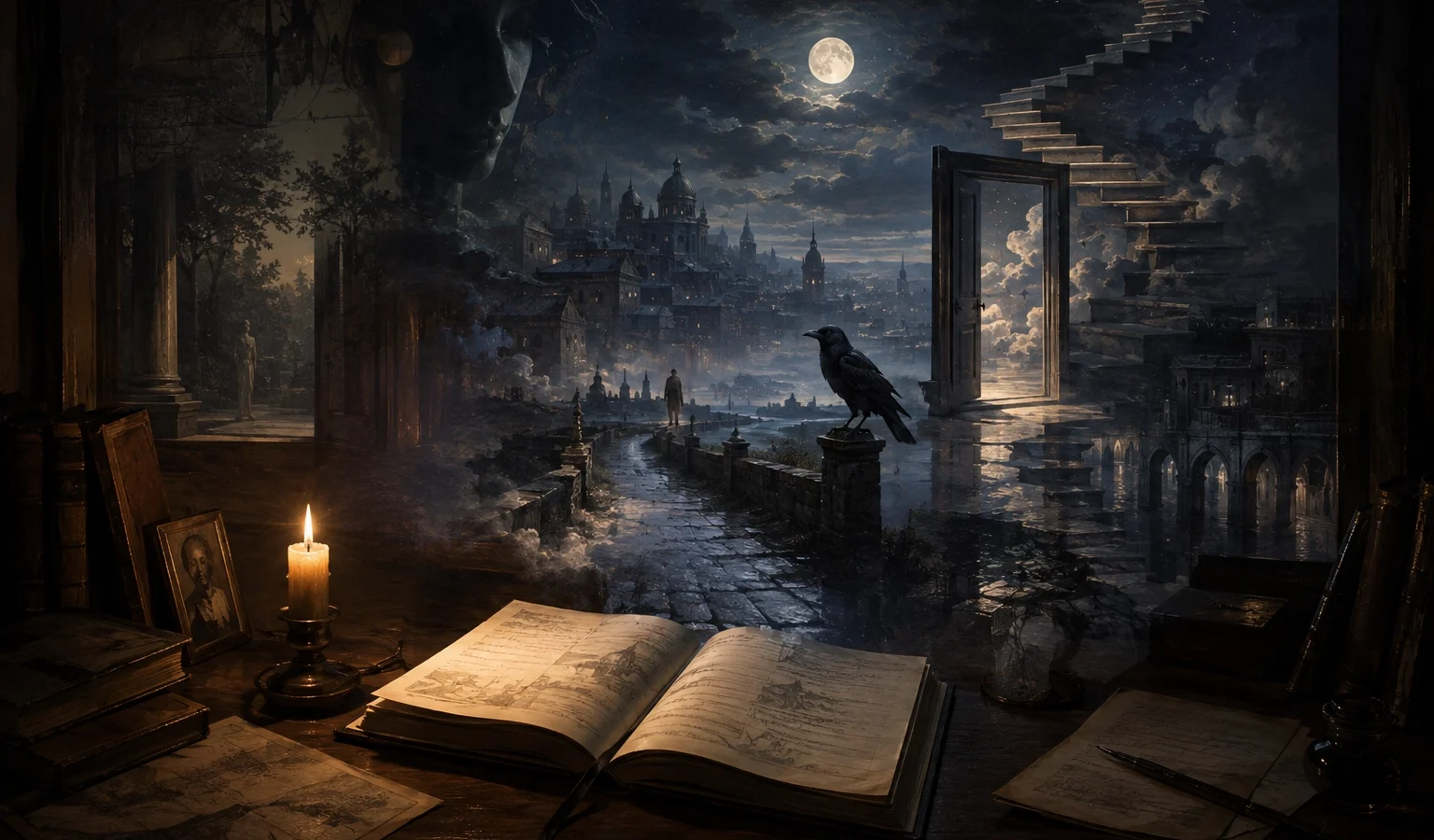
That fragile survival helps explain why dreams and imagination have remained so closely connected across art, myth, storytelling, psychology, and everyday life. Dreaming gives the mind an unusual form of experience: a world can appear without conscious planning, feel emotionally convincing while it lasts, and dissolve before the waking self has decided what to do with it.
Human cultures have repeatedly treated dreams as material worth preserving. Dreams have been recorded as omens, religious experiences, literary devices, private confessions, artistic sources, psychological evidence, and scientific data. These approaches do not agree on what dreams mean, and they should not be forced into one theory. What they share is the recognition that dreaming produces images and experiences capable of continuing into waking thought.
A dream may be forgotten as an event yet survive as a shape in the imagination.
Dreams matter not because every night contains a hidden message, but because the sleeping mind keeps showing how easily memory, emotion, place, and possibility can be rearranged into worlds.
Why Dreams and Imagination Belong Together
Waking imagination often feels intentional. A writer chooses a scene, an artist chooses a form, a child invents a game, an architect sketches a building, or a reader deliberately pictures a place described on a page. Dreaming feels different because the person experiencing the dream usually does not decide what should happen next.
A childhood friend may appear inside a railway station that resembles a school. A dead relative may speak as though nothing unusual has occurred. A city may contain streets from several countries. A room may lead into a forest, and the dreamer may accept the transition without demanding an explanation.
This involuntary construction is one reason dreams and imagination continue to fascinate. The mind demonstrates that it can generate scenes, characters, spatial relationships, emotional conflicts, and impossible transitions without the waking self supervising every detail.
That does not make dreams inherently profound. Many are repetitive, ordinary, fragmented, or difficult to remember. Their importance lies elsewhere. They reveal that imagination is not limited to deliberate invention. Some forms of imagery emerge before conscious interpretation catches up.
The Strange Logic of a Dream World
Dreams rarely behave like carefully edited stories. Location changes can happen without transition. Characters may merge. A person can be both familiar and unknown. Time may stretch, collapse, or lose ordinary sequence. Motives disappear. An ending may never arrive because waking interrupts the scene.
Yet dream experience can remain emotionally coherent even when its structure is not.
A train may pass through a childhood home, but the urgency feels real. A dead parent may be alive again, but the tenderness makes sense. A staircase may lead downward forever, but the fear is perfectly legible. An invented city may feel more familiar than a real place visited years ago.
This distinction between literal logic and emotional logic is central to the relationship between dreams and imagination. Art often works in a similar territory. A painting, poem, film, or novel does not need to reproduce ordinary reality exactly in order to communicate grief, desire, dread, memory, isolation, or wonder.
Dreams demonstrate this without asking permission from realism.
Dreams, Myth, and the Temptation of Universal Symbols
Dreams often resemble myth because both can use images larger than ordinary life. The dead return. Animals speak. A road leads beyond the known world. A person descends underground, crosses water, enters a forbidden room, climbs toward an unreachable height, or meets a figure whose identity seems more important than their biography.
These similarities are real, but they should be handled carefully.
It is too simple to claim that dreams created all myths, or that every recurring dream image has one universal meaning. A snake, river, mountain, house, moon, bird, or dead relative can carry different meanings across cultures and within individual lives. Even two people from the same culture may experience the same image very differently.
The connection between dreams and imagination becomes more interesting when fixed dictionaries are abandoned. Dreams and myths both allow thought to occur through image, transformation, repetition, and contradiction. They can hold several meanings at once without immediately reducing them to a single explanation.
Historical evidence also shows that dreams were interpreted long before modern psychology. The British Museum preserves an ancient Mesopotamian tablet containing instructions used by a professional dream interpreter. Such objects do not prove that ancient interpretations were scientifically correct. They show that people were already treating dreams as culturally significant experiences worth recording and organizing.
The Emotional Logic of Dreams
Dream research has repeatedly examined the relationship between waking life and dream content. Michael Schredl’s review of dream characteristics discusses the continuity hypothesis, the idea that waking concerns, activities, relationships, and emotional experiences often appear in dreams in altered form.
This continuity should not be understood as simple copying. A dream rarely functions like a video replay of the day. It may use recent material, older memories, familiar people, imagined places, and emotional concerns in combinations that never occurred in waking life.
The large-scale study Our Dreams, Our Selves also found measurable continuities between dream reports and waking-life patterns. Such work supports a modest conclusion: the night mind is not sealed away from ordinary experience.
This helps explain why dreams and imagination feel personal even when the scenes are impossible. The materials belong to the dreamer’s life, but their arrangement is freer. Emotion can become architecture. Anxiety becomes a collapsing floor. Grief becomes a person returning for one conversation. Uncertainty becomes a road without a visible end.
Dreams and Memory Do Not Work Like an Archive
Dreams are built partly from memory, but they are unreliable archivists.
They mix times, alter ages, combine places, and allow remote memories to enter recent situations. A childhood home may contain an adult workplace. A school friend may appear with the face they had decades ago. A room from one city may open onto a street from another country.
Research by Raphael Vallat and colleagues examined recent, remote, and mundane memory sources incorporated into dreams. Their work reinforces an important point: memory enters dreaming in varied forms, and not every source is a dramatic or emotionally exceptional event.
This recombination gives dreams and imagination much of their creative richness. Autobiographical memory usually helps waking life remain ordered. We know roughly what belongs to childhood, last year, yesterday, and the present room. Dreams loosen those boundaries.
The past is no longer placed neatly behind the present. It can walk through the same door.
Why Some Dream Images Survive for Years
Most dream plots disappear quickly, but isolated images can remain for a long time.
A red door. A flooded library. A black bird on a windowsill. A staircase beneath water. A hotel corridor that never ends. A city with no inhabitants. A familiar face seen from the wrong age.
The persistence of such images is one reason people continue to keep dream journals. The writer is not necessarily preserving a secret prophecy. Often the motive is simpler: something briefly existed in experience, and forgetting it feels like losing an unusual piece of inner history.
Dream recall varies greatly between people and from night to night. Research on dream recall has examined sleep stage, brain activity around awakening, interest in dreams, waking conditions, and individual differences. There is no reason to assume that forgetting a dream means it was unimportant, or that remembering one proves it carried a special message.
For dreams and imagination, the surviving fragment matters because it can become material later. A dream image may return in a drawing, a story, a photograph, a private symbol, or a way of describing an emotion that had previously resisted language.
Dream Journals as Private Archives
The dream journal is an unusual archive because it records experiences that cannot be independently revisited.
A photograph can be viewed again. A letter can be reread. A building can sometimes be returned to. A dream exists first as experience and then as memory. By the time it is written down, translation has already begun.
Words replace images. Sequence is imposed on fragments. The writer fills gaps without always noticing. A strange atmosphere becomes a sentence. A face that was obvious during sleep becomes difficult to describe.
This does not make dream journals worthless. It makes them records of remembered dreams rather than perfect copies of dream experience.
Over months or years, such journals can reveal recurring places, concerns, people, emotional tones, and forms of imagery. In that sense, dreams and imagination create a personal archive of changing inner life. The value lies less in proving what a symbol “really means” than in noticing what keeps returning and how the dreamer’s relationship to it changes.
Recurring Dreams and the Pressure of Repetition
Some dreams return with striking persistence. The setting may remain almost identical, or only the emotional structure repeats: being late, lost, pursued, unprepared, unable to speak, unable to find a room, trapped in a building, or trying to complete a journey that never resolves.
Recurring dreams are especially important to a pillar discussion of dreams and imagination because repetition turns a private image into a pattern. The dreamer is no longer dealing with one strange night but with a form the mind keeps rebuilding.
That does not produce a universal interpretation. A recurring school dream may concern performance anxiety for one person, nostalgia for another, and a completely different association for someone else.
Lucifer Heritage explores this more closely in Why Do Certain Dreams Repeat for Years?, where recurrence is treated as emotional and symbolic pressure rather than prophecy.
Falling Dreams and the Body’s Role in Imagination
Dreaming is not only visual. The body can participate intensely.
Falling dreams are a clear example. The sensation may arrive with a bodily jolt, tension, a change in breathing, or the sudden conviction that the ground has disappeared. Some falling sensations occur around the transition into sleep and may accompany hypnic jerks, while other falling dreams are embedded in longer dream narratives.
The image works symbolically because the body already understands loss of support. No complicated dictionary is required to recognize why falling can become associated with instability, risk, lack of control, or transition.
The article The Meaning of Falling Dreams and Emotional Instability develops this theme in detail. It is a useful reminder that dreams and imagination are embodied. The night mind does not only invent pictures. It can give emotional conditions weight, motion, pressure, distance, and gravity.
The Unknown Self and the Limits of Conscious Intention
Dreams fascinate because they challenge the assumption that the self is transparent to itself.
People wake asking why a particular person returned, why an unfamiliar place felt like home, why an ordinary object became terrifying, or why a forgotten event suddenly reappeared with emotional force. The question itself reveals a gap between conscious intention and mental production.
Different traditions have filled that gap with different explanations. Psychoanalysis emphasized unconscious meaning. Neuroscience investigates sleep states, memory, emotion, perception, and internally generated experience. Religious traditions may understand some dreams through spiritual frameworks. Artists often use the gap without trying to solve it.
A responsible account of dreams and imagination does not need to choose one theory as the answer to every dream. It is enough to recognize that dreaming involves processes not fully directed by waking awareness.
The inner life is active even when the conscious narrator is not in command.
Dreaming Is Not Limited to REM Sleep
Popular discussion often treats REM sleep and dreaming as identical. The relationship is more complicated.
Dream reports can be obtained from different sleep stages, although REM dreams are often described as more vivid, emotional, and perceptually rich. Modern research uses laboratory awakenings, sleep-stage recordings, questionnaires, dream diaries, and large collections of reports to investigate these differences.
J. Allan Hobson’s work on REM sleep and protoconsciousness proposed one influential framework in which dreaming contributes to a virtual model of the world. It remains a theory, not a final solution to why humans dream.
This scientific uncertainty is useful for Lucifer Heritage. The mystery of dreams and imagination does not depend on pretending that nothing is known. Scientific research can make questions more precise without making every personal dream interpretable by formula.
Dreams, Creativity, and the Problem of Romantic Legends
Stories about artists, scientists, and inventors receiving brilliant ideas in dreams are culturally attractive. Some are well documented, others have been polished by retelling, and many are difficult to verify.
The relationship between dreaming and creativity deserves a more careful approach. Research reviewed by Deirdre Barrett and later experimental work suggests that sleep and dream incorporation can sometimes contribute to creative problem-solving. The evidence is interesting, but it does not justify the claim that every dream contains a hidden masterpiece waiting to be extracted.
Dreams may support creativity because they allow unusual associations, loosen ordinary constraints, and present problems in altered forms. They may also be mundane, incoherent, repetitive, or useless.
The link between dreams and imagination is therefore best understood as possibility rather than guarantee. A dream can offer material. The waking artist still has to choose, revise, test, shape, discard, and work.
Surrealism and the Dream Image
Modern art provides one of the clearest examples of dream logic becoming a deliberate creative method.
Surrealist artists and writers were deeply interested in dreams, involuntary thought, the unconscious, chance, and combinations that disrupted ordinary realism. The Museum of Modern Art describes the Surrealists’ fascination with dreams as part of their effort to reach feelings and desires that ordinary rational control might not express directly.
This did not mean that every Surrealist artwork was a transcription of a literal dream. Artists transformed dream methods into artistic strategies. Objects were displaced from expected contexts. Scale changed. bodies, landscapes, interiors, and everyday objects entered impossible relationships.
The history of Surrealism shows how dreams and imagination can influence art without requiring a belief that dream images possess fixed supernatural meanings.
The dream becomes a permission structure: reality can be rearranged while emotional intensity remains intact.
Dreams in Literature and Storytelling
Dreams have long been useful to storytellers because they allow several narrative functions at once.
A dream can reveal fear without confession, return a dead character without changing the literal plot, compress memory, foreshadow without guaranteeing prediction, introduce an image that the character does not yet understand, or blur the boundary between event and interpretation.
The danger is convenience. Poorly used dream scenes can become shortcuts, delivering exposition or symbolism too directly. Stronger dream writing preserves some of the instability of actual dreaming. It leaves room for uncertainty.
This is where dreams and imagination meet the wider editorial philosophy of Lucifer Heritage. Symbols become weaker when the text explains them too quickly. A dream door does not need to be labeled “opportunity.” A black bird does not need to mean death. A flooded room does not need a universal translation.
Story gains depth when the image is allowed to remain connected to character, context, memory, and mood.
Dreams and the Architecture of Impossible Places
Dream places deserve special attention because they often feel more stable than dream plots.
People report houses with impossible rooms, cities made from several real places, corridors that change length, staircases leading somewhere different each time, schools that contain unfamiliar wings, hotels with endless floors, or landscapes that seem known despite never having been visited.
These places show how memory can be spatially recombined. The mind does not need to design architecture according to engineering rules. It needs only enough coherence for the dreamer to move through the scene.
This is one of the richest intersections between dreams and imagination. Human beings understand much of life spatially. We speak of being trapped, moving forward, reaching a threshold, returning home, losing ground, taking another path, or entering a new phase. Dreams turn such language back into places.
An impossible room can become emotional geography.
Dreams, Darkness, and Night Vision
Night already carries symbolic weight before dreaming begins. Darkness reduces ordinary visual certainty, changes the scale of attention, and has long been associated with privacy, fear, rest, danger, shelter, and inwardness.
Dreams add another layer. The sleeper can experience light, darkness, weather, buildings, faces, and landscapes without seeing them through waking eyes. The visual world is internally produced.
This makes dreams and imagination especially relevant to the Lucifer Heritage Philosophy of Darkness section. Darkness in a dream should not automatically be read as evil. It may suggest uncertainty, concealment, rest, grief, unfamiliarity, or nothing more than the setting the dream has created.
As with waking darkness, context matters more than a fixed code.
Silence Inside Dreams
Some dreams are memorable because expected sound is missing.
A crowded city may contain no voices. A familiar person may appear and refuse to speak. A forest may have no birdsong. A house may feel occupied even though every room is quiet.
Silence can intensify dream imagery because the mind notices the broken expectation. The absence becomes part of the scene.
This overlaps with The Symbolism of Silence in the World of Lucifer Heritage, where quiet is treated as a condition that changes attention rather than as automatic proof of mystery.
Within dreams and imagination, silence may accompany calm, fear, waiting, grief, secrecy, isolation, or a sense that something important has not yet become language.
Dreams in an Age of Screens
Modern visual culture has not made dreams obsolete. It has created new media capable of resembling dream logic.
Cinema can cut instantly between places. Digital art can build impossible architecture. Games can alter gravity, scale, time, and identity. Editing software can make familiar objects behave in unfamiliar ways. Online culture circulates uncanny images at a speed earlier generations could not have imagined.
Yet dreams remain different because the original experience is private. No camera records the dream itself. What survives is a report, sketch, memory, story, or reconstruction after waking.
This gap between experience and representation keeps dreams and imagination distinct from ordinary media. Something is always lost when the dream becomes shareable. The missing part may be the exact quality of fear, the certainty that a fictional place was familiar, or the way an impossible transition felt completely normal while it happened.
The Problem with Dream Dictionaries
Dream dictionaries are attractive because they remove uncertainty. A symbol appears, a meaning is supplied, and the dream seems solved.
The problem is that dream images are embedded in personal history, cultural context, recent experience, emotion, memory, and the structure of the dream itself. A dog may represent affection to one person and fear to another. A church may evoke childhood, faith, architecture, grief, anger, beauty, or nothing emotionally significant at all.
This does not mean symbolic interpretation is useless. It means interpretation should begin with the dreamer’s associations rather than finish with a universal code.
Lucifer Heritage treats dreams and imagination as fields of inquiry, not machines for prediction. A symbolic reading can ask better questions without pretending to know the future.
A Quiet Method for Reading Dream Images
Dream interpretation becomes more useful when the first task is observation rather than decoding.
- Record the dream before polishing it into a better story.
- Notice the strongest emotion, not only the strangest object.
- Ask which people and places come from waking life and which seem invented.
- Look for recent and older memory fragments without forcing a connection.
- Notice what changed unexpectedly: location, age, identity, gravity, scale, light, or time.
- Ask what felt normal inside the dream even though it seems impossible after waking.
- Compare recurring images across several dreams rather than assigning meaning from one appearance.
- Keep cultural symbolism separate from personal association until both have been considered.
- Avoid treating frightening imagery as prophecy.
- Allow some dreams to remain unresolved.
This method protects the relationship between dreams and imagination from becoming mechanical. A dream does not need to yield one answer in order to be worth remembering.
When Dream Interpretation Becomes Too Easy
Dreams are easy to sensationalize.
A dead relative becomes a guaranteed visitation. A black bird becomes an omen. A recurring number becomes a message from the universe. A nightmare becomes a warning of future disaster. A vivid dream becomes evidence that the dreamer has special powers.
Such claims create certainty quickly, but they flatten the complexity that makes dreams interesting in the first place.
A responsible symbolic journal should resist that pressure. Dreams can be emotionally meaningful without predicting events. They can contain cultural symbols without functioning as universal codes. They can inspire art without being supernatural instructions.
The relationship between dreams and imagination is already extraordinary enough. The sleeping mind constructs worlds, recombines memory, creates characters, bends space, and produces emotion without requiring deliberate waking authorship.
There is no need to exaggerate what is already strange.
Symbolic Observations ✦
- Dreams often recombine waking concerns, memories, relationships, places, and emotions rather than reproducing them literally.
- Dream logic can remain emotionally coherent even when time, place, and identity become unstable.
- Recurring dream images should be read through personal and cultural context rather than universal dictionaries.
- Dream memory is selective. A surviving image may outlast the plot that originally surrounded it.
- Dream journals preserve remembered experience, not perfect recordings of what occurred during sleep.
- Dreaming occurs across sleep, although REM dreams are often especially vivid and perceptually rich.
- Dreams can contribute to creativity, but they do not guarantee insight or artistic value.
- Myths and dreams share image-based ways of holding contradiction, but one should not be treated as a simple source code for the other.
- Impossible dream places can function as emotional geography.
- Falling, darkness, silence, pursuit, return, and transformation gain meaning from context, not from fixed symbolic rules.
- Scientific research can clarify how dreaming works without explaining the personal meaning of every dream.
- The most responsible interpretation often ends with better questions rather than absolute answers.
Why Dreams Still Shape Human Imagination
The enduring relationship between dreams and imagination is not difficult to understand once the dream is treated as an experience rather than a coded message.
Every night, the mind demonstrates that it can construct worlds from fragments. Memory becomes architecture. Emotion becomes weather. Fear becomes movement. A dead person can return for one conversation. A place can exist with complete familiarity and no address. Time can fold without explanation.
Most of these worlds disappear. That disappearance matters too.
We wake with incomplete evidence of something that felt real while it lasted. A room remains for a few minutes. A face survives until breakfast. A sentence cannot quite be recovered. A road continues in memory beyond the point where the dream ended.
This incomplete survival gives dreams their peculiar creative pressure. The waking mind wants to reconstruct, interpret, draw, write, compare, remember, or simply sit with the image before it fades.
Human beings have been doing this for centuries through ritual, myth, art, literature, private notebooks, psychoanalytic theory, neuroscience, and ordinary conversation. None of these approaches owns the dream completely.
That may be why dreams remain useful.
They resist becoming only one thing.
A dream can be a biological event, a remembered story, a psychological clue, a cultural symbol, an artistic seed, an emotional rehearsal, an absurd fragment, or a private experience with no final interpretation at all.
The sleeping world closes each morning, but the imagination keeps what it can carry out.
A door. A flooded room. A black bird. A face. A road continuing beyond the last visible light.
From those fragments, human beings keep making meaning.
Continue Through the Archive
Why Do Certain Dreams Repeat for Years?
A study of recurring dreams, emotional pressure, memory, unfinished patterns, and the night images that return long after their first appearance.
The Meaning of Falling Dreams and Emotional Instability
An exploration of descent, loss of control, unstable ground, bodily sensation, and the emotional force of falling during sleep.
The Symbolism of Silence in the World of Lucifer Heritage
A reflection on quiet, withheld meaning, memory, fear, attention, and the emotional pressure created when expected speech disappears.
The Mystery of Symbolic Marginal Notes in Old Books
A Hidden Archive essay on former readers, handwritten traces, private symbols, memory, and the human need to leave attention behind on the page.
Philosophy of Darkness
Further reading on darkness, uncertainty, inwardness, partial visibility, fear, and the symbolic meanings carried by night.
Further Reading & Sources
- Michael Schredl: Characteristics and Contents of Dreams
A review of dream phenomenology, dream-content research, waking-life influences, and the continuity between dreaming and waking concerns. - Alessandro Fogli, Luca Maria Aiello, and Daniele Quercia: Our Dreams, Our Selves
A large-scale analysis of dream reports using computational methods to examine characters, interactions, emotions, and continuity with waking life. - Raphael Vallat and colleagues: Characteristics of the Memory Sources of Dreams
Research on recent, remote, and mundane waking-life memories incorporated into dream reports. - J. Allan Hobson: REM Sleep and Dreaming, Towards a Theory of Protoconsciousness
An influential neuroscience theory proposing a relationship between REM dreaming and an internally generated virtual model of the world. - Deirdre Barrett: Dreams and Creative Problem-Solving
A review of historical accounts and experimental research concerning dreams, creativity, and problem-solving. - Marzano and colleagues: Recalling and Forgetting Dreams
Research on brain activity around awakening and factors associated with successful dream recall. - Museum of Modern Art: Surrealism and Dreams
Museum context for the Surrealists’ interest in dreams, involuntary thought, desire, and the unconscious as sources for modern art. - The British Museum: Mesopotamian Dream Interpretation Tablet
An ancient object documenting a formal tradition of dream interpretation and instructions intended for professional use.