June 10, 2026
The Emotional Meaning of Darkness in Human Thought
Meaning of darkness explores why shadow can evoke fear, uncertainty, shelter, imagination, and inner depth across psychology, art, and symbolic thought.
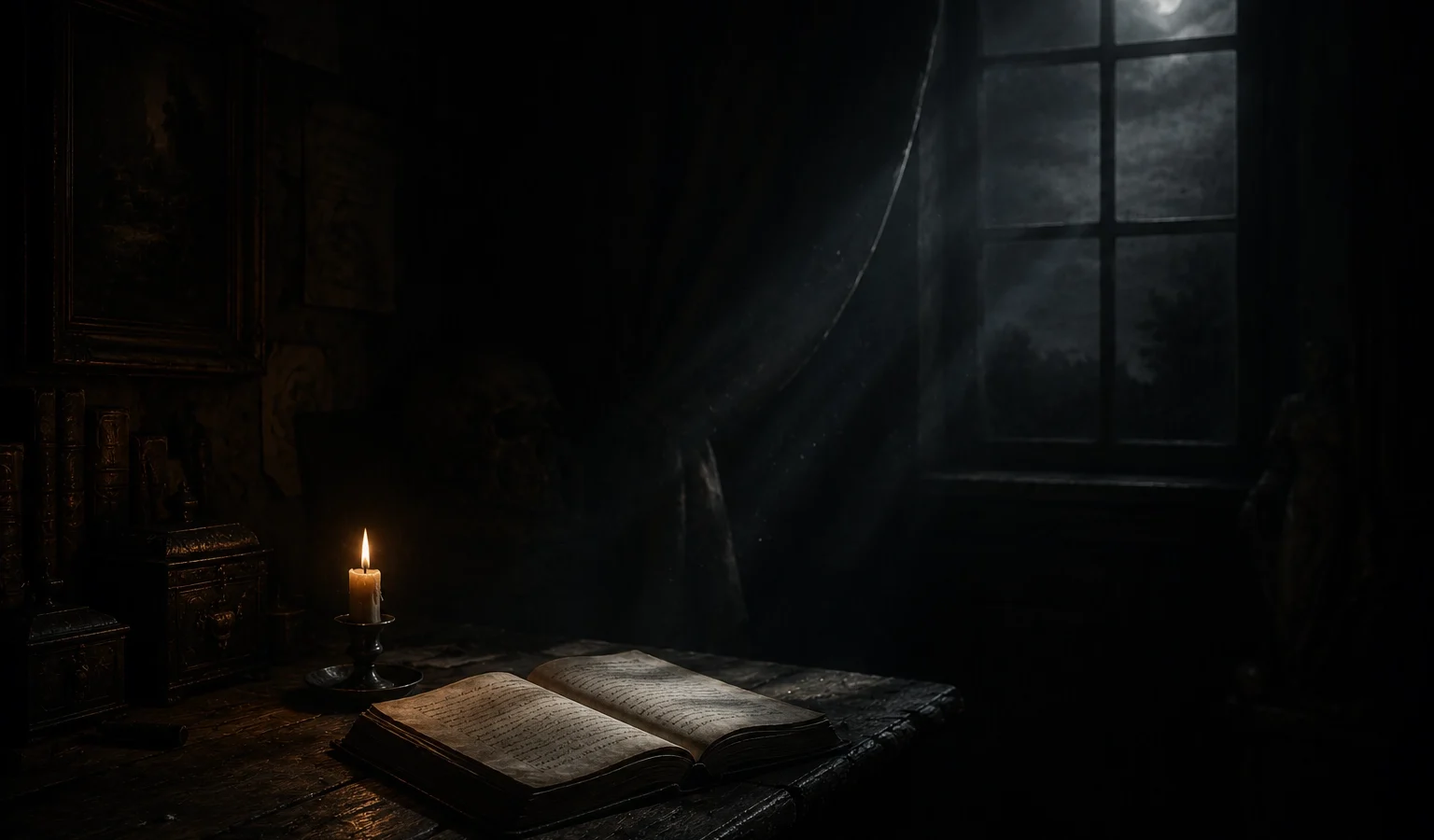
Darkness changes a room before anything inside the room has moved.
The chair remains where it was. The window still faces the same street. The door has not opened. No new object has entered the space. Yet when the light disappears, the familiar begins to loosen its shape.
A corner becomes less certain.
A hallway feels longer.
A quiet house develops another presence: not necessarily a supernatural one, but the presence of what cannot be verified at a glance.
This is why darkness has always carried such emotional weight. It is not only the absence of visible light. It is a change in the conditions of knowledge. The eye loses authority. Distance becomes harder to measure. Ordinary objects surrender part of their certainty. The imagination enters the space left open by incomplete perception.
The meaning of darkness begins here.
Human beings do not fear darkness only because it hides danger. They fear it because it hides proportion. A small sound may belong to the house settling, the wind touching a branch, an animal moving outside, or something the mind has not yet named. In daylight, the question may be answered quickly. At night, uncertainty remains active for longer.
But darkness is not only fear.
It can also be shelter. Privacy. Sleep. Intimacy. Relief from exposure. The quiet before thought becomes clear. The room in which grief no longer has to perform composure. The landscape where the visible world stops demanding constant response.
Darkness carries contradiction because human beings carry contradiction.
We seek light when we need orientation.
We seek shadow when we need refuge.
Darkness is not always the presence of something terrible. Sometimes it is the moment when certainty stops pretending to be complete.
Why Darkness Feels Different from Simple Absence
An empty room and a dark room are not the same experience.
Emptiness removes objects.
Darkness removes confidence.
The objects may still be present, but their outlines no longer answer immediately. The room becomes partially withheld. It asks the mind to complete what the eye cannot confirm.
This is an important part of the meaning of darkness. Darkness does not always create fear by adding an image. Often it creates unease by subtracting one.
A visible staircase can be climbed.
An unseen staircase must first be trusted.
A familiar road in daylight is a route.
The same road at night becomes an interval between pools of visibility.
A forest does not become physically larger after sunset, but the human imagination experiences it differently because the edges of the world have become less available.
Darkness changes the relationship between the observer and the observed.
In daylight, the gaze travels outward.
In darkness, the gaze returns inward.
The mind begins to test possibilities. It invents explanations. It remembers old fears. It notices sounds that daylight had buried beneath visual detail. It becomes alert not only to what is present, but to what might be.
This is why darkness has never been emotionally neutral.
The Psychology of the Unseen
Fear of darkness is often described too simply.
It is easy to treat it as a childish fear: a stage to be outgrown, a weakness to be overcome, a leftover superstition from a less rational age. But the emotional structure beneath it is more serious.
Darkness limits information.
When information becomes incomplete, the mind must decide whether to relax or remain alert. In uncertain conditions, alertness often feels safer. The nervous system prepares for a threat even when the source of danger cannot be identified clearly.
This helps explain why a dark alley may feel more threatening than an empty one seen clearly in daylight. The danger may not have increased. The number of possible explanations has.
The emotional language of darkness is therefore tied to uncertainty.
Not all fear requires a visible object.
Sometimes fear grows precisely because the object is missing.
A sound behind the wall.
A movement beyond the window.
A shape at the edge of vision.
A corridor extending farther than expected.
The mind does not like unfinished information when safety may be involved. It fills the gap quickly, often with the heavier possibilities first.
This does not mean every fear is rational.
It means fear has its own logic.
Darkness creates the conditions in which that logic becomes easier to hear.
Why Darkness Became Associated with Evil
Many cultures have used light and darkness as moral images.
Light can represent clarity, truth, divine presence, knowledge, life, purity, revelation, order, and salvation. Darkness can represent danger, confusion, concealment, death, ignorance, chaos, corruption, or separation from the sacred.
This symbolic opposition is understandable.
Light reveals.
Darkness conceals.
Light allows the path to be seen.
Darkness hides the edge.
Light allows a face to be recognized.
Darkness makes intention harder to read.
The moral language grows from lived experience.
But problems begin when metaphor becomes absolute.
If all darkness is treated as evil, then grief becomes suspicious because it is dark. Silence becomes suspicious because it is dark. Night becomes suspicious because it is dark. Solitude becomes suspicious because it is dark. The hidden layers of the self become suspicious because they cannot be illuminated immediately.
The meaning of darkness becomes impoverished when it is reduced to villainy.
Darkness may hide cruelty.
It may also hide vulnerability.
It may conceal a threat.
It may also protect what is not ready to be exposed.
It may symbolize ignorance.
It may also symbolize the humility of admitting that not everything has been understood.
| Darkness as Threat | Darkness as Depth | Emotional Difference |
|---|---|---|
| Concealment of danger | Protection of privacy | Fear versus refuge |
| Loss of orientation | Release from constant visibility | Confusion versus rest |
| Ignorance | Unfinished knowledge | Denial versus humility |
| Isolation | Chosen solitude | Abandonment versus inwardness |
| Death | Sleep, winter, incubation | Ending versus renewal held in reserve |
| Hidden harm | Hidden possibility | Threat versus potential |
This table is not an argument that darkness is harmless.
It is an argument against flattening a complex symbol into one moral command.
Darkness as Shelter
There are moments when light becomes exhausting.
Too much visibility can feel like pressure. The office remains bright. The screen continues glowing. Messages arrive. The room asks for productivity. The face remains available to other faces. Every surface appears ready to be evaluated, photographed, answered, organized, or used.
Darkness interrupts this demand.
It allows the body to withdraw from performance.
A dim room after a difficult day may feel gentler than a bright one. A walk at dusk may restore something daylight could not. A quiet bedroom becomes a place where the self no longer needs to explain its expression.
This is another part of symbolic darkness: shadow can protect the unfinished self.
Not everything needs immediate exposure.
A wound may require care before conversation.
A decision may require silence before announcement.
A grief may need a private room before it can enter public language.
A creative idea may need a period of obscurity before it can withstand interpretation.
Darkness can become shelter when it allows fragile things to remain alive long enough to take form.
The seed does not apologize for being underground.
The sleeping body does not apologize for leaving daylight.
The page does not apologize for remaining blank before the first sentence.
Night, Solitude, and the Inner Voice
Night changes the scale of thought.
During the day, attention is divided by practical life. Work, errands, traffic, noise, messages, schedules, meals, obligations, conversations, and small interruptions prevent one thought from becoming too large.
At night, the structure thins.
A question avoided for weeks may become louder after midnight. A memory may return with unusual clarity. A worry may grow larger than its daytime form. An idea may become possible because nothing else is speaking over it.
This is why night can be both creative and dangerous.
It gives inwardness more room.
But inwardness does not guarantee wisdom.
A tired mind can become cruel. Anxiety can rehearse itself endlessly. Loneliness can magnify ordinary silence into a verdict. Memory can become selective, preserving only the sharpest edges.
The meaning of darkness must include this ambiguity.
The night may reveal.
The night may distort.
The same solitude that produces a page of honest writing may also produce an hour of unnecessary fear.
Darkness is not automatically profound.
It simply removes some of the distractions that kept the inner voice at a distance.
The Shadow in Jungian Psychological Thought
In Jungian analytical psychology, darkness often becomes a metaphor for what the conscious self avoids, represses, or has not yet learned to recognize within itself.
The hidden anger.
The unadmitted desire.
The fear beneath competence.
The grief beneath irritation.
The need for recognition beneath apparent indifference.
The cruelty one notices easily in others but refuses to examine inwardly.
But the shadow is not simply an internal collection of everything unpleasant.
It may also contain neglected strength. A talent dismissed too early. A capacity for firmness misidentified as cruelty. A longing for freedom that did not fit the role a person learned to perform. A form of creativity exiled because it seemed impractical. A vulnerable need hidden because it once felt unsafe to admit.
The meaning of darkness in Jungian reflection is therefore not “badness.”
It is incompleteness.
What has not been integrated often returns indirectly.
It appears in dreams.
In disproportionate reactions.
In recurring conflicts.
In the people one cannot stop judging.
In the private fear that a calm public identity rests on a less stable foundation than anyone can see.
To approach the shadow is not to romanticize it.
It is to stop pretending that light alone makes a person whole.
The shadow is not healed by worshipping darkness. It is approached by refusing to confuse visibility with innocence.
Darkness in Art and the Imagination
Artists have long understood that darkness does not merely hide an image.
It gives the image pressure.
A face emerging from shadow feels different from a face shown evenly. A candlelit room suggests attention because only part of the room has been chosen for visibility. A figure standing at the edge of a forest becomes more emotionally charged when the path behind them disappears into dimness.
Darkness gives art a grammar of withholding.
This is especially important in Symbolist art, gothic literature, religious imagery, theatre, cinema, photography, and printmaking. The image becomes powerful not because everything is shown, but because some portion remains beyond immediate access.
The Metropolitan Museum of Art describes Symbolist artists as creators who valued the expression of emotion or idea over purely objective description of the visible world. Shadow becomes useful within this language because it allows the visible surface to carry an inner condition.
In art, darkness may suggest:
- the limits of knowledge;
- the nearness of death;
- the weight of memory;
- the privacy of grief;
- the instability of identity;
- the presence of the unconscious;
- the refusal to expose everything at once.
A work of art does not need to explain the darkness completely.
Its power may depend on leaving part of the room unlit.
Why Darkness Is Not the Same in Every Tradition
There is no single universal code for darkness.
Human beings have repeatedly used darkness in symbolic thought, but not always in the same way. In some religious systems, light and darkness are placed in sharp opposition. Darkness may represent evil, disorder, ignorance, or separation from divine truth.
In other systems, the relationship is less absolute.
The concept of yin, for example, includes associations with darkness, earth, passivity, and absorption. This is not the same as evil. Yin and yang are complementary forces rather than moral enemies. One cannot be understood properly by erasing the other.
This matters because modern symbolic language often inherits moral contrasts without noticing where they came from.
The meaning carried by darkness changes according to context.
A church vigil uses darkness differently from a horror film.
A Taoist image uses darkness differently from a religious dualism built around cosmic conflict.
A grieving person experiences a dim room differently from a traveler lost in an unfamiliar landscape.
A bedroom at night is not a battlefield.
A forest at midnight is not a moral argument.
Darkness becomes meaningful through relationship.
What surrounds it?
What interrupts it?
What does it protect?
What does it hide?
What kind of light enters it?
Dark Academia and the Aesthetic of Partial Light
Dark academia often uses shadow beautifully.
Old libraries. Rain against tall windows. Wood darkened by age. Ink. Dust. Lamps. Brass. Books that seem heavier because the room around them is quiet. Corridors where light reaches only part of the floor.
But dark academia becomes shallow when darkness is treated only as decoration.
A candle beside a book is not automatically profound.
A black coat, a skull, a raven, and a stack of worn volumes do not create philosophy by arrangement alone.
The aesthetic works when it expresses a real tension: the wish to know more than one can know, the attraction of old systems, the weight of inherited thought, the privacy of study, the fear that knowledge may change the person who seeks it.
This is where the meaning of darkness matters for Lucifer Heritage.
The project should not use darkness as a costume.
It should use darkness as restraint.
Not every surface needs illumination.
Not every object needs a supernatural explanation.
Not every image needs to shout that it is mysterious.
Partial light is stronger because it trusts the reader to approach.
When Darkness Becomes Too Easy
Darkness is one of the easiest symbols to misuse.
It creates atmosphere quickly. A shadowed room appears deeper than a bright one. A black bird appears more symbolic than a pigeon. A candle, an old key, a closed book, and a dark cloth can make almost any image feel occult.
But easy atmosphere becomes visual laziness.
Cheap mysticism treats darkness as proof of depth.
It assumes that black automatically means serious, hidden automatically means sacred, and frightening automatically means meaningful.
Lucifer Heritage needs a stricter standard.
The meaning of darkness should emerge from the subject, not be pasted onto it.
A dark room may be appropriate because the article concerns grief, memory, sleep, uncertainty, solitude, ritual attention, or hidden history.
It should not become the only room the project knows how to enter.
Darkness must have contrast.
A small lamp.
A line of dawn.
A window.
A visible hand.
A page still readable beneath the shadow.
Without contrast, darkness becomes flat.
With contrast, it becomes alive.
A Quiet Method for Reading Darkness Symbolically
Darkness should not be interpreted automatically.
It does not always mean evil, danger, depression, secrecy, or spiritual depth. Its meaning changes with context.
When darkness appears in a dream, artwork, ritual setting, story, photograph, or private emotional landscape, begin with slower questions:
- Does the darkness feel threatening, sheltering, intimate, empty, fertile, oppressive, restful, or unknown?
- What becomes hidden when the light disappears?
- What becomes easier to notice?
- Is the darkness chosen or imposed?
- Does it isolate the person or allow them to withdraw safely?
- Is there any source of light within the scene?
- What does the light reveal, and what does it leave untouched?
- Does the darkness contain danger, or only uncertainty?
- What part of the emotional response comes from the scene itself, and what part comes from memory?
This is not a method for turning every shadow into a message.
It is a way of becoming more exact.
The aim is not to glorify darkness.
The aim is to understand why darkness has become meaningful in this particular room, image, or moment.
Symbolic Observations ✦
- The meaning of darkness begins with reduced visibility and the uncertainty that follows.
- Darkness often feels threatening because it limits information rather than because it proves danger is present.
- Light and darkness have frequently been used as moral symbols, but darkness should not be reduced automatically to evil.
- Shadow can represent concealment, but also privacy, shelter, sleep, and creative incubation.
- Night may deepen thought, but it can also distort proportion when anxiety takes over.
- In Jungian thought, the shadow includes neglected and unrecognized parts of the self, not only qualities judged as unpleasant.
- In art, darkness creates emotional pressure by withholding part of the image.
- Different traditions give darkness different meanings; no single symbolic code explains them all.
- Dark academia becomes shallow when darkness is used only as aesthetic costume.
- Darkness becomes most powerful when it remains in relationship with some form of light.
The Darkness That Makes Light Visible
Light becomes meaningful because darkness exists.
This does not mean suffering is necessary for beauty. It does not mean fear should be romanticized. It does not mean every painful period contains a hidden blessing waiting to be extracted.
It means contrast is part of perception.
A candle in daylight is an object.
A candle at night becomes a center.
A window in a bright room is architecture.
A lit window across a dark field becomes orientation.
A hand reaching through shadow becomes more visible because the rest of the body is withheld.
Darkness gives light proportion.
It makes light local, fragile, chosen, and human.
Not the light of total conquest.
The light of a lamp placed carefully on a table.
The light of a window left on for someone returning late.
The light of a page still readable when the rest of the room has fallen quiet.
This kind of light does not destroy darkness.
It learns how to live inside it.
The Inner Room That Does Not Need to Be Erased
Human thought has often tried to conquer darkness.
To illuminate every corner.
To explain every fear.
To remove uncertainty.
Some of this is necessary.
Danger should be named when it can be named.
Harm should not be protected by mystery.
Grief should not be turned into aesthetic decoration.
Fear should not become a prison.
But total illumination is not always wisdom.
There are parts of life that require time rather than interrogation. Some questions become clearer only after being carried. Some memories need quiet before interpretation. Some creative thoughts need darkness before language. Some rooms should be entered slowly.
The meaning of darkness is not that the dark must defeat the light.
Nor that the light must defeat the dark.
It is that human beings live between them.
We need visibility.
We need shelter.
We need knowledge.
We need humility before what remains unknown.
The room grows dim.
The outlines soften.
A small lamp remains on the table.
Nothing terrible has necessarily entered.
Nothing has been solved completely.
And in that quieter balance, darkness stops being an enemy long enough to become a language.
Continue Through the Archive
The Forgotten History of Candle Rituals
A cultural and symbolic study of fragile light, attention, remembrance, sacred time, and the quiet difference between ritual and decoration.
The Symbolism of Silence in the World of Lucifer Heritage
A cornerstone essay on restraint, attention, atmosphere, and the quiet architecture that gives symbols enough room to remain alive.
Why Forests Feel Spiritually Different at Night
A symbolic study of uncertainty, listening, humility, instinct, and the transformed emotional presence of the natural world after sunset.
Why Humans Attach Meaning to Ritual Objects
A reflective exploration of material objects, memory, touch, attention, and the human need to give invisible experience a physical anchor.
The Hermit and the Meaning of Solitude
A quiet exploration of withdrawal, inner light, reflection, and the difference between chosen solitude and painful isolation.
Further Reading & Sources
- APA Dictionary of Psychology — Fear of Darkness
A concise psychological definition connecting fear of darkness with feelings of helplessness, unfamiliarity, danger, and threat. - Anderson et al. — The Relationship Between Uncertainty and Affect
An academic review of how uncertainty can produce negative or positive emotional responses and how mental simulation shapes affect. - McCall et al. — A Virtual Environment for Eliciting Ambiguous Threat
Research discussing how environments such as dark alleys and opaque waters can feel threatening when the source of danger remains uncertain. - Grogans et al. — The Nature and Neurobiology of Fear and Anxiety
A broad academic discussion of fear, anxiety, threat-related states, and their role in human and mammalian life. - International Association for Analytical Psychology — The Shadow
An official IAAP overview of the Jungian shadow as the part of personality that ego-consciousness does not know about itself. - Encyclopaedia Britannica — Religious Symbolism and the Sacred
Context for religious symbols, sacred spaces, and recurring symbolic oppositions including light and darkness. - Encyclopaedia Britannica — Dualism in Religion
A general reference on traditions that describe reality through opposing principles, including moralized contrasts between light and darkness. - Encyclopaedia Britannica — Yinyang
A reference on complementary forces in Chinese thought, including associations of yin with earth, darkness, passivity, and absorption. - The Metropolitan Museum of Art — Symbolism
A museum essay on artists who used visual form, color, and atmosphere to express emotion and ideas rather than merely describe the visible world. - The Metropolitan Museum of Art — The Printed Image in the West: Mezzotint
An essay on a printmaking technique that begins with a field of darkness and creates the image by bringing selected areas into light. - The Metropolitan Museum of Art — Abstract Expressionism
Museum context for twentieth-century artists concerned with vulnerability, irrationality, and the darker regions of human experience.