June 3, 2026
The Forgotten History of Candle Rituals
Candle rituals carry memory, devotion, mourning, and symbolic light, revealing why a small flame still holds cultural meaning across human traditions.
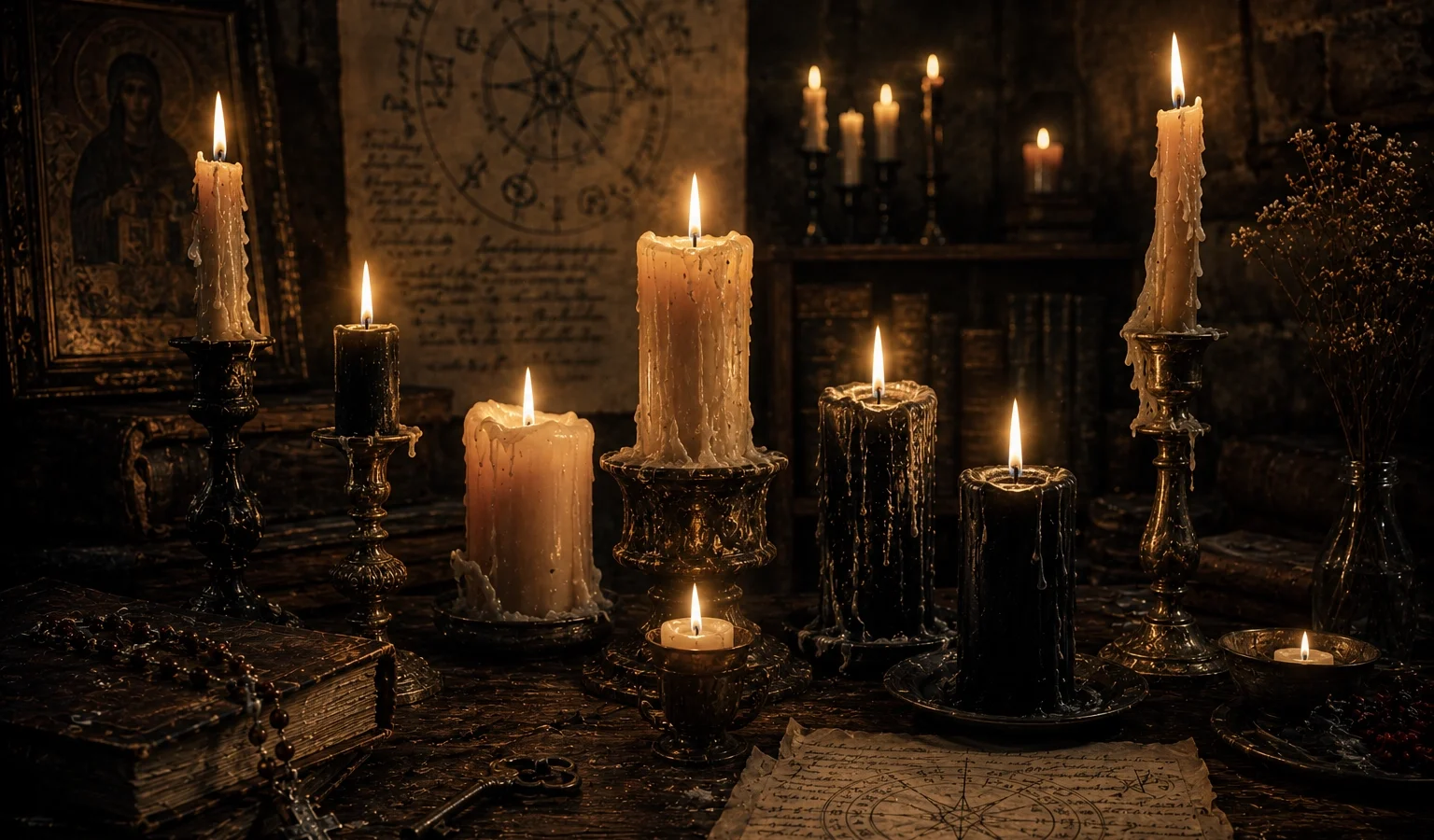
A candle is one of the smallest objects capable of changing a room.
It does not need to be large. It does not need to be rare. A single flame placed on a table alters the distance between objects. It gives old wood a warmer depth. It makes the edge of a book visible while allowing the rest of the room to remain partially hidden. It creates a circle of attention and leaves everything beyond that circle to shadow.
Perhaps this is why human beings have carried flame into so many meaningful moments.
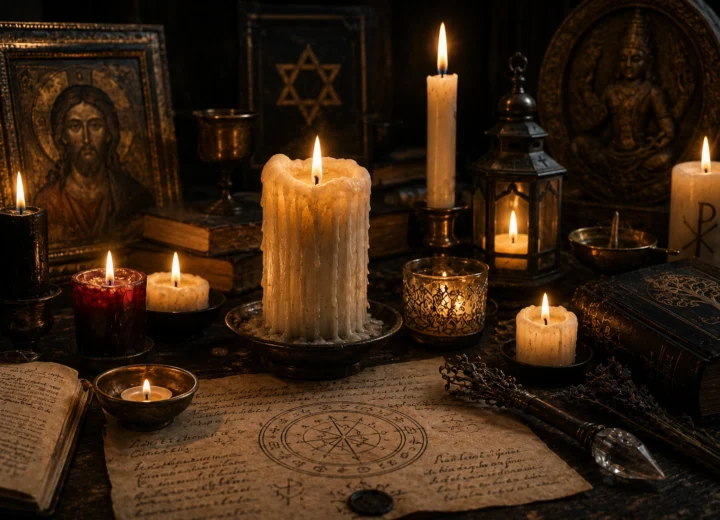
A candle may stand beside prayer, mourning, birth, illness, marriage, remembrance, vigil, study, hospitality, departure, and return. It may burn in a church, beside a household table, near a grave, in a quiet room after difficult news, or at the beginning of a private ritual whose meaning belongs only to the person who lights it.
The history of candle rituals is not a single secret lineage. It is older, wider, and more complicated than that. Candles did not emerge as ready-made mystical tools carrying one universal meaning. They began as practical sources of light. Different cultures developed different forms of ritual illumination: candles, rushlights, oil lamps, butter lamps, ghee lamps, torches, hearth fires, and ceremonial flames. Over time, necessity and symbolism moved closer together.
Light became more than illumination.
It became presence.
A flame marked the place where ordinary time changed texture. It could signal that prayer had begun, that the dead were being remembered, that a sacred day was arriving, that a threshold had been crossed, or that someone wished to remain attentive for a little longer than darkness usually allowed.
This is the forgotten history behind candle rituals: not a history of theatrical magic, but a long human attempt to give visible form to attention.
A candle does not defeat darkness. It teaches the eye how to remain present inside it.
Before the Candle, There Was the Human Need for Light
Fire is older than the candle.
This sounds obvious, but it matters. The symbolic history of ritual flame cannot be reduced to the history of wax and wick. Long before modern candles existed, human beings gathered around fire for warmth, safety, food, orientation, protection, ceremony, and social life. Fire separated the inhabited circle from the unknown dark beyond it.
The earliest candle-like devices were practical. Britannica notes that objects resembling candlesticks are known from ancient Egypt and Crete from at least the third millennium BCE. Ancient Egyptian rushlights were made by soaking the pith of reeds in melted animal fat, although they lacked the wick structure of a true candle. Romans later developed wicked candles by dipping rolled papyrus in tallow or beeswax.
These distinctions matter because history becomes weaker when every ancient light is casually called a candle. An oil lamp is not a wax candle. A ritual fire is not a household taper. A rushlight is not a modern pillar candle. Yet they belong to the same larger human archive: the wish to hold flame in a form that can be carried, placed, repeated, and watched.
The candle became symbolically powerful partly because it domesticated fire without making fire harmless.
A flame could now be placed on a table, carried through a dark corridor, raised near an altar, protected by the hand, or extinguished deliberately at the end of a ceremony. Fire became smaller, but no less alive.
The Candle as a Fragile Form of Control
A candle is controlled fire.
But only partly.
The wick gives direction. The wax gives fuel. The holder gives stability. The hand chooses where the candle stands. Yet the flame still moves according to air, heat, material, and time. It bends. It gutters. It brightens. It smokes. It consumes the body that sustains it.
This is one reason candle rituals feel so emotionally precise.
The flame is ordered, but not obedient. It is fragile, but not passive. It is temporary, but not meaningless. It burns because something is being spent.
Human beings recognize themselves in such images.
A candle can become an image of life, attention, mortality, devotion, and memory because its form makes these ideas visible without explaining them too loudly. The flame rises while the candle diminishes. Light appears through consumption. Presence contains its own ending.
No complicated doctrine is required to understand this.
The eye already knows.
From Household Necessity to Ritual Meaning
For most of history, a candle was not primarily an atmospheric object.
It was useful.
It allowed work to continue after sunset. It made reading possible. It helped people move through rooms, prepare food, care for the sick, watch beside the dead, pray in darkness, and gather after the day’s labor had ended. Before electric light, flame belonged to ordinary survival.
This ordinary function gave candlelight emotional weight.
A candle was expensive enough to matter. It burned for a limited time. It required preparation. It had to be protected from wind. It could not illuminate every corner. A room lit by candles taught people to live with partial visibility.
The symbolic meaning did not arrive from nowhere. It grew from use.
To light a candle meant that attention had been chosen. Something was important enough to receive fuel, time, and care. A prayer, a task, a bedside vigil, a manuscript, a meal, a conversation, a body awaiting burial, a traveler expected home.
This is the deeper origin of many candle rituals.
The flame was not decorative.
It was a decision to keep watch.
Wax, Tallow, and the Social Life of Flame
Not all candles were equal.
Materials mattered. Tallow candles, made from rendered animal fat, were common and practical, but they could smoke, drip, and smell unpleasant. Beeswax candles generally burned more cleanly and became closely associated with religious ceremony, wealth, and spaces where a clearer flame was valued.
In medieval Europe, wax candles were costly enough that their use carried social meaning. A bright beeswax candle in a church or wealthy household did not only provide better light. It revealed access to material, labor, and privilege. The candle could become both sacred object and status object.
| Material or Form | Historical Use | Symbolic Atmosphere |
|---|---|---|
| Rushlight | Simple domestic illumination made from reed pith and fat | Survival, poverty, practical endurance |
| Tallow candle | Affordable household light made from animal fat | Ordinary labor, domestic necessity, limited means |
| Beeswax candle | Cleaner-burning and often more costly ceremonial or elite light | Purity, devotion, dignity, sacred attention |
| Oil or ghee lamp | Ritual and domestic illumination across many traditions | Offering, continuity, knowledge, presence |
| Modern paraffin candle | Accessible domestic, decorative, memorial, and ceremonial use | Atmosphere, remembrance, personal ritual |
This table is not a hierarchy of spiritual value. A costly candle is not more meaningful than a simple one. The point is historical: material conditions shaped the way flame entered ritual life.
A candle always belonged to the economy of the household as well as the imagination of the sacred.
Christian Candle Rituals and the Language of Light
Christian traditions developed some of the most visible candle rituals in European cultural memory.
Candles appear around altars, processions, vigils, prayer, baptism, funerals, Easter observance, memorial practices, and private devotion. Their meanings vary according to context. A candle can symbolize Christ as light, the life of faith, remembrance, prayer, watchfulness, resurrection, or the presence of worship.
One of the clearest examples appears in baptism. The Catholic Catechism explains that a candle lit from the Easter candle signifies that the newly baptized person has been enlightened by Christ and is called to become “the light of the world.”
This is a precise ritual image.
The flame is received, not invented. It passes from one candle to another without diminishing the first. Light becomes continuity. The ritual does not merely speak about transformation. It makes transformation visible through transfer.
The Easter candle carries another layer. It belongs to the movement from darkness toward light, death toward resurrection, waiting toward proclamation. A church darkened before the entrance of flame is not merely theatrical. It allows the body to experience the difference between absence and arrival.
In this Christian context, candle rituals are not generic atmosphere. They are part of a theological language. The candle does not mean whatever the observer wishes. It stands inside a specific tradition of symbol, scripture, worship, and community memory.
Jewish Candle Rituals and the Boundaries of Sacred Time
In Jewish practice, candles often mark the architecture of time.
Shabbat candles are lit on Friday evening and on the eve of Jewish holidays. Their light belongs to peace, sanctity, domestic gathering, and the arrival of sacred time within the home. The gesture is not merely decorative. It marks a change in the quality of the evening.
Havdalah, performed at the end of Shabbat, creates another kind of threshold. The Hebrew word refers to separation: the distinction between the sacred day and the ordinary week that follows. The ritual includes wine, fragrant spices, and a braided candle or flame. Chabad describes Havdalah as a multi-sensory ceremony engaging speech, hearing, sight, smell, and taste while marking the boundary between sacred and everyday time.
This gives candlelight a different symbolic function.
The flame is not only hope or remembrance. It is discernment. It helps mark division: one period ending, another beginning. The candle belongs to the intelligence of the threshold.
This is one reason flame appears so often in rituals of transition. Human beings need help noticing when time has changed. A calendar date is not always enough. The body requires gesture, scent, speech, food, and light.
Ritual makes the invisible border visible.
Lamps, Diyas, and the Wider History of Sacred Light
The history of candle rituals should not become narrowly European.
Many traditions use other forms of flame: oil lamps, ghee lamps, butter lamps, temple lamps, festival lights, and continuously burning flames. These objects are not interchangeable with candles, but they reveal a broader symbolic pattern.
In Hindu worship, the diya is a small lamp that plays an important role in domestic and temple practice. Britannica notes that diyas are lit during puja and during arti, a ceremonial offering of light in which a flame is moved before an image of a deity. The lamp is connected with knowledge, purity, blessing, and the dispelling of ignorance.
Britannica’s discussion of ceremonial objects also points to lights surrounding sacred places in Buddhist festival contexts and to perpetually burning lamps in Buddhist Japan. These traditions remind us that human beings have repeatedly connected flame with continuity, presence, teaching, reverence, and the wish for attention to outlast the individual moment.
This broader context matters.
A candle is one member of a larger family of ritual lights.
The forms differ.
The cultures differ.
The theological meanings differ.
But the flame repeatedly becomes a way to make invisible values visible without reducing them to explanation.
The Candle Beside the Dead
Death changes the meaning of light.
A candle beside the dead does not function like a candle at dinner. The same object enters another emotional order. It becomes vigil, witness, memory, farewell, prayer, and the refusal to let absence pass unnoticed.
This is one of the oldest human uses of ritual light: to remain near what cannot be repaired.
The flame does not bring the dead back. It does not solve grief. It does not make loss gentle. Its power lies in a quieter gesture. It stays.
A candle may burn beside a photograph, a grave, a memorial, a place of disaster, a church altar, or an empty chair. It marks attention after speech has become inadequate. It gives the hand something to do when no action can reverse what has happened.
This is why candlelight vigils remain powerful even in secular public life. People gather with small flames after tragedy, violence, loss, and collective grief because the candle creates a visible community of witnesses. One flame is fragile. Hundreds of flames become a shared refusal to forget.
A memorial candle does not claim to conquer death. It simply refuses to leave grief alone in the dark.
Candlelight and the Ritual of Waiting
Not every candle ritual belongs to formal religion.
Some belong to waiting.
A candle is lit while someone is ill. A flame burns beside a window when a traveler is expected. A small light remains on during a difficult night. A person lights a candle before opening a letter, beginning a piece of work, writing in a journal, or sitting with a question that cannot yet be answered.
Such gestures are easy to dismiss because they may not belong to an official ceremony. Yet they reveal the same human impulse found in older traditions: the wish to give form to attention.
Waiting is difficult because it has no clear shape. It is time without resolution. A candle gives waiting a visible rhythm. The flame changes slowly. Wax descends. The room remains quiet. Time is allowed to pass without pretending that the outcome can be forced.
In this sense, candle rituals may be understood as modest architectures of uncertainty.
They do not command the future.
They give the present somewhere to stand.
The Candle as Prayer Without Continuous Speech
There is a reason candles are often left burning after the person who lit them has stepped away.
The candle seems to continue the gesture.
Britannica’s discussion of ceremonial objects describes the idea of permanent prayer through objects, including candles lit in churches and perpetually burning lamps in Buddhist contexts. The phrase is useful because it captures something human beings have long understood intuitively: an object can carry attention beyond the duration of spoken words.
This does not mean the candle possesses intention of its own.
It means the object becomes a material extension of the act.
The hand lights.
The person leaves.
The flame remains.
This continuation can feel deeply moving. Human attention is limited. No one can remain awake forever. No one can speak endlessly. No one can keep watch without rest. The candle becomes a small representative of endurance.
It burns where language pauses.
The Forgotten Difference Between Ritual and Decoration
Modern culture loves candles.
They appear in restaurants, bathrooms, bedrooms, product photography, seasonal displays, luxury interiors, social media images, meditation corners, and dark academic compositions. Their atmosphere is immediate. A candle makes almost any room feel more intentional.
But atmosphere is not yet ritual.
A decorative candle changes the mood of a space. A ritual candle changes the manner in which the person enters the moment. The material object may be identical. The difference lies in attention, repetition, context, and meaning.
This distinction matters for Lucifer Heritage.
A candle should not be treated as a cheap occult accessory. It should not be placed into an image merely because flame looks mysterious. It should not be sold with exaggerated promises. A candle does not automatically create protection, healing, transformation, love, wealth, or certainty.
The deeper symbolic value is more honest.
A candle can mark an intention.
It can gather attention.
It can create a threshold.
It can accompany remembrance.
It can slow a room down enough for thought to become audible.
That is already enough.
Candle Rituals and the Temptation of False History
Candle rituals are often surrounded by claims of ancient continuity.
A modern practice may be described as though it passed unchanged through thousands of years. Color correspondences, candle spells, wax readings, intention practices, and personal ceremonies may be presented as if they all belong to one universal tradition with a single origin.
History is rarely so neat.
Different communities used candles and lamps for different reasons. Religious traditions developed their own meanings. Household necessity shaped practice. Folk customs changed across regions. Later esoteric systems borrowed, adapted, combined, and reinvented earlier symbols.
This does not make modern personal ritual meaningless.
It makes honesty more important.
A person may light a candle during reflection, mourning, journaling, meditation, or private symbolic practice without pretending the gesture belongs to an unbroken ancient mystery school. Meaning does not become weaker when false history is removed.
Often, it becomes clearer.
The flame does not require an invented lineage.
It already carries enough history.
The Candle in Folk Practice and Private Ritual
Outside formal religious settings, candles have also entered folk customs, domestic observances, seasonal traditions, personal memorials, and later esoteric practices.
These forms vary widely. Some are inherited within families or local communities. Some belong to specific religious-cultural mixtures. Some emerged through modern occult publishing, spiritual movements, or contemporary personal ritual culture. Some are simply quiet habits developed by individuals during difficult periods.
Lucifer Heritage should approach these practices with restraint.
A candle may become part of a personal ritual without being treated as a supernatural machine. It may hold a sentence, a memory, a threshold, a hope, a farewell, or an intention to remain attentive. The symbolic value comes from the relationship between person, object, gesture, and moment.
Not every flame needs to promise an outcome.
Sometimes the ritual is meaningful because it refuses to make such a promise.
The candle does not say: the future will obey.
It says: this moment will not be passed through carelessly.
The Meaning of Extinguishing the Flame
Lighting is only half of the ritual.
Extinguishing matters too.
A candle does not need to burn forever to carry meaning. In many settings, the end of the flame marks closure: a prayer completed, a vigil paused, a period of reflection ended, a threshold crossed, a sacred interval returned to ordinary time.
This is important because ritual should not become an endless emotional chamber.
A beginning deserves attention.
An ending deserves form.
To extinguish a candle deliberately can be a small act of acceptance. The flame goes out. Smoke rises briefly. The room changes again. The object remains, but the atmosphere loosens.
There is wisdom in this.
Human beings cannot remain permanently inside heightened symbolic attention. They must return to ordinary life: food, sleep, work, family, daylight, errands, conversation. A healthy ritual creates a threshold and then allows the person to cross back.
The candle teaches both presence and release.
A Quiet Method for Using a Candle Symbolically
A meaningful candle ritual does not need complicated instructions.
It does not require theatrical language, expensive tools, rigid correspondences, or exaggerated spiritual claims. The purpose is not to command the invisible. The purpose is to give one moment a clearer boundary.
A simple method may look like this:
- Choose the reason for lighting the candle: remembrance, reflection, grief, study, gratitude, waiting, or the beginning of a difficult conversation with yourself.
- Place the candle safely on a stable, heat-resistant surface away from drafts, children, animals, paper, cloth, and anything flammable.
- Keep the meaning precise. One flame does not need to carry every hope at once.
- Allow a few quiet minutes before reaching for a phone, book, or distraction.
- Notice what changes in the room and what changes in your attention.
- Extinguish the candle safely when the moment is complete. Never leave a burning candle unattended.
This is not a spell for controlling reality.
It is a practice of presence.
The flame gives the mind something simple enough to watch and alive enough not to become empty.
When Candle Rituals Become Too Easy
The candle is one of the easiest symbols to misuse.
It is beautiful. It photographs well. It instantly suggests mystery, intimacy, ritual, romance, memory, and darkness. For this reason, it can become visual shorthand: a candle is added whenever a scene needs to feel spiritual.
But a symbol repeated without thought becomes decoration.
Cheap candle imagery treats the flame as an occult costume. It piles candles around every object, every room, every product, every page, until the flame loses its gravity. The symbol becomes louder and therefore weaker.
A more restrained approach is stronger.
One candle may carry more weight than twenty.
A flame beside an old book may mean attention.
A flame beside a photograph may mean remembrance.
A flame near a doorway may mean threshold.
A flame in a dark room may mean nothing more theatrical than the decision to remain awake with a difficult thought.
The candle should earn its place.
Symbolic Observations ✦
- Candle rituals developed from the practical human need to hold and carry flame.
- A candle is controlled fire, but never completely obedient fire.
- The flame often symbolizes presence because it is visible, fragile, and temporary.
- Wax and wick give attention a material form.
- Religious candle rituals carry meanings specific to their traditions and should not be flattened into one generic system.
- Shabbat and Havdalah candles show how light can mark sacred time and the return to ordinary time.
- Christian baptismal and Easter candles show how flame can represent continuity, illumination, and passage from darkness into light.
- Diyas, oil lamps, and other sacred lights belong to a wider ritual history that should not be casually reduced to candles.
- A memorial candle becomes a witness when language is no longer enough.
- A candle used symbolically should deepen attention rather than promise control over the future.
The Candle as a Small Archive
A candle keeps time differently from a clock.
A clock measures duration through numbers. A candle measures duration through disappearance. It becomes shorter while the room remains illuminated. It gives light by becoming less of itself.
This is why candlelight feels archival.
A half-burned candle carries evidence that attention once gathered nearby. Wax hardened along the side. A darkened wick. A small pool where the flame stood. A holder marked by use. These are modest traces, but they belong to the same family as marginal notes, worn book covers, faded photographs, and objects kept after grief.
The candle becomes a record of presence.
Someone sat here.
Someone waited.
Someone prayed.
Someone read.
Someone remembered.
Someone needed the darkness to become a little more habitable.
The Flame That Still Matters
Candle rituals endure because the candle continues to express something electric light cannot fully replace.
Electric light is more useful. It is safer when properly installed, brighter, cleaner, and easier to control. It allows an entire room to become visible at once. Modern life depends on it.
But a candle does something else.
It does not abolish darkness.
It enters into a relationship with darkness.
It illuminates selectively. It creates a center. It asks the eye to slow down. It makes the surrounding shadow visible as shadow. It reminds the room that light can be local, fragile, temporary, and still sufficient.
This is why the candle remains present in worship, mourning, celebration, remembrance, private reflection, and symbolic culture. Human beings do not use candles only because they need to see.
They use candles because they need to notice.
The Light That Refuses to Become Loud
The forgotten history of candle rituals is not the story of a magical object promising control.
It is the story of human beings bringing a small flame into moments that required attention.
Prayer.
Waiting.
Mourning.
Return.
Beginning.
Departure.
Study.
Memory.
The candle survived because it never needed to overpower the room. Its meaning lies in proportion. A small flame answers a large darkness without pretending to eliminate it.
This is its dignity.
A candle does not announce itself like lightning.
It does not make promises on behalf of the future.
It does not turn uncertainty into spectacle.
It stands on the table.
The wax descends slowly.
The room gathers around the light.
And for a little while, the human being remains near what matters without asking the flame to explain everything.
Related Symbolic Essays
Why Humans Create Rituals During Times of Uncertainty
A reflective exploration of repeated gestures, fear, order, and the human need to create form when the future is unclear.
Why Humans Attach Meaning to Ritual Objects
A calm study of objects, memory, touch, protection, identity, and the need to give invisible experience a material anchor.
The Candle as a Symbol of Memory and Witness
A deeper symbolic essay on vigil, grief, attention, fragile light, and the quiet dignity of a flame that does not overpower darkness.
The Symbolism of Silence in the World of Lucifer Heritage
A cornerstone reflection on restraint, atmosphere, memory, and the refusal to turn symbolic culture into loud occult spectacle.
Why Darkness Is Not Always Evil
A reflective essay on shadow, secrecy, night, depth, and the symbolic difference between darkness and harm.
Continue Through the Archive
- Why Humans Create Rituals During Times of Uncertainty
A reflective exploration of repeated gestures, fear, order, and the human need to create form when the future is unclear. - Why Humans Attach Meaning to Ritual Objects
A calm study of objects, memory, touch, protection, identity, and the need to give invisible experience a material anchor. - The Symbolism of Silence in the World of Lucifer Heritage
A cornerstone reflection on restraint, atmosphere, memory, and the refusal to turn symbolic culture into loud occult spectacle. - Why the Moon Became a Symbol of Transformation
A symbolic essay on cycles, disappearance, return, partial light, and the quiet rhythm of inner change.
Further Reading & Sources
- Encyclopaedia Britannica — Candle
A historical overview of candles, early rushlights, Roman wicked candles, wax, tallow, and later developments. - Encyclopaedia Britannica — Wax
Background on beeswax, paraffin, and the ceremonial use of wax candles. - Encyclopaedia Britannica — Ceremonial Object: Other Ritual Objects
A reference on candles, perpetual lamps, and the idea of continuing prayer through material objects. - Encyclopaedia Britannica — Ceremonial Objects and Ritual Light
Context for ceremonial lights and lamps in sacred settings, including Buddhist festival practice. - Encyclopaedia Britannica — Diya
A concise guide to the Hindu ritual lamp used in domestic and temple worship and in the offering of light. - Vatican — Catechism: How Is the Sacrament of Baptism Celebrated?
An official Catholic source explaining the baptismal candle lit from the Easter candle and its symbolism. - Chabad.org — Shabbat Candle Lighting
A Jewish source explaining the lighting of Shabbat candles on Friday evening and before holidays. - Chabad.org — Havdalah Blessings and Instructions
An explanation of Havdalah as a multi-sensory ceremony marking the boundary between sacred and ordinary time. - The Metropolitan Museum of Art — European Candlestick, 15th–16th Century
A museum object illustrating the material culture of candlelight in late medieval and early modern Europe. - Library of Congress — American Folklife Center Collections
Folklore and cultural memory collections useful for studying domestic customs, ritual practices, vigils, and inherited traditions.