May 23, 2026
The Symbolism of Ravens Across Different Traditions
Raven symbolism reveals why this dark bird became a sign of memory, death, wisdom, trickster intelligence, prophecy, and threshold across traditions.
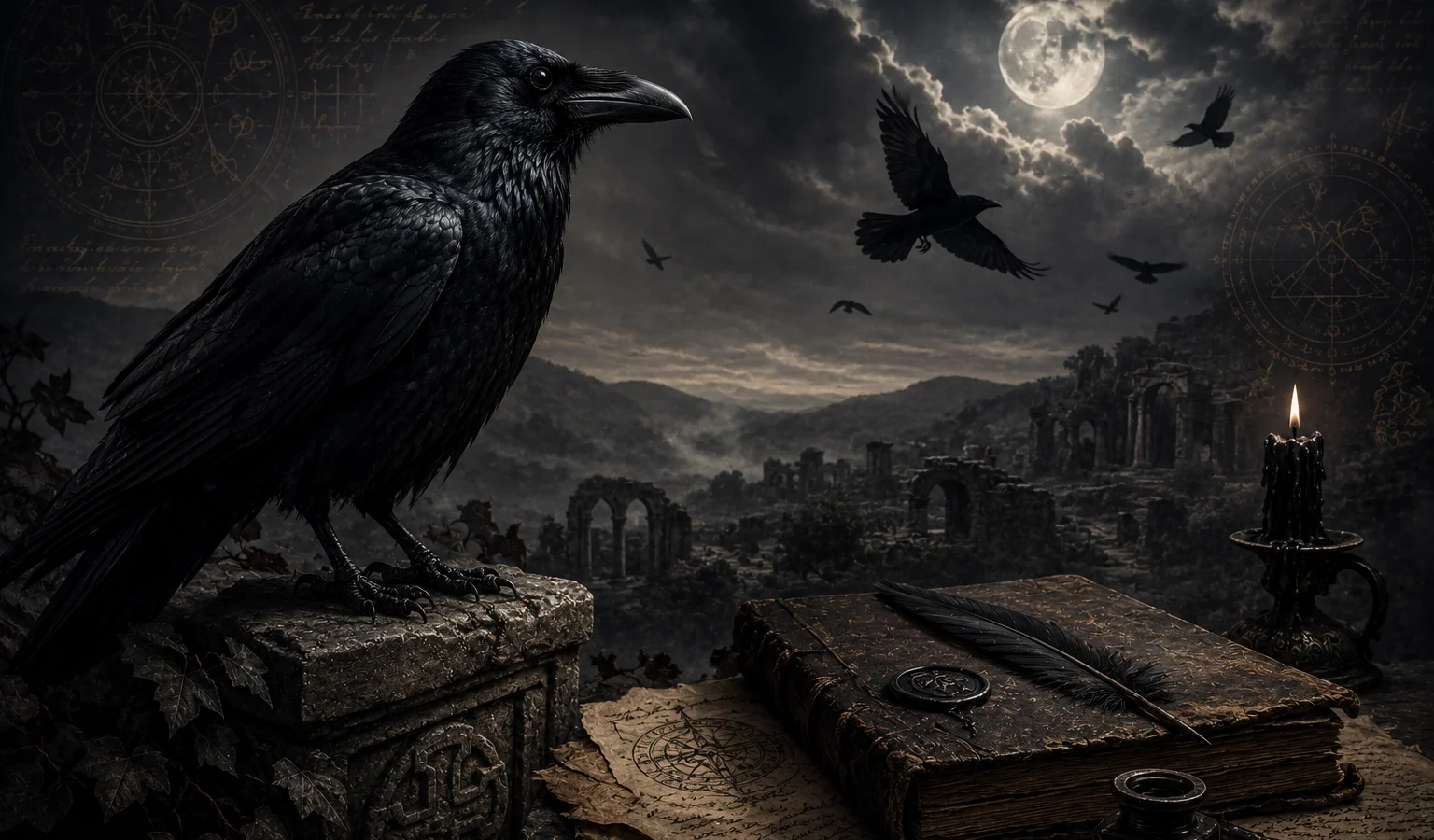
A raven is never only a bird in the human imagination.
It may stand on a branch, cross a winter field, circle above a battlefield, call from the edge of a forest, or appear suddenly against a pale sky. Biologically, it is a corvid: intelligent, adaptable, black-feathered, watchful, and capable of living close to both wilderness and human settlement. Symbolically, it is much harder to contain.
The raven has become messenger, trickster, omen, witness, thief of light, keeper of memory, companion of gods, eater of the dead, guardian of thresholds, and voice from the margins of ordinary life.
This is why raven symbolism appears across so many different traditions. The bird carries several qualities that make it unusually available to symbolic thought. It is black without being invisible. It feeds near death without belonging only to death. It is intelligent enough to seem intentional. It moves between forests, fields, settlements, battlefields, cliffs, ruins, and roads. It makes a voice that is not song in the gentle sense, but a rough utterance that sounds almost like speech before meaning.
Human beings have always noticed such creatures.
The raven enters stories because it stands where categories become unstable: between life and death, speech and cry, wildness and intelligence, destruction and survival, darkness and revelation. It does not offer a simple meaning. That is precisely why it endures.
To study the symbolic raven is not to claim one universal interpretation. Different cultures have given the raven very different roles. In some stories, it brings light. In others, it foretells death. In some, it serves a god of wisdom. In others, it unsettles the moral order through trickery, hunger, and transformation.
The raven remains powerful because it refuses to become harmless.
The raven is a dark bird not because it hides meaning, but because it carries too many meanings for daylight to simplify.
Why Ravens Became Symbolic Birds
Some animals become symbolic because they are beautiful. Others because they are dangerous, rare, useful, domesticated, sacred, or strange. Ravens became symbolic for a more complex reason: they seem to understand the world too well.
A raven does not behave like a decorative creature in the background of human life. It watches. It adapts. It appears near roads, fields, settlements, carcasses, camps, cliffs, and refuse. It follows opportunity. It survives in difficult places. Its intelligence is visible enough to disturb the old human habit of imagining intelligence as a human possession.
This gives the raven image its first layer: witness.
It sees what people would rather pass by. It stands near endings. It notices what is left behind. It thrives in the aftermath of human action. That alone makes it an uneasy bird. It does not need to cause death to become associated with it. It only needs to arrive where death has already spoken.
But the raven is not only a scavenger in human thought. It is also a problem-solver, a voice, a shadow in motion, a creature of memory and adaptation. This combination gives the bird a strange dignity. It belongs to ruin, but not only to ruin. It belongs to darkness, but not only to evil. It belongs to prophecy, but often without comfort.
The raven does not purify the symbol.
It complicates it.
The Raven as Messenger Between Worlds
Many traditions place ravens near the border between worlds.
This is not accidental. Birds already move between earth and sky. They cross spaces that humans cannot cross without tools, effort, or danger. A raven, with its dark body and harsh voice, becomes an especially powerful version of this messenger figure. It does not look delicate. It does not carry innocence. It carries news from places the living may fear to approach.
In traditional raven imagery, the bird often moves between the visible and invisible, the human and more-than-human, the living and the dead, the known and the forbidden. It may carry information, but the information is rarely gentle. It may announce what has happened, what will happen, or what has been hidden.
A messenger is not always kind.
Sometimes the messenger is loved because it brings hope. Sometimes feared because it brings truth. The raven belongs more often to the second order. It is the messenger that does not soften the message.
That is why the raven can appear at thresholds: before battle, after catastrophe, near graves, beside prophets, in forests, on towers, in dreams, and in stories where a character is about to learn something that cannot be unlearned.
The raven is not the answer.
It is the arrival of a question with wings.
Raven Symbolism in Norse Tradition
In Norse mythology, ravens are inseparable from Odin.
Odin’s two ravens, Huginn and Muninn, are often translated through meanings connected with thought and memory. They fly through the world and return to the god with what they have seen and heard. In this tradition, the raven is not simply a bird of darkness. It is an extension of perception.
This gives the Norse raven extraordinary philosophical depth.
Thought leaves the self and returns. Memory leaves the self and returns. Knowledge is not passive. It must travel, risk distance, gather what lies beyond the immediate field of vision, and come back altered by what it has witnessed.
The raven on Odin’s shoulder is therefore not mere decoration. It is a symbol of intelligence that moves through shadow. It suggests that wisdom is never only internal. It must send part of itself into the world, into danger, into death, into distance.
Odin is also a god of sacrifice, poetry, war, magic, kingship, and hidden knowledge. His ravens belong to that severe atmosphere. They are not comforting birds. They are instruments of awareness. They carry the price of knowing.
In a Lucifer Heritage reading, Huginn and Muninn become more than mythological companions. They become images of the mind divided into its two dark wings: the wing that seeks and the wing that remembers.
The Raven and Memory
The association between raven and memory is especially important.
Memory is not a passive archive. It circles. It returns. It appears at inconvenient moments. It feeds on what remains. It can be faithful, but it can also be cruel. It does not always bring back what we want. Sometimes it brings back what has not finished speaking.
This is why raven symbolism fits memory so well. The raven does not belong to clean nostalgia. It belongs to remembered things that still have weight.
A raven on a battlefield does not remember heroism the way a monument does. It remembers consequence. A raven above a ruined city does not remember glory the way an empire would prefer. It remembers aftermath. A raven near a grave does not sentimentalize death. It stands close to the fact of it.
Memory, like the raven, can be black-winged without being evil.
It may come to preserve, but also to disturb. It may guard the dead from erasure, but also prevent the living from pretending nothing was lost. It may return to the same branch again and again until someone looks up.
The raven is memory when memory refuses to become decorative.
Ravens in Celtic and Irish Imagination
In Celtic and Irish traditions, black birds often appear near battle, sovereignty, death, prophecy, and transformation. The Morrígan, a powerful figure in Irish mythology associated with war and fate, is frequently connected in later interpretation with crow or raven imagery, battlefield presence, and ominous transformation.
This form of black corvid symbolism is not simply about death as an ending. It is about fate made visible.
The battlefield raven is disturbing because it arrives where human intention has already turned violent. It does not create the war. It reveals what war becomes when the speeches, banners, and heroic names fall away. It shows the body beneath glory.
In this symbolic world, the raven is not only an omen. It is a witness to the price of power.
The connection between black birds and fate also matters because fate is not the same as prediction. Prediction tells what may happen. Fate suggests a pattern already closing around the living. The raven appears at the edge of that pattern, as if it has seen the end before the human actors have accepted it.
This makes the raven a deeply uncomfortable symbol. It does not flatter courage. It does not romanticize violence. It stands near the place where consequence becomes unavoidable.
The Raven as Trickster and Culture Hero
Among many Indigenous traditions of the Northwest Pacific Coast, Raven can appear as a trickster, transformer, and culture hero. It is important not to flatten these traditions into one generic meaning. Nations, stories, languages, and ceremonial contexts differ. Still, Raven often appears as a powerful figure whose hunger, wit, mischief, and transformation help shape the world of human beings.
In the Raven cycle, Raven is not morally simple.
He may be clever and foolish, creative and greedy, comic and dangerous. He may bring light, release what was hidden, cross boundaries, break rules, or create consequences through appetite. This is a very different kind of raven mythology from the European death-omen raven, though both share an interest in thresholds.
The trickster does not preserve order. The trickster exposes order by violating it.
Raven as trickster shows that creation is not always pure, solemn, or morally tidy. Light may enter the world through theft. Transformation may arise through appetite. Wisdom may arrive through foolishness. The sacred may wear a comic mask.
This makes Raven one of the most psychologically rich figures in world storytelling. He reminds us that change often enters through the side door, not the ceremonial gate.
| Tradition or Context | Raven Role | Symbolic Meaning |
|---|---|---|
| Norse mythology | Companion of Odin | Thought, memory, knowledge, surveillance, wisdom with a cost |
| Irish and Celtic imagination | Battlefield bird, omen, fate figure | War, death, sovereignty, prophecy, consequence |
| Northwest Coast traditions | Trickster and transformer | Creation, hunger, mischief, light, boundary-crossing |
| Biblical narrative | Bird sent from the ark | Testing, survival, desolation, the world after flood |
| Modern gothic literature | Voice of haunting memory | Grief, repetition, obsession, the mind unable to release |
| Natural observation | Intelligent corvid | Adaptability, watchfulness, problem-solving, uneasy kinship |
This table is not a universal code. It is a way of seeing how flexible the raven becomes. Across traditions, it does not carry one meaning. It carries a structure of meanings: intelligence, threshold, death, transformation, memory, and the dangerous gift of awareness.
The Biblical Raven and the World After Flood
In the story of Noah, the raven is sent out from the ark before the dove. It flies back and forth until the waters have dried from the earth. The dove later becomes the more widely remembered image of return, peace, and the olive leaf. The raven remains stranger.
This biblical moment gives the raven a powerful atmosphere of aftermath.
The raven is sent into a drowned world. It moves across the space between catastrophe and habitation. It belongs to the question no one on the ark can yet answer: is there still a world outside? Is the earth ready to receive the living again? What remains after judgment, flood, destruction, and waiting?
The raven does not bring back the gentle sign that later tradition attaches to the dove. Its role is less comforting. It enters the uncertainty first.
Symbolically, this matters.
The raven becomes the bird of the first reconnaissance after disaster. It does not offer innocence. It offers contact with what remains. It belongs to the harsh intelligence needed before consolation can arrive.
Sometimes the soul sends out the raven before it is ready for the dove.
The Raven and Death Without Sentimentality
Ravens have often been associated with death because of their presence near carrion, battlefields, and remains. But this association should not be reduced to horror.
Death symbolism becomes cheap when it exists only for shock. The raven carries something more serious. It stands near death without moral panic. It belongs to the ecology of endings. It reminds the human imagination that death is not only a tragedy for the living, but also part of the world’s material continuity.
This is why the symbolic raven often feels colder than symbols of mourning. A candle mourns. A grave marker remembers. A flower softens. The raven does not soften.
It acknowledges.
There is dignity in that refusal of sentimentality. The raven does not turn death into beauty too quickly. It does not make loss acceptable. It does not promise immediate transformation. It remains beside the fact.
For a symbolic world like Lucifer Heritage, this matters deeply. Darkness is not treated as evil. Death is not treated as theatrical decoration. The raven belongs to the discipline of looking without rushing to comfort.
The Raven as an Omen
An omen is not merely a sign.
A sign points. An omen changes the atmosphere. It makes the present feel watched by the future. It does not need to explain itself clearly. In fact, its force often depends on ambiguity.
The raven became an omen because it appears at meaningful edges: before battle, after death, near lonely roads, above ruins, during winter, at the boundary of settlement and wilderness. Its dark body is highly visible against snow, sky, stone, or field. Its call cuts through silence. Its arrival feels deliberate even when it is not.
This gives the raven its omen quality.
But the mature reading of an omen should avoid superstition. A raven appearing in daily life does not automatically “mean” death, warning, destiny, or spiritual instruction. Lucifer Heritage does not turn animals into commands.
The symbolic question is quieter: why does this image feel charged? What atmosphere does it awaken? What tradition of meaning has taught the human mind to pause when this bird appears?
The raven may not predict the future.
It may reveal the mood of the threshold one is already standing near.
The Raven in Gothic Literature and Modern Imagination
Modern readers often meet the raven through gothic atmosphere: old houses, winter windows, graveyards, ruined towers, black branches, obsessive memory, and voices that return when silence becomes too large.
Edgar Allan Poe’s “The Raven” has deeply shaped this modern association. The bird becomes not only a creature but a repeating voice, a figure of grief that will not leave. It perches inside the room like an external form of the speaker’s own inability to escape memory.
This modern raven image is less about mythology and more about psychological haunting.
The raven is the thought that returns.
The word that will not change.
The memory that enters the room and refuses consolation.
This is one reason the raven fits so naturally into dark academic and symbolic writing. It belongs to libraries, letters, portraits, winter light, grief, repetition, and the mind’s long conversation with what it has lost.
The raven is not merely outside the window.
It is already inside the mind.
Black Feathers and the Meaning of Darkness
The raven’s blackness is one of the reasons it became such a powerful symbol.
Black is not a simple color in symbolic language. It can suggest death, secrecy, elegance, authority, mourning, hiddenness, night, ink, soil, mystery, protection, or the unknown. The raven gathers many of these meanings into a living form.
Its feathers do not look empty. In the right light, they contain blue, violet, green, and metallic depth. This matters symbolically. The raven is dark, but not flat. It is black in the way old ink is black, in the way deep water is black, in the way night can contain hidden color.
This gives raven symbolism its visual power. The bird appears to carry shadow as a surface. It makes darkness mobile.
That darkness has often been misunderstood as evil, but the deeper symbolic reading is more interesting. The raven’s darkness belongs to what has not yet been simplified. It is the color of secrets, not necessarily sins. The color of thresholds, not necessarily endings. The color of knowledge before it becomes safe.
The Raven as Keeper of Forbidden Knowledge
Because ravens are intelligent, watchful, and associated with gods, battlefields, ruins, and thresholds, they easily become figures of forbidden knowledge.
Forbidden knowledge is not always evil knowledge. Sometimes it is knowledge hidden because it is dangerous. Sometimes hidden because it is sacred. Sometimes because power benefits from concealment. Sometimes because the one who learns it cannot remain unchanged.
In this sense, the raven often belongs to the archive.
The raven sits above the closed book. It watches the sealed chamber. It crosses the ruined city. It appears in dreams where the dreamer is not ready to understand what they have seen. It carries the feeling that something is known, but not yet spoken.
This makes the raven a natural companion to manuscripts, old libraries, locked rooms, ritual objects, and moonlit thresholds. It does not explain the secret. It marks the place where secrecy has gathered.
To follow the raven in a story is often to approach knowledge with a cost.
Raven, Crow, and the Problem of Blurred Symbols
In symbolic traditions, ravens and crows are often blurred.
Biologically, they are not identical, though both belong to the corvid family. Ravens are generally larger, with heavier bills and different calls and flight patterns. Symbolically, however, cultures and translations often merge or overlap black corvid imagery.
This means that raven symbolism sometimes absorbs meanings that belong more broadly to black birds, crows, carrion birds, battlefield birds, or trickster corvids. This is not necessarily a mistake, but it requires caution.
A serious symbolic reading should avoid pretending that all traditions speak with one voice. The raven of Odin is not the same as Raven of Northwest Coast traditions. The biblical raven is not the same as the gothic raven. The battlefield crow of Irish myth is not the same as the intelligent bird observed by ornithologists.
Yet the overlap is still meaningful.
Across these differences, black corvids repeatedly gather around certain human concerns: death, intelligence, speech, memory, transformation, warning, hunger, and the edge between worlds.
The symbol is not universal because every culture says the same thing.
It is powerful because different cultures found the same bird impossible to ignore.
A Quiet Method for Reading Raven Symbolism
To read raven symbolism carefully, begin by resisting the urge to reduce it.
Do not immediately ask whether the raven means death, luck, wisdom, warning, or magic. Ask first where the raven appears. Symbols change according to setting.
- Is the raven alone, paired, or part of a flock?
- Is it speaking, watching, eating, flying, waiting, or returning?
- Does it appear near death, threshold, prophecy, memory, or forbidden knowledge?
- Is the raven frightening, comic, solemn, intelligent, or ambiguous?
- Does the tradition treat it as messenger, trickster, witness, companion, or omen?
- What does the raven know that the human characters do not?
- What changes after the raven appears?
This method keeps the raven alive as a symbol.
A symbol should not be flattened into a fixed answer. The raven’s power lies in its refusal to become morally simple. It can bring light and feed on death. It can serve wisdom and disturb peace. It can be sacred and unsettling, comic and grave, prophetic and hungry.
The raven belongs to the difficult intelligence of thresholds.
When Raven Symbolism Becomes Too Easy
The raven is visually dramatic, so it is easy to misuse.
A black bird on a branch can instantly create atmosphere. It can make a book cover, product image, tattoo, poem, or article look mysterious. But atmosphere without thought becomes decoration.
Cheap raven symbolism reduces the bird to darkness, death, or gothic style. It uses the raven because it looks occult, not because the symbol has been understood.
Lucifer Heritage needs the more restrained approach.
The raven should not be used as a generic “dark” accessory. It should be used when the subject requires memory, witness, threshold, intelligence, transformation, omen, or the unsentimental presence of death. The bird must earn its place in the image.
A raven on a skull is easy.
A raven as memory, thought, hunger, messenger, or witness is more difficult.
And therefore more worthy of the symbol.
Symbolic Observations ✦
- Ravens often symbolize intelligence because their behavior appears watchful, adaptive, and deliberate.
- In Norse tradition, ravens are linked with thought, memory, and Odin’s awareness of the world.
- In some Celtic and Irish contexts, black birds gather around war, fate, sovereignty, and death.
- In Northwest Coast traditions, Raven can appear as trickster, transformer, and culture hero.
- The biblical raven belongs to the atmosphere of flood, aftermath, testing, and survival.
- Gothic raven imagery often turns the bird into a voice of grief and repeated memory.
- The raven’s blackness does not simply mean evil; it suggests depth, secrecy, night, and the unknown.
- The raven is powerful because it stands near thresholds between life and death, speech and silence, knowing and not knowing.
- Raven symbolism should not be reduced to one universal meaning across all cultures.
- The strongest raven images preserve ambiguity rather than explaining the bird too quickly.
The Raven as a Living Archive
The raven carries many archives.
It carries the archive of myth, where gods send birds into the world to gather knowledge. It carries the archive of battlefield and carrion, where human violence becomes matter again. It carries the archive of trickster stories, where creation may happen through theft, hunger, and laughter. It carries the archive of scripture, where the first bird sent into the drowned world does not return with a gentle symbol of peace.
It also carries the archive of ordinary observation.
People have watched ravens for centuries because ravens watch back. They are not passive symbols invented by human beings and placed upon nature. Their real behavior has shaped their symbolic life. Intelligence, adaptability, harsh voice, black feathers, appetite, and proximity to human settlements all helped make the raven symbol possible.
This is why raven symbolism remains so enduring.
The bird has not been emptied by interpretation. It continues to appear in the world, still alive, still watchful, still refusing to become merely an emblem.
Every real raven interrupts the decorative raven.
Why the Raven Still Matters
Modern people may not live inside the same mythic systems that first gave ravens their sacred or ominous roles. Yet the bird continues to matter because the questions it carries have not vanished.
What does memory know that comfort tries to forget?
What arrives after disaster?
What speaks from the edge of death?
What kind of intelligence belongs to darkness?
What hidden thing must be stolen before light can enter?
What does the watcher see?
These are not obsolete questions. They belong to grief, history, ecology, psychology, literature, ritual, and the private symbolic life of human beings.
Raven symbolism remains powerful because it does not console too quickly. It allows the dark bird to remain dark. It allows intelligence to be unsettling. It allows death to be present without becoming spectacle. It allows memory to keep its sharp edges.
The raven still matters because not every symbol should comfort us.
Some symbols should make us more honest.
The Dark Bird at the Threshold
Across traditions, the raven returns to the threshold.
It stands between worlds, between the living and the dead, between silence and message, between destruction and creation, between hunger and wisdom, between the sacred and the comic. It does not belong entirely to one side.
This is the deeper reason raven symbolism has survived so many changes in belief.
The raven is useful wherever the human imagination needs a figure for crossing. It crosses the sky. It crosses the battlefield. It crosses the boundary between animal voice and almost-human speech. It crosses from myth into literature, from ritual into art, from death into memory.
The raven does not resolve the threshold.
It inhabits it.
That is why the bird remains so potent in symbolic storytelling. It can appear for a moment and change the temperature of the scene. It brings with it the pressure of old traditions without needing to explain them aloud.
A raven lands.
The room, road, grave, forest, or tower becomes different.
Not because the bird has delivered a simple message.
Because the threshold has become visible.
The Meaning That Refuses to Become Simple
Raven symbolism endures because the raven refuses simplicity.
It is not only death, not only wisdom, not only trickery, not only prophecy, not only darkness, not only memory. It is all of these in different arrangements, depending on the tradition, story, and emotional climate in which it appears.
This refusal is the source of its power.
The raven can stand beside Odin and become thought returning from the world. It can move through Northwest Coast stories as trickster and transformer. It can appear in biblical flood narrative as the bird of harsh reconnaissance. It can hover near Irish battlefield imagination as omen and fate. It can enter gothic poetry as the voice of grief that will not release the mind.
Each tradition changes the bird.
The bird also changes each tradition.
To read the raven well is to accept ambiguity without turning it into confusion. The raven does not ask to be solved. It asks to be approached with enough silence to notice how much it carries.
Black wing.
Rough voice.
Bright eye.
The branch bends slightly beneath its weight.
And somewhere in that stillness, the human imagination remembers that not all messengers arrive in white.
Related Symbolic Essays
Why Symbols Outlive Belief
A broader reflection on why ancient images, animals, objects, and archetypes continue to speak after their original belief systems have changed.
The Symbolism of Silence in the World of Lucifer Heritage
A cornerstone essay on quiet, restraint, memory, atmosphere, and the refusal of loud occult spectacle.
Why Forests Feel Spiritually Different at Night
A symbolic study of moonlit paths, listening, fear, humility, and the strange presence of trees after dark.
Why Humans Attach Meaning to Ritual Objects
A calm exploration of objects, memory, touch, protection, identity, and the human need to give matter symbolic weight.
Why Darkness Is Not Always Evil
A reflective essay on shadow, secrecy, night, depth, and the symbolic difference between darkness and harm.
Further Reading & Sources
- Encyclopaedia Britannica — Common Raven
A natural-history reference on the common raven, its intelligence, distribution, habitat, and behavior. - Cornell Lab of Ornithology — Common Raven
A useful overview of common raven behavior, intelligence, habitat, and relationship with human environments. - Encyclopaedia Britannica — Raven Cycle
Background on Raven trickster-transformer tales from the Northwest Pacific Coast. - The Metropolitan Museum of Art — Raven Rattle
Museum context for a Tsimshian raven rattle and its symbolic relationship to power, shamanic practice, and transformation. - World History Encyclopedia — Odin
A more detailed reference on Odin, including his ravens Huginn and Muninn as old mythical elements connected with thought and wisdom. - Encyclopaedia Britannica — Morrígan
A reference on the Irish war goddess associated with fate, battle, and later black-bird symbolism. - Bible Gateway — Genesis 8:6–12
The biblical passage in which Noah sends out the raven before the dove after the flood. - Bugnyar — Why Are Ravens Smart?
Academic discussion of raven intelligence, social cognition, and corvid behavioral research. - Library of Congress — American Folklife Center Collections
Folklore and cultural memory collections useful for studying animal symbolism, oral tradition, and inherited narrative patterns.