May 13, 2026
Repeating Numbers: Why They Appear During Change
There are periods when ordinary details begin to feel unusually precise. A clock shows 11:11 while an old memory returns. The same digits appear later on a receipt, a room number, a message timestamp, or a page. Nothing about the number proves that an outside force has arranged the moment, yet the repetition can feel difficult to ignore.
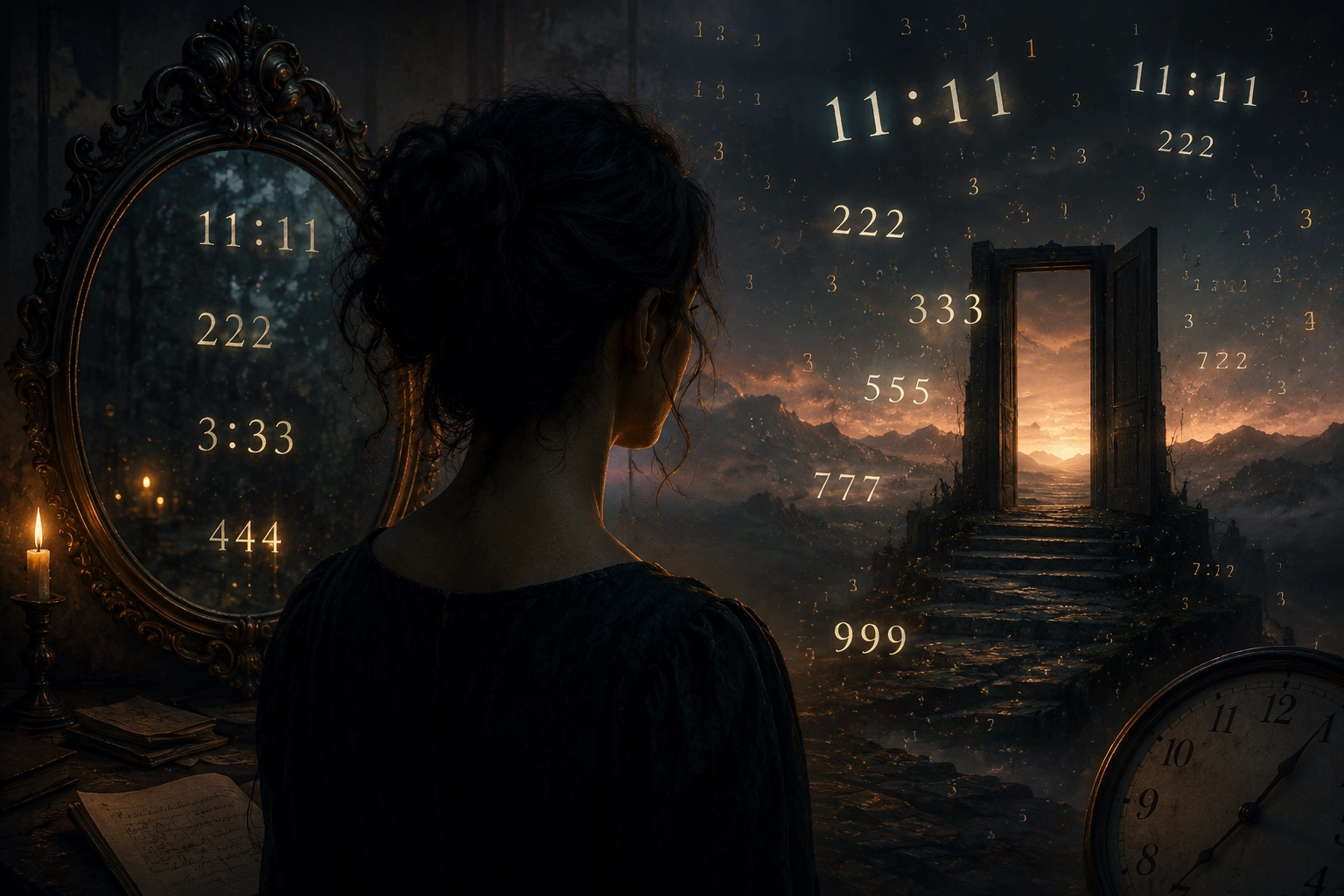
This is the territory of repeating numbers during emotional change. The interesting question is not whether every sequence is a supernatural message. The more useful question is why certain patterns become so noticeable when a person’s inner life is under pressure.
Periods of grief, uncertainty, separation, relocation, new relationships, identity change, difficult decisions, or long-delayed beginnings can sharpen attention. The mind looks for order because familiar structure has weakened. Numbers are everywhere, so they become especially available as material for that search.
Lucifer Heritage approaches repeating numbers as symbolic events of attention. A pattern may be coincidental and still become personally meaningful because of the moment in which it is noticed. Meaning does not have to come from prophecy. Sometimes it comes from the relationship between coincidence, memory, expectation, and the need for orientation.
A repeated number does not need to command the future in order to reveal something about the present.
Why Emotional Change Makes Patterns More Noticeable
Emotional change rarely arrives as a clean announcement. More often, it begins as tension. A relationship feels different before anyone names the difference. A job loses meaning before a resignation is written. A familiar home begins to feel temporary. A belief stops working long before a replacement appears.
During such periods, attention changes. Details that would normally pass unnoticed can acquire unusual weight. A phrase in a book feels exact. A song appears at the right moment. A number sequence repeats several times in one week. The experience can feel as if the outside world has become more articulate.
Psychology offers a grounded explanation for part of this effect. Attention is selective. People do not process every available detail equally. Emotion, expectation, stress, memory, and current goals influence what stands out. When a person is preoccupied with change, the mind may become more sensitive to anything that appears orderly, symmetrical, familiar, or personally associated with the situation.
This does not mean the experience is meaningless. It means that repeating numbers can become meaningful through attention rather than through supernatural certainty.
Pattern Recognition Is a Human Strength
Human beings survive by noticing patterns.
We recognize faces, recurring behavior, weather changes, danger signals, social tone, routines, and cause-and-effect relationships. Pattern recognition allows us to predict what may happen next and to organize a world that would otherwise feel chaotic.
The same capacity also produces false positives. Sometimes unrelated events look connected simply because the mind is very good at building connections.
The term apophenia is often used for the perception of meaningful links in unrelated or random information. The concept is useful here, but it should not be used carelessly as an insult. Ordinary human cognition constantly searches for structure. The important question is whether the detected pattern helps a person reflect more clearly or begins to replace evidence, judgment, and ordinary decision-making.
With repeating numbers, both possibilities can exist at once. The sequence may be random, while the act of noticing it may reveal something real about the observer’s emotional state.
Why Numbers Are Especially Good at Catching Attention
Numbers are unusually effective symbolic material because modern life places them everywhere.
They appear on clocks, phones, doors, receipts, invoices, passwords, license plates, dates, addresses, account balances, page numbers, train platforms, hotel rooms, medical forms, and digital notifications. A person can encounter hundreds of numerical combinations in a single day without consciously registering most of them.
Repetition changes that.
A random four-digit number may disappear from attention immediately. A symmetrical time such as 11:11 or 22:22 is visually distinctive. Repeated digits are easy to remember because the pattern is simple. Once the sequence becomes emotionally salient, the next appearance is easier to notice.
This is one reason repeating numbers can seem to increase during emotional periods. The environment may not contain more patterns than before. The observer may simply be detecting and remembering more of them.
Repeating Numbers as Mirrors Rather Than Commands
Popular spiritual content often assigns instructions to number sequences. One number is said to promise love, another money, another protection, another transformation. These systems can feel reassuring because they remove ambiguity quickly.
Lucifer Heritage takes a different approach.
A number is more useful as a mirror than as an order.
A mirror does not decide what a person should do. It makes something visible. Repeating numbers can work in a similar way. Instead of asking what the universe is demanding, it can be more revealing to ask what was already happening internally when the number became important.
Was there a decision being avoided? A fear of loss? A wish for reassurance? A memory connected with the digits? A hope that someone or something would confirm a difficult choice?
This approach keeps repeating numbers symbolically alive without handing authority over to them.
The Difference Between Coincidence and Personal Meaning
Coincidence and meaning are not opposites.
Two events can be objectively unrelated and still become subjectively important because of timing, memory, or emotional context. A song heard after a funeral may become permanently associated with the person who died, even if the song had no prior connection with them. A particular date may gain emotional weight because several unrelated events happened around it.
Numbers can acquire meaning in the same way.
A sequence seen repeatedly during a difficult month may later become associated with that period. The number did not have to cause the events. It became part of the memory architecture surrounding them.
This distinction matters. The symbolic question is not always, “Did the number come from somewhere else?” Sometimes the more interesting question is, “Why did this coincidence become part of my personal archive?”
Personal Numbers Carry More Weight Than Generic Charts
Some numbers are emotionally charged before repetition begins.
A birth date, death date, house number, hospital room, anniversary, school number, train platform, apartment floor, or the hour of an important phone call may already belong to memory. When such digits reappear, they can feel more intense because the sequence is connected with a specific life.
A clock showing 3:17 may be meaningless to one person and unforgettable to another. The difference is not hidden cosmic mathematics. The difference is biography.
This is why generic number charts are often less interesting than personal association. A public list may say that 444 means stability, but if 444 was once the number of a hospital room, a childhood address, or a workplace that changed someone’s life, the personal history will usually carry more emotional force.
For a serious symbolic reading, repeating numbers should begin with memory before they begin with doctrine.
Symmetry Makes Certain Sequences Feel Special
Some number patterns feel striking because they are visually ordered.
11:11 resembles four standing marks. 12:21 mirrors itself. 22:22 has repetition and symmetry. Palindromic dates and mirrored clock times are easy to recognize because the arrangement is simple and balanced.
Symmetry has long attracted human attention in art, architecture, mathematics, religious design, and nature. It creates a sense of structure. In a period of emotional uncertainty, that structure can feel especially reassuring.
The effect does not require a universal spiritual law. A symmetrical sequence may simply provide a brief visual experience of order at a time when life feels less ordered.
That alone can explain part of the emotional appeal of repeating numbers.
Why Clocks Make Repeating Numbers Feel Intimate
Clock numbers carry a special emotional charge because they appear inside time.
A repeated sequence on a receipt is static. A repeated sequence on a clock disappears almost immediately. The person sees it, and within a minute it is gone.
This gives clock patterns a threshold quality. They are noticed inside passing time, which can make them feel especially significant during periods of change, grief, waiting, or decision.
People often become more conscious of time when a life structure is changing. The end of a relationship, the approach of a move, an illness, a birthday, the beginning of a new project, or the fear of missing an opportunity can make clocks feel more personal than usual.
In that context, repeating numbers on a digital clock may function less like instructions and more like brief markers of awareness.
Memory, Grief, and Numerical Triggers
Grief can make ordinary details unusually powerful.
A date, time, room number, age, or sequence connected with the dead may become a trigger for memory. Seeing it again can produce a strong emotional reaction, even if the appearance is coincidental.
This does not make the reaction irrational. Memory works through association. A smell, place, song, object, or number can reopen an emotional pathway quickly because it has become connected with a person or event.
The important distinction is between association and proof. A repeated number can remind someone of a person who died without proving that the dead person caused the sequence to appear.
Lucifer Heritage treats this kind of repeating numbers experience with restraint. The memory deserves respect without being turned automatically into a supernatural claim.
Emotional Change Creates a Hunger for Confirmation
Major decisions are difficult partly because certainty usually arrives after the choice, not before it.
Leaving a relationship, changing work, moving to another country, beginning a creative project, ending an old identity, or returning to something abandoned can produce a strong desire for confirmation. The person wants evidence that the direction is correct.
Repeating numbers can become attractive at this point because they appear objective. The digits seem external to the person, which can make the experience feel like independent validation.
That is precisely where caution becomes important.
A symbol may help clarify a question, but it should not carry the full responsibility of the decision. The practical facts still matter. Safety, finances, consequences, relationships, health, obligations, and evidence do not disappear because a clock showed a memorable sequence.
The best use of repeating numbers is reflective. They may reveal what a person hopes is true, fears is true, or wants permission to do.
A Better Question Than “What Does This Number Mean?”
Fixed interpretation begins with the number. Reflective interpretation begins with the situation.
When a sequence becomes noticeable, several questions are more useful than searching immediately for an online meaning:
- What was I thinking about when I noticed it?
- What emotion was strongest at that moment?
- Have these digits been important in my life before?
- Am I looking for reassurance about a decision?
- What do I hope the number confirms?
- What am I afraid it might mean?
- Would I make the same decision if the number had not appeared?
- Does the pattern still feel important after a day or a week?
These questions keep symbolic attention grounded. The point is not to strip the moment of atmosphere. It is to prevent atmosphere from becoming authority.
Numbers in Myth, Religion, and Cultural Memory
Numbers have carried symbolic significance in many cultures, but the meanings are not universal.
Three, seven, twelve, forty, and other numbers recur in myth, religious texts, calendars, rituals, narrative structures, and cosmological systems. Their importance depends on tradition, history, and context. A number that is sacred in one system may be ordinary in another.
This history helps explain why modern people are ready to experience numbers symbolically. The habit is not new. Human cultures have long used numerical structure to organize stories, sacred time, architecture, music, ritual, and memory.
What has changed is the medium. Repetition that once appeared in scripture, architecture, or ritual sequence can now appear on a phone screen or digital clock.
The old symbolic reflex meets modern technology.
Why Universal Number Meanings Become Too Easy
The internet has made number symbolism extremely simple to consume.
Search a sequence and a ready-made interpretation appears immediately. The result may promise love, money, protection, awakening, reunion, destiny, or a coming transformation.
The problem is not that symbolic associations are forbidden. The problem is that fixed charts erase context. They turn the same digits into the same message for millions of people with different histories, cultures, fears, and circumstances.
This is exactly the kind of symbolic flattening Lucifer Heritage tries to avoid.
A sequence should not be treated as a vending machine for certainty. The same repeating numbers can be noticed by two people for completely different reasons.
Repeating Numbers and the Psychology of Salience
Once a pattern becomes important, it becomes easier to notice.
This effect is part of attentional salience. The mind prioritizes information that appears relevant to current goals, concerns, or expectations. A person who buys a particular car suddenly notices the same model everywhere. Someone learning a new word begins hearing it more often. A person emotionally focused on 11:11 may become more likely to look at the clock around that time and more likely to remember the occasions when the sequence appears.
The pattern can then feel as though it is pursuing the observer.
Understanding this process does not destroy the symbolic experience. It explains how attention and meaning can reinforce one another. The person notices the number, assigns importance to it, becomes more alert to it, and then experiences later appearances as increasingly significant.
With repeating numbers, awareness of this loop can make reflection calmer.
When the Pattern Becomes Part of a Personal Archive
Lucifer Heritage often treats objects and traces as archives of attention. Repeating numbers can be approached in the same way.
Instead of interpreting each appearance immediately, a person can record it. Date, place, emotional state, surrounding event, and personal association can be written down without forcing a conclusion.
After several entries, patterns may emerge that are more useful than the digits themselves.
Perhaps the number appears most often because the person checks the clock during anxiety. Perhaps it becomes noticeable after conversations with the same person. Perhaps it is connected with grief, insomnia, anticipation, or a period of intense decision-making.
The archive changes the question from “What is the number telling me?” to “What keeps happening around the moments when I notice it?”
That is a much stronger form of symbolic inquiry.
The Archive Method
| Record | What to Notice |
|---|---|
| Date and time | When did the sequence appear? |
| Place | Where were you? |
| Emotional state | What were you feeling? |
| Context | What had just happened? |
| Thought | What were you thinking about? |
| Personal association | Does the number connect with a memory, date, person, or place? |
| Action | Did the number influence a decision? |
| Later reflection | Did the moment still feel important after some time passed? |
The purpose is not to prove supernatural causation. The purpose is to preserve enough context to see whether the emotional pattern is more consistent than the numerical one.
Sometimes the most important repetition is not the number. It is the feeling beside it.
Repeating Numbers and the Desire for Order
Emotional change can make life feel shapeless.
Old routines stop working. Roles become uncertain. A familiar future disappears before another one has become believable. This can make even small forms of order feel reassuring.
Repeated digits are tiny structures. Their symmetry, recurrence, and simplicity stand out against emotional complexity. They are easy to recognize and easy to remember.
This may be one reason repeating numbers become comforting during transition. They do not solve the problem. They provide a momentary experience of form.
A pattern can feel like a handrail in an unfamiliar staircase, even when the staircase still has to be climbed by ordinary judgment.
Coincidence Without Cynicism
There are two easy extremes in discussions of signs.
One extreme declares every coincidence meaningless. The other treats every coincidence as an instruction from a hidden intelligence.
Neither is necessary.
A coincidence can remain coincidental while still becoming part of a person’s story. Human beings create meaning through memory, timing, association, culture, and reflection. That process is not fraudulent simply because the events were not causally connected.
The mature position is to preserve both levels. The outer event may be random. The inner response may still be worth understanding.
This approach allows repeating numbers to remain interesting without turning ordinary life into a coded surveillance system.
When Repeating Numbers Become Too Heavy
Symbolic attention should deepen life rather than make it smaller.
If a person begins checking clocks compulsively, delaying decisions until a preferred number appears, fearing punishment when a sequence is absent, or interpreting every ordinary event as a coded instruction, the symbolic practice has stopped being spacious.
At that point, grounding matters more than interpretation.
Step away from number charts. Stop recording every sequence. Return attention to ordinary routines, conversations, sleep, work, food, movement, and practical decisions. If the experience becomes distressing or interferes with daily life, speaking with a mental health professional can be appropriate.
There is no contradiction in appreciating symbols while refusing to be controlled by them.
Repeating Numbers, Silence, and the Space Between Answers
Repeating numbers often become powerful because they appear inside uncertainty. The same is true of silence.
In The Symbolism of Silence in the World of Lucifer Heritage, quiet is treated as a condition that changes attention rather than as proof of hidden meaning. A missing answer becomes noticeable because the person expected one.
Numbers work similarly. A repeated sequence stands out because the observer is already waiting for orientation.
Both silence and repeating numbers become more useful when they are allowed to raise questions without being forced to deliver commands.
Repeating Numbers and the Archive of Memory
The relationship between numbers and memory becomes even clearer when compared with old books and handwritten traces.
In The Mystery of Symbolic Marginal Notes in Old Books, a mark can survive after the reader who made it is gone. The symbol remains, but the original explanation may be lost.
Repeating numbers often acquire meaning in a similar way. A person remembers the sequence and the emotional moment together. Years later, the number may still carry the atmosphere even after the original situation has changed.
The number becomes a small marginal note in the archive of the self.
Repeating Numbers, Darkness, and Uncertainty
Darkness and repeating numbers share one important feature: both can become more emotionally charged when information is incomplete.
The Philosophy of Darkness section explores how reduced visibility can increase uncertainty without proving that danger exists. Repeating numbers can create a related form of uncertainty. The sequence is visible, but its meaning is not.
The mind wants to close the gap quickly.
Lucifer Heritage prefers to leave enough space for evidence, memory, and personal context to remain part of the interpretation.
Repeating Numbers and Ritual Attention
Repeated numbers sometimes become part of personal ritual. A person writes them in a journal, pauses when a certain time appears, or uses the moment to review an emotional question.
Such practices do not need to become magical. The same principle appears in The Emotional Meaning of Full Moon Rituals, where recurring celestial time is treated as a structure for reflection rather than a force that guarantees outcomes.
A repeated number can serve the same purpose. It can mark a pause.
The value lies in the quality of attention, not in the promise that reality will obey the sequence.
A Quiet Method for Reading Repeating Numbers
A grounded symbolic reading can remain simple.
- Notice the sequence without immediately searching for a universal meaning.
- Record the emotional and practical context.
- Check whether the number has a personal history.
- Ask what you want the sequence to confirm.
- Separate coincidence from decision-making responsibility.
- Look for repeated emotions rather than only repeated digits.
- Compare several observations before drawing conclusions.
- Allow the experience to remain unresolved if the evidence remains unclear.
- Do not treat fear as proof.
- Return to ordinary life after reflection.
This method protects symbolic attention from becoming superstition.
Symbolic Observations ✦
- Repeating numbers become more noticeable when attention is heightened by emotion, uncertainty, memory, or expectation.
- Pattern recognition is a normal human capacity, but it can produce false connections as well as useful ones.
- A coincidence can be objectively random and still become subjectively meaningful.
- Personal numerical associations often matter more than generic online number charts.
- Symmetry and repetition make some sequences visually memorable.
- Clock patterns feel especially intimate because they appear inside passing time.
- Numbers connected with grief or biography can act as memory triggers.
- Symbols can support reflection, but they should not carry the responsibility of major decisions.
- Recording context can reveal whether the deeper pattern is emotional rather than numerical.
- No universal chart can account for every culture, memory, or personal history.
- Symbolic attention becomes unhealthy when it produces fear, compulsion, or loss of judgment.
- The most mature reading preserves both possibilities: the number may be random, and the noticing may still matter.
The Number and the Moment
The mystery of repeating numbers is not only the sequence itself.
The deeper mystery is why a person notices a particular pattern at a particular stage of life and then carries it forward in memory.
During emotional change, the world can feel unusually responsive because the mind is unusually alert. A clock, receipt, door, page, or number plate becomes part of the inner landscape for a few seconds. The sequence may not predict what happens next. It may simply mark the moment when uncertainty became visible.
That is enough to make the experience worth examining.
There is no need to call every sequence a message. There is also no need to mock every moment of symbolic recognition. Human beings have always organized experience through pattern, story, ritual, number, memory, and association.
The better question is not whether the number controls reality.
The better question is what became easier to see when the pattern appeared.
The clock changes a minute later. The receipt is folded. The door is passed. The number disappears back into ordinary life.
What remains is attention.
Continue Through the Archive
The Symbolism of Silence in the World of Lucifer Heritage
A reflection on quiet, attention, memory, fear, and the pressure created when expected answers do not arrive.
The Mystery of Symbolic Marginal Notes in Old Books
A study of handwritten traces, private symbols, memory, former readers, and the meanings that survive after their original explanations disappear.
The Emotional Meaning of Full Moon Rituals
A grounded exploration of recurring time, reflection, emotional change, and ritual attention without promises of supernatural control.
Philosophy of Darkness
Further essays on uncertainty, partial knowledge, fear, inwardness, shadow, and the meanings people create when certainty is limited.
Why Do Certain Dreams Repeat for Years?
An exploration of repetition, memory, emotional pressure, recurring imagery, and why the mind returns to certain patterns during sleep.
Further Reading & Sources
- Encyclopaedia Britannica: Number Symbolism
A broad overview of the ways numbers have acquired symbolic, religious, philosophical, and cultural meanings across different traditions. - Encyclopaedia Britannica: Number Symbolism and Pythagoreanism
Historical context for philosophical traditions that treated numerical relationships as part of the structure of reality. - American Psychological Association: Perception and Attention
General psychological context for selective attention, perception, and the way some information becomes more salient than other information. - American Psychological Association: Stress
Background on how stress affects attention, emotion, judgment, and everyday psychological functioning. - Emotion and Perception
An academic discussion of the relationship between emotional states and perceptual processing. - Apophenia and False-Positive Pattern Detection
Research context for the human tendency to perceive patterns and meaningful connections where objective relationships may be weak or absent. - Library of Congress Folklife: Friday the Thirteenth and Number Folklore
A cultural example of how numbers accumulate symbolic meaning through folklore, repetition, historical interpretation, and popular belief. - JSTOR: The Origin of Sacred Numbers
A historical scholarly discussion of number symbolism and the development of sacred numerical associations.