May 14, 2026
Why Humans Create Rituals During Times of Uncertainty
Uncertainty changes the texture of ordinary actions. A person waiting for medical news may make tea at the same hour each morning. Someone preparing for an important conversation may arrange a desk before beginning. A family facing loss may return to the same meal, prayer, candle, song, or place because repetition gives the day a shape that fear cannot provide on its own.

These actions are not all religious, and they are not all ancient. Some are inherited from a community. Some are private habits that slowly acquire meaning. Some last only for the duration of a difficult period. What connects them is the human tendency to create pattern when the future becomes difficult to predict.
This is why rituals during uncertainty appear so often around illness, travel, mourning, examinations, performance, seasonal change, marriage, birth, departure, and other thresholds. The ritual may not control what happens next. Its first function is often more modest: it gives the present a sequence when the future has lost one.
Research on ritualized behavior supports part of this picture. Experimental and field studies have examined how anxiety, repetition, predictability, and ritual participation interact. The evidence does not show that every ritual reduces anxiety or that symbolic practice can replace treatment. It does show that patterned action can affect the way people experience uncertain situations.
A ritual cannot guarantee the outcome, but it can give the waiting a form.
Why Uncertainty Is So Difficult to Hold
Uncertainty creates a particular kind of strain because it leaves several possible futures open at once. A person may know what they fear without knowing whether it will happen, when it will happen, or whether their own actions can prevent it.
Research on anxiety has repeatedly examined this relationship between uncertainty and anticipatory distress. The problem is not always the presence of a known danger. Sometimes the lack of reliable information is what keeps attention active.
Ordinary decision-making becomes harder in such conditions. The mind checks, rehearses, predicts, imagines, and searches for something stable enough to organize the next step.
Rituals during uncertainty offer one possible response. They narrow the field for a moment. The person may not know what the doctor will say, whether the journey will be safe, or whether the interview will go well, but they can know how the next few minutes will unfold.
The candle is placed here. The words are spoken in this order. The table is set. The hands are washed. The same path is walked. The beginning and ending are recognizable.
Ritual, Habit, and Routine Are Related but Not Identical
Not every repeated action is a ritual.
A routine is often practical. It reduces effort by making familiar actions automatic. A habit may happen with little conscious attention at all. Ritual usually contains an additional layer: the action matters partly because of how it is performed, when it is performed, or what the sequence represents.
Making coffee every morning can be a routine. Preparing the same cup on the anniversary of someone who died can become a memorial ritual. Lighting a candle because the room is dark is practical. Lighting one before reading a letter from a loved person may mark the emotional importance of the moment.
The material act may be almost identical. Meaning changes the relationship to it.
This distinction helps explain why rituals during uncertainty can emerge from very ordinary behavior. A practical action may acquire symbolic weight because it is repeated at a moment when the person needs orientation.
Repetition Creates Temporary Order
Repetition reduces the number of decisions that have to be made. This is one reason rituals during uncertainty often become repetitive without becoming meaningless.
The action is already known. The sequence has already been chosen. The body does not need to invent the next gesture while the mind is occupied with an uncertain outcome.
Research by Jan Krátký, Martin Lang, and colleagues found that induced anxiety was associated with more repetitive, rigid, and redundant patterns of hand movement. The study did not prove that people consciously invent rituals whenever they are anxious. It showed that anxiety itself can influence the structure of behavior.
Later work by Lang and colleagues examined predictable behavioral patterns and anxiety dynamics. The results add nuance to the common claim that repetition is automatically calming. Predictability, timing, and the way a sequence is experienced all matter.
This is important for Lucifer Heritage because rituals during uncertainty should not be romanticized as universal medicine. Their psychological value depends on context, expectation, flexibility, and the person performing them.
What Ritual Can Change When the Outcome Cannot Be Changed
A ritual does not need to alter the external world in order to alter the experience of a moment. The value of rituals during uncertainty can lie in changing how the interval is carried rather than changing the result itself.
A person before surgery cannot guarantee the result by repeating a prayer or touching a familiar object. A performer cannot guarantee applause through a backstage gesture. A family cannot reverse death by gathering around a memorial table.
Yet these actions can change attention, posture, social connection, pacing, and the sense of entering or leaving an important interval.
In a field study of Marathi Hindu ritual practice in Mauritius, Martin Lang, Jan Krátký, and Dimitris Xygalatas found lower self-reported anxiety after ritual participation and lower physiological anxiety in the ritual group. The result belongs to a particular setting and should not be universalized, but it demonstrates that ritual behavior can interact measurably with anxiety.
Another experimental study found that ritualized action reduced neural response to performance failure. Again, this is not evidence that ritual guarantees success. It suggests that ritual may influence how a person processes an uncertain or threatening outcome.
The Ritual Before the Result
Many rituals appear at exactly the point where preparation reaches its limit.
An athlete may have trained. A student may have studied. A traveler may have checked the route. A surgeon may have prepared the procedure. A family may have done everything practically possible before waiting for news.
Then comes an interval in which action cannot force the result.
This is fertile ground for rituals during uncertainty. The ritual creates a bridge between preparation and outcome. It gives the body something deliberate to do while reality remains unresolved.
The act does not have to be dramatic. A repeated breath, a familiar object, a short prayer, a cup of tea, a written sentence, or a moment of silence can be enough to mark the transition.
Thresholds Need Visible Form
Human life contains many thresholds that are difficult because two states overlap.
A wedding marks a change in social relationship. A funeral changes the relationship between the living and the dead. A birth reorganizes family roles. A move places a person between one home and another. Initiation marks entry into a new status. Departure places someone between presence and absence.
The old state may have ended before the new state feels real.
Ritual gives this middle space form. There is an entrance, a sequence of actions, witnesses or participants, and an ending. Something that is emotionally difficult to locate in time becomes visible. Seen this way, rituals during uncertainty help people recognize a threshold before they fully understand what lies beyond it.
This is one reason rituals during uncertainty are so often associated with doors, roads, candles, water, rings, names, clothing, food, bells, and other objects or gestures that can mark a boundary.
Objects Make Invisible States Tangible
Rituals often depend on material objects because emotion is difficult to hold without form.
A ring can mark commitment. A photograph can hold memory. Water can mark washing, transition, purification, or welcome depending on tradition. A candle can mark vigil, attention, sacred time, or mourning. A bell can divide one kind of time from another.
The object does not carry one universal meaning by itself.
Lucifer Heritage explores this principle more closely in The Symbolism of Candles Across Traditions. A candle becomes symbolically powerful through material, context, gesture, repetition, and attention. The same object can accompany dinner, prayer, grief, celebration, or emergency light without becoming the same symbol in every setting.
For rituals during uncertainty, objects can give abstract pressure a stable place. The hands know what to hold even when the mind does not know what will happen.
Candlelight and the Ritual of Waiting
Candle rituals show this relationship especially clearly.
A flame changes slowly enough to make waiting visible. Wax descends. The wick darkens. The room remains partly in shadow. The person does not have to pretend that the uncertain situation has been solved.
The historical development of these practices is explored in The Forgotten History of Candle Rituals. Across different religious, domestic, and memorial settings, light has been used to mark presence, prayer, sacred time, vigil, remembrance, and transition.
The broader lesson is not that flame has one hidden power. It is that people repeatedly use physical structure to make difficult time more bearable.
Ritual Gives Time a Boundary
Uncertainty often feels endless because it has no clear edge. Many rituals during uncertainty work by giving that open period a beginning, a duration, and an ending.
A ritual can establish one. It begins at a recognizable moment and ends at another. For a short period, ordinary time is reorganized around a sequence that has been deliberately chosen.
This temporal boundary can be as important as the gesture itself.
A memorial service does not end grief, but it creates a time in which grief is allowed to become central. A family meal can mark an anniversary. A weekly religious practice can divide work from sacred time. A repeated evening practice can create a transition between a difficult day and sleep.
The article The Emotional Meaning of Full Moon Rituals examines a modern form of recurring symbolic time. Its responsible value lies in reflection and deliberate attention, not in the claim that a calendar phase can command reality.
Private Rituals That Nobody Else Sees
Not all ritual belongs to a public institution.
A person may arrange a desk before difficult work, touch a particular object before leaving home, listen to the same song on an anniversary, write a name once a year, or prepare the same meal after receiving troubling news.
These actions can accumulate meaning through repetition even when nobody else knows they exist.
Private rituals during uncertainty are especially interesting because they reveal how quickly ordinary behavior can become symbolic. The person may not describe the act as spiritual or ceremonial. The repetition simply becomes part of how a difficult period is carried.
Such practices can be comforting, neutral, or burdensome. Their value depends on whether they support life or begin to restrict it.
Shared Ritual Turns Private Uncertainty Into Collective Experience
Uncertainty can isolate. Shared ritual can reduce that isolation without pretending to remove the problem itself.
At a funeral, participants do not need to invent every gesture while grieving. At a vigil, people can stand together without producing an original response to tragedy. Seasonal and religious rituals place current participants inside a sequence that existed before them and may continue after them.
This can create continuity at a moment when individual experience feels unstable.
A ritual says, in effect, that other people know this kind of threshold. The current participants may be frightened, grieving, or uncertain, but they do not have to construct the entire emotional architecture alone.
This social dimension is one of the most important reasons rituals during uncertainty survive.
Ritual, Memory, and Inheritance
Repeated actions can outlive the beliefs that first explained them. This helps explain why rituals during uncertainty can survive even when their original theology, folklore, or family explanation has changed.
A family may continue a seasonal meal after its religious meaning has weakened. A person may light a candle on a particular date without sharing the theology of earlier generations. An inherited gesture may survive because it has become attached to family identity rather than doctrine.
This does not mean the ritual has remained unchanged. Traditions are edited by use. Meanings can shift, disappear, or be added later.
Ritual therefore acts as a form of cultural memory, but not as a perfect archive. It preserves continuity while also changing through repetition.
Why Rituals Survive After Belief Changes
Belief and practice do not always move at the same speed.
People may stop accepting a theological explanation while continuing to value the meal, candle, visit, song, silence, or gathering associated with it. The act can retain emotional usefulness because it organizes time, connects generations, or preserves memory.
This helps explain why rituals during uncertainty do not belong only to religious people. The need for visible structure can persist even when the metaphysical explanation changes.
A ritual can survive as remembrance, identity, family continuity, or personal reflection.
The Difference Between Ritual and Magical Guarantee
Ritual becomes weaker when it is sold as certainty.
A gesture may be meaningful, but that does not mean it controls weather, health, love, money, death, or the decisions of other people. The symbolic value of an action should not be confused with evidence that the action can force an external result.
This distinction is central to the editorial approach of Lucifer Heritage.
A candle can accompany grief without reversing loss. A full moon practice can create time for reflection without guaranteeing transformation. A repeated phrase can help someone concentrate without becoming a command to reality.
Rituals during uncertainty become more mature when they acknowledge the limit of control instead of disguising it.
Why False Certainty Is So Tempting
Uncertainty is uncomfortable, so systems that promise exact outcomes can become attractive.
Do this three times and the relationship will return. Light this color candle and money will arrive. Repeat these words and danger will disappear. Follow the sequence perfectly and the future will become safe.
The appeal is understandable. A guaranteed method replaces an open future with a procedure.
The problem is that symbolic life becomes manipulative when it exploits fear by promising control it cannot demonstrate. A ritual can support attention, memory, belonging, and emotional transition without making claims that exceed the evidence.
Ritual Is Not the Same as Compulsion
Repeated behavior also requires an important clinical distinction.
Obsessive-compulsive disorder involves obsessions, compulsions, or both. Compulsions can include repeated behaviors or mental acts performed in response to distress or rigid rules, and they can become time-consuming and interfere with daily life.
A cultural, religious, family, or personal ritual should not automatically be described as compulsive simply because it repeats. The function, flexibility, distress, and impact are different.
At the same time, symbolic language should not romanticize behavior that a person feels unable to resist and that causes significant suffering. When repetition becomes controlling rather than supportive, practical mental health care matters more than giving the behavior a mystical interpretation.
This boundary keeps the discussion of rituals during uncertainty responsible.
When a Helpful Ritual Becomes Too Rigid
A useful ritual usually has some flexibility.
If a candle cannot be lit, another form of reflection is possible. If a familiar route is unavailable, the day can continue. If one step is forgotten, the person does not believe disaster will follow automatically.
Rigidity changes the relationship.
A ritual becomes concerning when the person feels forced to repeat it, cannot tolerate interruption, believes catastrophe will occur if the sequence is imperfect, or loses substantial time and freedom to the behavior.
The question is no longer whether the ritual feels meaningful. The question is whether the person remains free in relation to it.
Ritual and the Need for Control
Research on uncertainty and ritual often returns to control, but control should be understood carefully.
A ritual may not create objective control over the outcome. It can create procedural control over a small part of the present. The person knows where to stand, what to say, what to hold, or when the sequence ends.
That modest form of control can matter.
In periods of uncertainty, people are often forced to distinguish between what can still be done and what must be waited for. Ritual can help mark that boundary, provided it does not pretend to erase it.
The Body Understands Sequence
Ritual is not only an intellectual idea. It is performed through the body, which is another reason rituals during uncertainty can feel more substantial than reflection alone.
Standing, kneeling, washing, lighting, touching, walking, eating, singing, carrying, writing, breathing, or remaining silent gives emotion a physical sequence. The body participates in the transition rather than merely thinking about it.
This may help explain why ritual can feel more complete than a verbal explanation alone. A person can understand intellectually that a chapter has ended while still needing a physical act to mark the ending.
Rituals during uncertainty often provide that embodied boundary.
Ritual and Silence
Many rituals contain periods when speech stops.
Silence can divide ordinary conversation from prayer, mourning, remembrance, or concentrated attention. It can also allow a group to share an experience without requiring everyone to produce the same words.
Lucifer Heritage treats silence as a symbolic condition rather than automatic proof of depth. Quiet can protect, clarify, conceal, or intensify uncertainty depending on context.
Within ritual, silence is strongest when it has a function. It may mark respect, create attention, acknowledge that language is insufficient, or establish a boundary before the next action begins.
Ritual in Sacred and Abandoned Places
Place can become part of ritual memory.
A church, shrine, cemetery, family home, kitchen table, roadside memorial, or particular landscape may carry repeated actions across years. The place becomes associated with the ritual because bodies return there under similar circumstances.
This relationship becomes especially visible when ritual stops. In The Symbolism of Abandoned Churches, architecture preserves the form of former gathering after regular worship has ended. Aisles, graveyards, windows, and thresholds remain as evidence that people once organized meaningful time around that place.
Ritual leaves traces even after the participants have gone.
A Quiet Method for Understanding Ritual
A ritual is easier to understand when interpretation begins with context rather than claims about hidden power.
- What uncertainty, transition, loss, or celebration surrounds the action?
- Who performs it, and who observes?
- Which parts repeat every time?
- Which objects or places matter?
- What marks the beginning and ending?
- Is the ritual private, communal, religious, domestic, or newly invented?
- Does it create memory, belonging, attention, calm, or a sense of control?
- How flexible is the practice if circumstances change?
- Which meanings belong to the tradition itself, and which were added later?
- Does the ritual support ordinary life, or is it beginning to control it?
These questions allow rituals during uncertainty to remain symbolically rich without requiring exaggerated claims.
A Simple Reflective Ritual Without Magical Claims
A personal ritual does not need elaborate equipment or invented ancient lineage.
For a period of waiting or change, a simple structure may be enough:
- Choose a clear purpose, such as reflection, remembrance, gratitude, or preparation.
- Select one safe object or gesture that helps mark the beginning.
- Set a limited period of time.
- Write down the question or emotion that is actually present.
- Allow a few minutes without checking messages or searching for reassurance.
- End deliberately and return to ordinary activity.
The aim is not to force an outcome. It is to stop an uncertain moment from becoming completely shapeless.
When Ritual Becomes Too Easy
Ritual is visually attractive, which makes it easy to imitate without understanding.
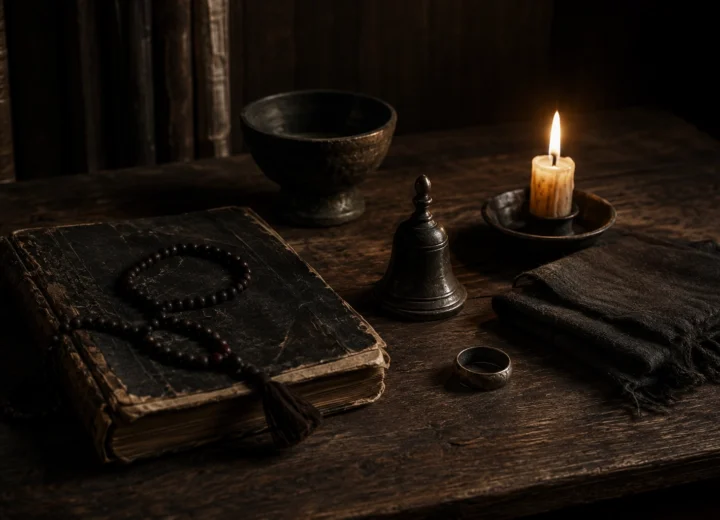
A candle, bowl, old book, dark cloth, dried plant, and a few solemn words can make almost any scene look ceremonial. Yet atmosphere alone does not create ritual.
The stronger question is what the action is doing. Is it marking grief? Creating a boundary? Preserving memory? Beginning sacred time? Gathering a community? Helping someone prepare for an event they cannot fully control?
If the answer is only that the scene looks mysterious, the ritual has become decoration.
Lucifer Heritage should keep rituals during uncertainty connected with actual human conditions rather than treating ceremonial objects as generic occult scenery.
Symbolic Observations ✦
- Uncertainty can increase the human need for predictable structure.
- Ritual differs from routine because context, attention, sequence, and meaning matter to the act.
- Research suggests that anxiety can influence repetitive and rigid behavior.
- Some ritual settings have been associated with reductions in self-reported or physiological anxiety, but the effect should not be universalized.
- Ritual can provide procedural order even when the external outcome remains uncontrollable.
- Thresholds such as birth, death, marriage, departure, and initiation often attract ritual because identity and time are changing.
- Objects gain ritual meaning through context rather than universal power.
- Shared ritual can turn private uncertainty into collective experience.
- Practices may survive after belief changes because they also carry memory and social continuity.
- Ritual should not be confused with compulsive behavior that causes distress or loss of freedom.
- A responsible ritual creates a boundary and eventually allows a return to ordinary life.
- The strongest rituals do not promise control over the future. They help people remain present while the future is still unknown.
The Small Order We Make
The deepest reason humans create rituals during uncertainty may be that uncertainty has no visible shape.
Waiting can stretch without a clear beginning or ending. Grief can make one day resemble another. A difficult decision can occupy every ordinary task. Fear can keep producing possible futures faster than the mind can resolve them.
Ritual makes a small area of that experience definite.
The object is placed. The gesture begins. The words, silence, movement, or meal follow a known sequence. Then the interval closes and ordinary time resumes.
The larger uncertainty may remain. The diagnosis is still unknown, the traveler has not returned, the result has not arrived, and the loss has not been reversed. Even so, the person has crossed one small piece of time deliberately.
That is not mastery over reality. It is a human way of refusing to let uncertainty occupy every part of the room.
Continue Through the Archive
The Forgotten History of Candle Rituals
A historical exploration of household flame, sacred time, prayer, vigil, mourning, waiting, and the long development of ritual light.
The Symbolism of Candles Across Traditions
A study of contained fire, ritual objects, memory, sacred light, attention, and the different meanings flame acquires across traditions.
The Emotional Meaning of Full Moon Rituals
A grounded reflection on recurring time, release, emotional honesty, and symbolic attention without promises of supernatural control.
The Symbolism of Abandoned Churches
An exploration of sacred architecture, former ritual, community memory, silence, decay, and the traces that remain after regular worship ends.
Rituals & Traditions
Continue through the archive of essays on ritual practice, sacred time, repetition, memory, uncertainty, and ceremonial objects.
Further Reading & Sources
- Krátký et al.: Anxiety and Ritualization
An experimental study examining how induced anxiety was associated with greater redundancy, repetitiveness, and rigidity in spontaneous hand movements. - Lang, Krátký, and Xygalatas: The Role of Ritual Behaviour in Anxiety Reduction
A field study of Marathi Hindu ritual practice in Mauritius examining self-reported and physiological measures of anxiety. - Lang et al.: Effects of Predictable Behavioral Patterns on Anxiety Dynamics
Research investigating the relationship between predictable patterned behavior and the development of anxiety over time. - Hobson et al.: Rituals Decrease the Neural Response to Performance Failure
An experimental study examining how ritualized behavior influenced neural responses after performance failure. - FeldmanHall and Shenhav: Resolving Uncertainty in a Social World
A review discussing uncertainty, social decision-making, distress, and the role predictable structures can play in uncertain conditions. - Legare and Nielsen: Ritual Explained
An interdisciplinary review of ritual behavior, its functions, development, mechanisms, and persistence across human societies. - National Institute of Mental Health: Obsessive-Compulsive Disorder
Clinical background on obsessions, compulsions, repetitive behaviors, distress, and the difference between ordinary repeated actions and OCD symptoms.