May 14, 2026
Why Tarot Archetypes Continue to Resonate Today
Tarot archetypes endure because their old images give language to change, fear, choice, loss, and the hidden patterns of modern inner life today quietly.
Why Tarot Archetypes Still Speak to the Modern Mind
Some images survive because they are beautiful.
Others survive because they are useful.
Tarot belongs to the stranger category of images that survive because they keep finding new rooms inside the human imagination. A card painted centuries ago can still unsettle a reader in a modern apartment. A crowned figure, a tower struck by lightning, a fool near the edge of a road, a woman holding a sword, a boat crossing dark water — these images do not require literal belief to create recognition.
They do not always explain themselves.
That may be part of their strength.
Tarot archetypes continue to resonate today because they offer a symbolic language for experiences that modern life often describes too narrowly. We have clinical language for anxiety, productivity language for ambition, social language for identity, and economic language for survival. Yet many of the deepest human experiences still arrive as images before they become sentences.
A person does not always feel “in transition.” They feel like they are standing before a gate. They do not always feel “emotionally overwhelmed.” They feel like a tower has cracked open. They do not always feel “ready for change.” They feel like a figure stepping onto a road without knowing where it leads.
This is where tarot archetypes remain powerful. They do not replace reason. They do not need to promise prediction. They function as old symbolic mirrors: imperfect, theatrical, sometimes severe, sometimes tender, but capable of reflecting parts of the self that ordinary language leaves untouched.
A tarot card does not have to foretell the future to reveal the present more sharply.
The Endurance of Images Older Than Their Explanations
Tarot cards have had more than one life. They have been playing cards, aristocratic objects, printed images, occult tools, artistic systems, psychological mirrors, popular icons, and cultural artifacts. Their meanings have changed across time, but their visual force has remained unusually persistent.
The modern reader often encounters tarot through divination, self-reflection, art, or symbolic study. Yet the cards did not begin as a single finished spiritual system descending from some hidden, perfect origin. Their history is more human and more interesting: layered, adapted, reinterpreted, reshaped by artists, printers, mystics, collectors, writers, and readers.
This layered history helps explain why tarot archetypes still feel alive. They are not sterile symbols invented in a laboratory. They have passed through hands. They have been shuffled, copied, repainted, argued over, misunderstood, loved, commercialized, rescued, and reimagined.
An image that survives this long becomes more than its first use.
It becomes a vessel.
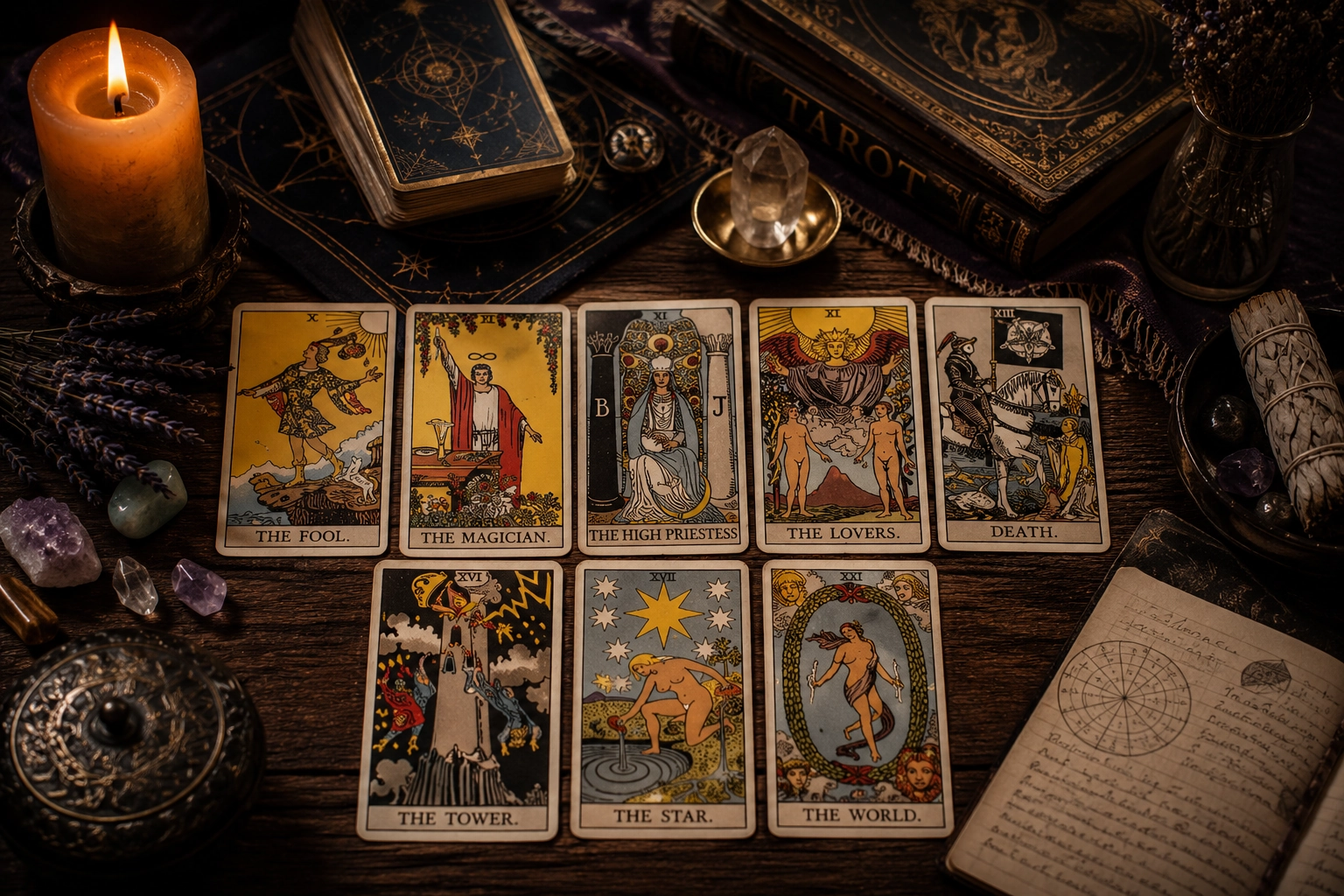
The Fool, the Magician, the High Priestess, the Hermit, the Lovers, Death, the Tower, the Star — these names now carry centuries of interpretation. Yet they also remain strangely immediate. Even before one knows the traditional meanings, the images suggest movement, secrecy, desire, solitude, crisis, release, collapse, renewal.
They work because they belong to the old grammar of human experience.
What Makes an Archetype Different from a Sign?
A sign points toward something specific. A red traffic light tells the driver to stop. A label on a bottle identifies its contents. A number on a door indicates a location. The sign is successful when it is clear and limited.
An archetype is different.
It does not point to one simple answer. It gathers a field of meaning. It can hold contradiction. It may appear personal and universal at once. It may change depending on the moment in which it is encountered.
This is why tarot archetypes are not best understood as fixed definitions. The Tower does not simply “mean disaster.” The Lovers do not simply “mean romance.” Death does not simply “mean ending.” The Hermit does not simply “mean solitude.” Each image contains a symbolic pattern large enough to include many possible situations.
| Card Image | Surface Meaning | Archetypal Field |
|---|---|---|
| The Fool | Beginning, risk, innocence | The self before experience; trust before proof |
| The Magician | Will, skill, conscious action | The human ability to shape raw possibility |
| The High Priestess | Mystery, intuition, hidden knowledge | The threshold between knowing and not knowing |
| The Lovers | Union, attraction, choice | The moment when desire becomes decision |
| Death | Ending, transformation | The dignity and terror of necessary change |
| The Tower | Collapse, rupture, revelation | The structure that fails because it was not true enough |
| The Star | Hope, restoration, quiet faith | The return of inner light after destruction |
| The World | Completion, integration | The self briefly gathered into wholeness |
This table is not a dictionary. It is an entrance.
An archetype is alive only when it meets a living person. The same card can speak differently to the grieving, the ambitious, the exhausted, the newly free, the ashamed, the lonely, the person beginning again after failure. That elasticity is not weakness. It is the reason tarot archetypes remain useful.
The Fool and the Modern Fear of Beginning
The Fool is often treated lightly, but the image is more serious than it first appears. A figure steps forward with little protection, little certainty, and often little awareness of the edge nearby. The scene can be comic, innocent, foolish, brave, or dangerous depending on how the viewer stands before it.
Modern people understand this card instinctively because modern life produces constant beginnings.
New careers. New countries. New technologies. New identities. New risks. New public selves. New forms of exposure. The modern person is often forced to begin before feeling ready, to step forward before the map is complete, to appear confident while privately carrying confusion.
The Fool does not say that every leap is wise. It does not glorify recklessness. It simply gives image to a condition everyone eventually meets: the beginning that cannot be fully prepared for.
This is one reason tarot archetypes endure. They do not describe rare mystical states. They describe ordinary human thresholds with unusual clarity.
The Fool is not only the young person. It is the older person starting again after loss. It is the immigrant at the airport. It is the artist before the first page. It is the entrepreneur before debt becomes visible. It is the lover before confession. It is anyone who discovers that certainty is not always granted before movement begins.
The Magician and the Hunger for Agency
The Magician stands before tools.
This image has always been attractive because it suggests agency. Something can be shaped. Something can be arranged. The world is not only endured; it can be addressed. The figure does not appear passive before fate. The hand, the table, the instruments, the gesture — all imply that attention and skill matter.
In modern culture, agency is often exaggerated into performance. People are told to optimize, brand, control, achieve, transform, produce. The result is not always empowerment. Sometimes it is exhaustion disguised as ambition.
The Magician remains compelling because the image offers a subtler question: what tools are actually yours, and what do you know how to do with them?
This is not the language of cheap manifestation. It is the language of craft. The card can be read as a reminder that power without discipline becomes theatre, while discipline without imagination becomes machinery.
Among tarot archetypes, the Magician speaks to the modern need to feel capable without pretending to be omnipotent. It offers a middle path between helplessness and fantasy: the recognition that human beings cannot command everything, but they can learn how to participate more consciously in what is possible.
The High Priestess and the Intelligence of the Hidden
Modern culture often rewards speed, visibility, explanation, and immediate response. The High Priestess belongs to another order of knowing.
She does not rush to disclose. She does not translate mystery into useful slogans. She is the figure of the threshold, the veil, the page not yet read, the knowledge that cannot be forced open without losing its depth.
This is why the image remains so powerful today. Many people live surrounded by information and still feel starved of understanding. They can search, measure, compare, and publish, yet the deeper questions do not become simpler. What do I truly know? What am I avoiding? What has not yet become speakable? What part of me watches silently while the public self performs competence?
The High Priestess gives form to this hidden intelligence.
She is not anti-rational. She is pre-verbal, symbolic, interior. She represents the kind of knowledge that gathers slowly, like water behind stone. Among tarot archetypes, she protects the dignity of what has not yet been explained.
In a culture that confuses visibility with truth, this image retains a quiet severity.
Not everything hidden is false. Some things are hidden because they are still becoming true.
The Lovers and the Difficulty of Choice
The Lovers is often reduced to romance, but its deeper force lies in choice. Love is present, but love is rarely only feeling. It becomes consequential when it asks for alignment: between desire and value, body and vow, freedom and attachment, self and other.
This is why the card remains modern.
Contemporary life multiplies choices while weakening the structures that once made many choices automatic. People choose careers, partners, identities, places, beliefs, communities, forms of family, public images, private loyalties. Freedom expands, but so does the anxiety of choosing wrongly.
The Lovers gives symbolic form to the moment when desire must become decision.
Among tarot archetypes, this card refuses to treat intimacy as simple sweetness. It suggests that love can reveal division as much as union. The person who chooses another may also have to choose a version of themselves. The person who refuses love may also be refusing risk. The person who enters love may be entering a mirror.
Modern people recognize this because they know that choices are rarely clean. The heart has its reasons, but the life that follows those reasons must still be lived.
Death and the Modern Discomfort with Endings
Few cards are as misunderstood as Death.
Its power comes partly from the fact that it does not soften the image. It does not replace ending with polite language. It shows the figure plainly. Something ends. Something passes. Something cannot continue in its previous form.
Modern culture often struggles with endings. It prefers reinvention, transition, upgrade, rebranding, recovery, closure. These words can be useful, but they sometimes protect the mind from the severity of loss. The Death card does not allow such protection for long.
It does not necessarily announce literal death. More often, in symbolic reading, it gives form to irreversible transformation. A role ends. A self-image ends. A relationship ends. A belief ends. A season of life ends. The person may continue, but not as before.
This is why tarot archetypes remain emotionally precise. They do not flatter the wish that everything can be kept if only one arranges life cleverly enough. Death, as an archetype, says that some doors close not because the person failed, but because life has moved beyond the form that once contained it.
The terror of this card is also its mercy. It tells the truth that endings are not always mistakes.
The Tower and the Collapse of False Structures
The Tower is not merely disaster.
It is revelation by collapse.
The image is violent because the structure is high, rigid, and suddenly broken. Lightning does not politely negotiate with architecture. The fall is terrifying because what seemed stable is exposed as vulnerable. Yet the Tower’s symbolic force does not lie only in destruction. It lies in the question of what kind of structure was standing there in the first place.
Modern people know the Tower intimately.
A career collapses. A public reputation breaks. A family truth emerges. A political system reveals its cracks. A financial structure fails. A private denial can no longer be maintained. A body forces attention. A carefully edited identity becomes impossible to continue.
Among tarot archetypes, the Tower resonates because contemporary life is full of systems that appear solid until they do not. The card gives image to the moment when reality interrupts construction.
It is not a pleasant image. But it is an honest one.
The Tower does not say that collapse is good. It says that collapse sometimes reveals the cost of building too high on what was never stable.
The Star and the Quiet After Ruin
After the Tower, the Star feels almost impossible in its gentleness.
It does not offer triumph. It does not rebuild the fallen structure overnight. It does not shout hope as a command. It places a figure beneath open sky, pouring water, exposed and calm. The image suggests restoration without spectacle.
This is why the Star remains one of the most necessary tarot archetypes for modern life. People are often told to recover quickly, return to productivity, convert pain into wisdom, and become inspirational before they have even stopped bleeding. The Star refuses that violence.
Its hope is not motivational. It is atmospheric.
It is the first quiet after catastrophe. The first breath after crying. The first morning when grief is still present but no longer fills the entire room. The first sense that life may continue without requiring the old structure to return.
The Star resonates because it represents a kind of hope that does not insult suffering. It does not erase what happened. It simply shows that after ruin, the human being may still kneel beside water and begin the slow work of returning.
Why Tarot Feels Psychological Without Becoming Psychology
Tarot has often been interpreted through psychological language, especially through ideas of archetype, shadow, persona, transformation, and individuation. This can be fruitful when done carefully. The cards often do resemble a symbolic map of inner states, conflicts, thresholds, and developmental passages.
But tarot should not be reduced too quickly into psychology.
A card is not a diagnosis. A spread is not a clinical instrument. A symbolic reading is not therapy, even if it produces reflection. The strength of tarot archetypes lies partly in their ability to remain images rather than conclusions.
Psychology often asks: what pattern is operating here?
Symbol asks: what image is carrying the pattern?
These questions can help each other. A person who feels trapped may see that feeling in the image of bondage, enclosure, repetition, or a blocked path. A person who feels divided may recognize themselves in a card of choice. A person who has lost a former identity may find the Death card severe but clarifying. The image gives the inner condition a shape that can be contemplated rather than merely endured.
This is not magic in the cheap sense.
It is the old human practice of thinking through images.
The Artistic Power of Tarot Archetypes
Tarot remains visually alive because each generation can redraw it without exhausting it.
Medieval and Renaissance imagery, Marseille decks, Rider-Waite-Smith symbolism, modern feminist decks, surrealist decks, minimalist decks, folk-art decks, digital decks, queer decks, ancestral decks, mythological decks — the structure remains recognizable while the surface changes dramatically.
This adaptability is central to the survival of tarot archetypes. They are strong enough to endure reinterpretation and flexible enough to invite it.
An archetype that cannot change becomes a museum label. An archetype that changes too easily becomes decoration. Tarot occupies the tense space between inheritance and invention. The Fool can wear old clothes or modern boots. The Tower can be a stone fortress, a corporate building, a burning city, a broken screen, or a private room. The underlying pattern remains: beginning, will, secrecy, choice, ordeal, collapse, restoration, completion.
Artists return to tarot because the cards offer an already-charged symbolic grammar. They do not begin with a blank page. They begin with images that have been waiting for another century to translate them.
In this sense, tarot is not only an occult object. It is also an archive of visual thinking.
Tarot as a Mirror, Not a Master
The most dangerous way to use tarot is to surrender responsibility to it.
When cards are treated as commands, they become smaller, not greater. A symbol that could have opened reflection becomes an authority that closes it. This is how tarot collapses into superstition, dependency, or theatrical certainty.
A more mature approach is to treat tarot as a mirror.
A mirror does not tell the face what to do. It reveals angles that cannot be seen directly. In the same way, tarot archetypes can show the emotional arrangement of a moment: where fear stands, where desire hides, where power gathers, where denial has become expensive, where a threshold has appeared.
The card does not remove choice.
It sharpens the awareness with which choice is made.
This distinction matters. Tarot is most interesting not when it pretends to replace judgment, but when it returns judgment to the reader with greater depth. The question is not “What will happen to me?” but “What pattern am I standing inside, and how am I participating in it?”
A Quiet Method for Reading Tarot Archetypes
A serious symbolic reading does not require dramatic performance. It requires attention.
Begin not with the wish to predict, but with the wish to see. Choose one card, or look at one image that keeps returning to your attention. Do not rush toward a standard meaning. Look first.
- What is the central figure doing?
- What is the atmosphere of the card?
- Where is the tension?
- What seems hidden or unfinished?
- Which part of the image feels familiar?
- Which part feels resisted?
- What situation in waking life carries the same emotional climate?
This method respects tarot archetypes as images before interpreting them as answers. The card becomes a room one enters, not a verdict one receives.
After looking, write one sentence beginning with: “This image shows me…” Then write another beginning with: “This image refuses to let me ignore…” The point is not to be mystical. The point is to become more exact.
Tarot, when read this way, becomes less about fortune and more about symbolic literacy. It trains the mind to notice images, tensions, thresholds, repetitions, and emotional climates.
Symbolic Observations ✦
- Tarot endures because its images are broad enough to meet different lives without losing their form.
- An archetype is not a fixed meaning, but a field of recurring human experience.
- The Fool speaks to beginnings before certainty.
- The Magician speaks to agency, skill, and the shaping of possibility.
- The High Priestess protects the dignity of what is not yet ready to be explained.
- The Lovers is as much about choice as romance.
- Death gives form to endings that cannot be negotiated away.
- The Tower reveals the instability of false structures.
- The Star offers restoration without denying ruin.
- Tarot is strongest when used as a mirror, not as a master.
Why Tarot Archetypes Still Belong to the Present
It may seem strange that old cards should matter in an age of algorithms, data, and constant screens. Yet perhaps this is exactly why they matter.
Modern life produces information faster than meaning. It names, measures, compares, and updates. It offers dashboards, feeds, reports, metrics, and predictions. But the symbolic life of the human being has not vanished. People still dream, fear, desire, mourn, begin, fail, recover, choose, and stand before thresholds they cannot fully explain.
Tarot archetypes remain because they answer a hunger that information does not satisfy: the hunger for images that can hold complexity without immediately reducing it.
A card can be looked at slowly.
It does not refresh. It does not demand a notification. It waits. Its silence is part of its intelligence. The viewer must bring themselves to it, and in doing so, may discover what they have been carrying without language.
This is why tarot continues to move through art, literature, psychology, fashion, cinema, personal reflection, and spiritual practice. Its images are portable thresholds. They allow modern people to encounter old questions without pretending those questions are obsolete.
Who am I when I begin?
What power do I actually possess?
What remains hidden?
What must I choose?
What must end?
What structure is failing?
What remains after ruin?
These are not medieval questions. They are human questions.
The Cards Remain Because the Patterns Remain
Tarot archetypes continue to resonate today because the patterns they hold have not disappeared.
The world has changed its instruments, but not its thresholds. People still begin without certainty. They still seek agency without full control. They still hide knowledge from themselves. They still confuse desire with choice. They still resist endings. They still build towers too high on unstable ground. They still require hope that does not lie.
Tarot survives because it gives these experiences a visible form.
Not proof.
Not command.
Not supernatural certainty.
Form.
And form matters. A fear with an image can be approached. A transition with a symbol can be contemplated. A collapse with a name can be mourned. A beginning with a figure can be entered more consciously.
The cards do not need to be believed in crudely to be taken seriously. Their seriousness lies elsewhere: in the old, difficult art of letting images think with us.
A tarot archetype is not a closed answer placed on a table.
It is a mirror in which the present briefly remembers that it belongs to a much older human story.
The card is turned.
The image waits.
And something in the modern mind, tired of explanation but still hungry for meaning, recognizes itself before it knows why.
Related Articles
The Symbolism of the Fool in Tarot
A reflective exploration of beginnings, risk, innocence, and the strange courage required before certainty appears.
Why the Tower Card Still Feels So Modern
A symbolic essay on collapse, revelation, unstable structures, and the moment when reality interrupts illusion.
The High Priestess and the Language of the Hidden
A study of secrecy, intuition, silence, and the kind of knowledge that cannot be forced into immediate speech.
Death as a Symbol of Transformation
A calm meditation on endings, necessary change, and the dignity of forms that cannot continue.
Why Symbols Outlive Belief
A broader reflection on why ancient images continue to speak even when their original systems of belief have changed.
Further Reading & Sources
- Encyclopaedia Britannica — Tarot
A concise historical reference on tarot cards, their early development, and later uses. - Encyclopaedia Britannica — Tarot Game
Background on tarot as a trick-taking card game and the structure of the tarot deck. - The Metropolitan Museum of Art — It’s in the Cards
Museum context for tarot’s visual history, including references to early decks and later artistic interpretations. - The Morgan Library & Museum — Visconti-Sforza Tarot Cards
Collection material connected with one of the most important surviving early tarot traditions. - Library of Congress — Tarot Cards
Library catalog context for tarot cards as a graphic and cultural subject. - JSTOR — Tarot as Text
A scholarly source discussing tarot, Jungian symbolism, and the interpretation of images. - JSTOR — Image, Symbol, and Archetype
Academic background for thinking about symbols, images, and archetypal interpretation. - Encyclopaedia Britannica — Collective Unconscious
A reference source for Jung’s idea of archetypes and symbolic patterns in the psyche. - Library of Congress — American Folklife Center Collections
Folklore and cultural memory archives useful for broader symbolic and mythic context.