May 13, 2026
Why Do Repeating Numbers Appear During Emotional Change?
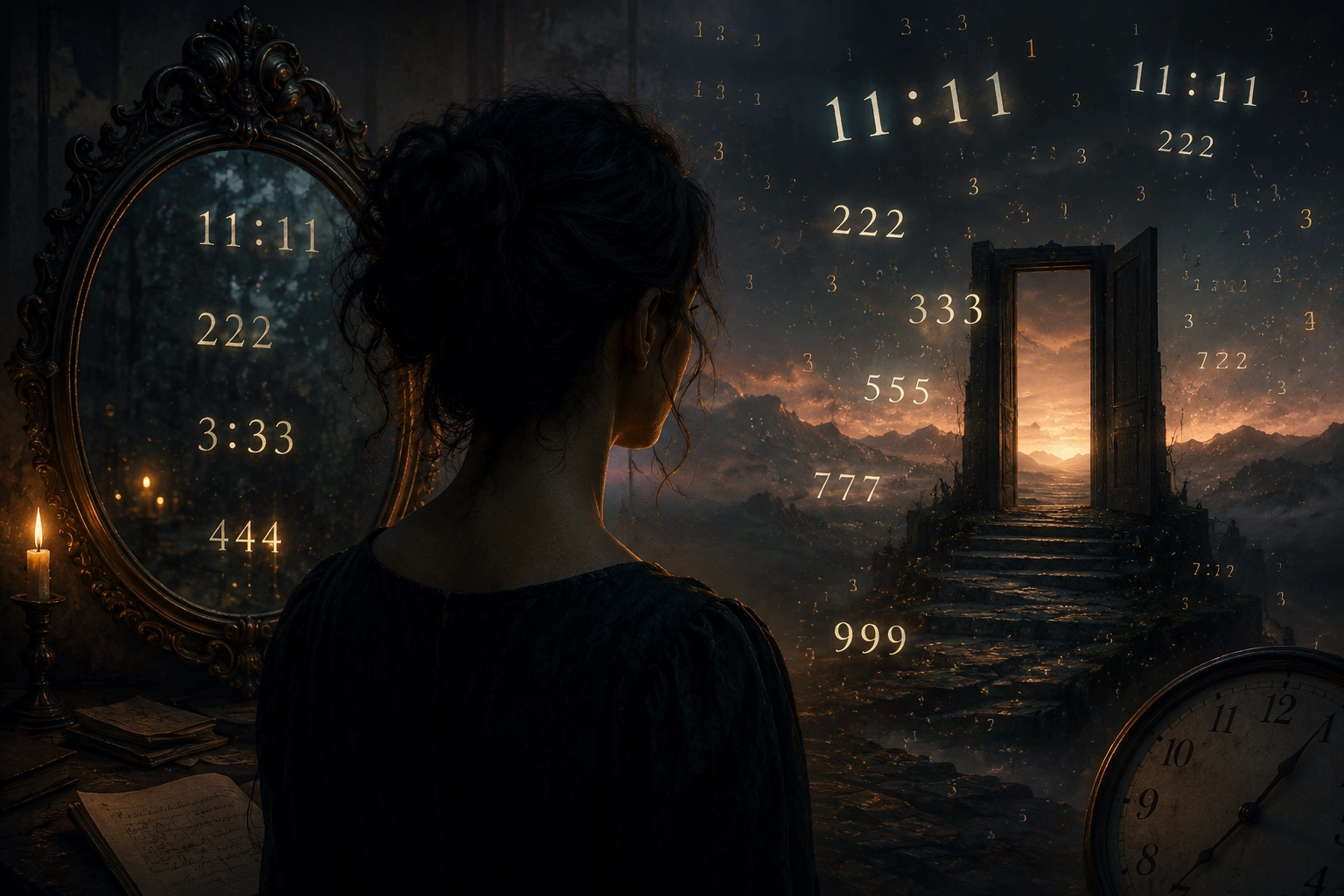
Why Do Repeating Numbers Appear During Emotional Change?
There are seasons of life when the ordinary world begins to feel strangely articulate.
A clock shows 11:11 just as an old memory returns. A receipt ends in 222 on the day a decision feels heavier than it should. The same number appears on a door, a license plate, a message timestamp, a page, a hotel room, a forgotten invoice. Nothing has objectively changed, and yet something has begun to feel arranged.
This is the peculiar atmosphere of repeating numbers during emotional change: not proof, not prophecy, not command, but a symbolic disturbance in the ordinary surface of things. The world remains practical, measurable, indifferent. Still, under pressure, the mind begins to read it differently.
Repeating numbers do not need to be treated as supernatural instructions to matter. They may be more interesting than that.
They may reveal how the psyche searches for pattern when the old structure of life is dissolving. They may show how attention sharpens around thresholds. They may become quiet emblems of transition — small numerical mirrors held up by the everyday world.
A sign is not always a message from elsewhere. Sometimes it is the shape our attention takes when the soul is rearranging itself.
In the language of Lucifer Heritage, repeating numbers during emotional change belong not to cheap fortune-telling, but to the darker, subtler archive of human perception: grief, desire, fear, memory, decision, and symbolic recognition.
The Threshold State: Why Change Makes the World Feel Symbolic
Emotional change rarely announces itself cleanly. It does not arrive like a letter with a date and seal. More often, it begins as unease.
A relationship starts to loosen. A belief no longer holds. A familiar room feels altered. The future becomes visible but unreadable. Something has ended inwardly before it has ended outwardly.
During such periods, the mind becomes unusually alert. It searches for confirmation, warning, rhythm, coherence. This is one reason repeating numbers during emotional change often feel so charged: they appear at the very moment when ordinary life no longer feels ordinary.
Psychologically, emotional intensity affects attention. When something matters deeply, the mind begins selecting details with greater force. A number that might have passed unnoticed yesterday suddenly becomes luminous today.
Not because the number has necessarily changed.
Because the observer has.
Emotional Change Creates Symbolic Hunger
When life is stable, we can afford to ignore small patterns. We move through days as through corridors already mapped. But during transition, the inner map is damaged. The psyche begins looking for markers.
- a repeated phrase
- a dream image
- a familiar song
- an animal appearing at a strange moment
- a particular name
- a number sequence
- a time on the clock
- a symbol from childhood
- a sentence in a book that feels too precise
In this sense, repeating numbers during emotional change are part of a larger human tendency: the search for orientation when identity is being revised.
They become little nails in the fog.
Repeating Numbers as Mirrors, Not Commands
The mistake of shallow spirituality is to treat repeating numbers as orders.
111 means do this.
222 means love is coming.
555 means your destiny is changing.
Such formulas may comfort for a moment, but they flatten the symbolic life. They replace reflection with a vending machine: insert anxiety, receive meaning.
Lucifer Heritage takes a quieter view.
Repeating numbers are not necessarily commands. They are better approached as mirrors.
A mirror does not tell you what to do. It returns your image with merciless calm. It lets you notice what you were carrying before you entered the room.
When repeating numbers during emotional change appear, the first question is not, “What does the universe want from me?”
The better question is:
What part of me is awake enough to notice this?
This shifts the experience from superstition to symbolic reflection. The number does not have to be a supernatural telegram. It can be a surface upon which the inner life becomes visible.
The Psychology of Pattern: Why the Mind Notices Repetition
The human mind is built to detect patterns. This is not a flaw. It is one of the reasons we survive.
We recognize faces, seasons, danger, habits, tone of voice, emotional shifts, repeated behavior. Pattern recognition allows us to predict the world. Without it, every moment would be chaos.
But the same gift can become strange under emotional pressure.
When we are grieving, uncertain, in love, afraid, or standing near a major decision, the mind may become more sensitive to repetition. Numbers are especially noticeable because they are everywhere: clocks, screens, passwords, dates, prices, codes, addresses, phones, receipts.
So repeating numbers during emotional change may emerge from the meeting of two forces: the outer abundance of numbers and the inner intensity of attention.
| Inner Condition | Outer Material | Symbolic Result |
|---|---|---|
| heightened emotion | visible numbers everywhere | numbers feel meaningful |
| uncertainty | repeated sequences | repetition feels like guidance |
| grief or longing | time-based numbers | clocks feel intimate |
| decision pressure | numerical coincidences | patterns feel like confirmation |
| identity change | mirrored digits | numbers feel like thresholds |
This does not reduce the experience to “nothing.” Psychology does not destroy symbolism. It often explains why symbols are powerful.
A candle is only wax and flame — until the room is dark.
Apophenia, Meaning, and the Border Between Pattern and Poetry
There is a psychological word often used in this territory: apophenia — the tendency to perceive meaningful patterns or connections in unrelated data. In clinical and cognitive discussions, it can describe false-positive pattern detection, especially when the mind overconnects random events.
This concept is useful, but it should be handled carefully.
To say that humans find patterns does not mean all symbolic experience is foolish. It means the mind is an interpreter. It is always arranging fragments into possible meaning.
A historian does this with documents. A poet does this with images. A grieving person does this with memory. A lover does this with silence. A philosopher does this with contradiction.
The question is not simply, “Is the pattern objectively real?”
The deeper question is:
What does this pattern reveal about the one who notices it?
That is why repeating numbers during emotional change are so compelling. Even if the sequence itself is coincidental, the moment of noticing may not be empty. It may disclose a hidden tension, an unspoken desire, a fear of choosing wrongly, or the mind’s attempt to create continuity between a former self and an emerging one.
Coincidence becomes symbolic when it touches a wound, a question, or a door not yet opened.
Why Numbers Feel Different From Other Signs
Numbers are among humanity’s oldest symbolic tools. Long before modern numerology, numbers carried religious, philosophical, architectural, musical, and cosmological significance. They ordered temples, calendars, myths, rituals, laws, and stories.
Numbers are strange because they belong to two worlds at once.
They are practical and abstract. Exact and mysterious. Cold and intimate. Human-made and yet somehow discovered. Used for taxes, stars, graves, music, scripture, and time.
This dual nature explains why repeating numbers during emotional change can feel so powerful. A number appears objective. It seems less sentimental than a dream, less personal than a song. It arrives with the authority of measurement.
And yet, repetition gives it atmosphere.
11:11 is not merely time. It is symmetry. A little gate of vertical marks. Four standing lines. A corridor of ones.
222 is not merely arithmetic. It feels like echo. A soft insistence. A pattern refusing to remain singular.
333 gathers rhythm.
444 suggests structure.
555 feels unstable, transitional, almost migratory.
These associations are not universal laws. They are symbolic impressions. But impressions matter. Much of human life is governed not by what things are in isolation, but by what they become in relation to memory, fear, culture, and longing.
Symbolic Observations: What Repetition Does to Meaning
Repetition changes the emotional weight of almost anything.
A single footstep is nothing. Many footsteps behind you become a story.
A single word is ordinary. A repeated word becomes prayer, warning, obsession, music.
A single number is information. A repeated number becomes pattern.
This is why repeating numbers during emotional change often feel like they have crossed a threshold. The first sighting is coincidence. The second is curiosity. The third becomes atmosphere.
The Symbolic Effect of Repetition
| Repeating Pattern | Emotional Impression | Symbolic Reading |
|---|---|---|
| 11:11 | threshold, awakening, symmetry | a door, mirror, beginning |
| 222 | tenderness, hesitation, duality | relationship, balance, waiting |
| 333 | rhythm, emergence, voice | expression, triad, inner alignment |
| 444 | structure, gravity, enclosure | foundation, protection, limits |
| 555 | disruption, movement, restlessness | change, release, crossing |
| 777 | mystery, solitude, sacred distance | contemplation, hidden knowledge |
| 999 | completion, exhaustion, finality | ending, closure, last page |
These meanings should not be treated as rigid definitions. They are not commandments. They are symbolic weather.
A number sequence may mean one thing to a person ending a marriage and something entirely different to someone beginning a new discipline, grieving a parent, leaving a country, or returning to an abandoned creative work.
The number is the signpost.
The life around it is the landscape.
Mythological Parallels: Numbers as Ancient Architecture
In mythology, numbers often structure reality.
There are three trials, three sisters, three wishes, three nights, three warnings. There are seven heavens, seven gates, seven sleepers, seven years, seven seals. Twelve months, twelve zodiac signs, twelve labors, twelve apostles. Forty days of wandering, fasting, rain, or trial.
Human cultures have long used numbers to give shape to the invisible. A myth without number may drift; a myth with number gains architecture.
This helps explain why repeating numbers during emotional change feel ancient even when they appear on a phone screen. The medium is modern, but the symbolic reflex is old.
A glowing digital clock can become, for one second, a shrine of numbers.
Not because the device is sacred.
Because the human mind still carries the old habit of arranging crisis into pattern.
The Mythic Function of Number
- Numbers create order in events that would otherwise feel chaotic.
- Numbers mark thresholds between ordinary and sacred time.
- Numbers give rhythm to transformation.
- Numbers make memory easier by binding stories to structure.
- Numbers suggest completion when a cycle reaches symbolic fullness.
When a person notices repeating numbers during emotional change, the same ancient mechanism may be quietly active. The psyche is trying to number the unnumbered. It is giving emotional weather a visible form.
Emotional Change and the Need for Confirmation
One of the most human reasons repeating numbers become powerful is the hunger for confirmation.
When we are changing, we rarely feel fully authorized.
Leaving something familiar can feel like betrayal. Beginning something new can feel naïve. Outgrowing a former identity can feel like death without ceremony.
In such moments, a repeated number may seem to whisper: “Continue.” Or: “Notice.” Or: “This moment matters.”
But caution is necessary.
A symbol should not be forced to carry the responsibility of a decision. Repeating numbers during emotional change can accompany reflection, but they should not replace discernment.
A number can illuminate a question.
It should not decide your life for you.
A More Grounded Way to Read the Sign
Instead of asking, “What is this number telling me to do?” try asking:
- What was I feeling when I saw it?
- What question was already alive in me?
- What am I hoping this number confirms?
- What am I afraid it means?
- What decision am I avoiding by turning the moment into a sign?
These questions keep the symbolic experience alive without surrendering judgment.
They allow mystery to remain mystery — but not become manipulation.
The Role of Memory: Why Some Numbers Follow Us
Not all repeated numbers are emotionally neutral.
Some numbers carry personal history: a birth date, death date, address, anniversary, hospital room, school number, old password, train platform, apartment floor, or hour of a decisive phone call.
When those numbers recur, the experience can feel uncanny.
The repetition is not only numerical. It is mnemonic.
A number becomes a drawer in the archive of the self.
This is one reason repeating numbers during emotional change may intensify around grief or longing. The mind is not only seeing digits. It is brushing against stored emotional material.
A clock showing 3:17 may mean nothing to one person and everything to another. A receipt ending in 108 may be numerically ordinary but personally charged if that number belongs to a room, date, or childhood memory.
In this way, repeating numbers can behave like keys.
Not keys to the universe.
Keys to rooms inside the observer.
Mirrors, Doors, and Clocks: The Hidden Imagery of Repeating Numbers
Certain objects intensify the symbolism of repeated numbers. This is especially true of clocks, mirrors, doors, and written pages.
Clocks: Repetition Inside Time
When repeating numbers appear on clocks, they feel intimate because clocks measure mortality. Time is never abstract when life is changing. It becomes a pressure, a witness, sometimes an accusation.
11:11 is powerful partly because it appears in time itself. It suggests alignment, but also passage. You cannot hold it. The minute vanishes.
Mirrors: Repetition as Reflection
Mirrored numbers — 12:21, 10:01, 22:22 — carry a reflective quality. They seem to look back. During emotional change, this can feel like confrontation with the self.
A mirror does not create the face. It reveals the angle.
Doors: Numbers as Thresholds
Addresses, hotel rooms, apartment doors, hospital rooms, office numbers — these place numbers on thresholds. Seeing repetition there can feel like entering a chapter.
Pages: Numbers as Archive
Page numbers, chapter numbers, document codes, old manuscripts — these make numbers feel archival. They suggest that life itself is being indexed, filed, preserved somewhere in the dark.
This is why repeating numbers during emotional change belong so naturally to the imagery of hidden archives. They feel like catalog numbers for experiences we have not yet understood.
The Danger of Overreading
There is dignity in symbolic attention. But there is also danger in symbolic excess.
When every number must mean something, the world becomes exhausting. Reflection becomes surveillance. Mystery becomes anxiety. The person no longer lives; they interpret.
A mature symbolic practice must include restraint.
Not every repeated number is a sign. Not every coincidence is a summons. Not every pattern deserves obedience.
Sometimes a number repeats because numbers are everywhere.
The purpose of reflection is not to turn life into a coded prison. It is to notice where meaning naturally gathers — and where the mind may be clinging too tightly.
A calm approach to repeating numbers during emotional change accepts both possibilities:
- The number may be random.
- The noticing may still be meaningful.
This distinction is essential.
The symbol does not need to control reality in order to reveal something real about the person experiencing it.
A Lucifer Heritage Reading Method
For those who want to reflect on repeating numbers without falling into superstition, a more elegant method is possible.
Call it an archival reading.
Not prediction. Not manifestation. Not command.
Observation.
The Archive Method
When a repeated number appears during a period of emotional change, write down:
| Archive Note | Question |
|---|---|
| Date and time | When did the number appear? |
| Place | Where were you? |
| Emotional state | What were you feeling? |
| Context | What had just happened? |
| Thought | What were you thinking about? |
| Body | Was there tension, calm, fear, relief? |
| Association | What does the number personally evoke? |
| Later reflection | Did the moment still matter after a day? |
After several entries, do not ask, “What number appeared most?”
Ask:
What emotion kept appearing beside the number?
That is where the real symbol may be hidden.
This method treats repeating numbers during emotional change as material for self-study. It gives the experience dignity without exaggerating it into dogma.
Why Emotional Change Makes Signs Feel Personal
A strange thing happens during transformation: the boundary between inner and outer life feels thinner.
A line in a book seems written for you. A stranger says the exact phrase you feared. Rain begins at the end of a conversation. A clock repeats the same number when you are about to send a message.
The rational mind may dismiss these moments. The symbolic mind preserves them.
Both responses have value.
The rational mind protects us from delusion.
The symbolic mind protects us from spiritual numbness.
The art is not choosing one against the other. The art is allowing them to stand in tension.
Repeating numbers during emotional change live precisely in that tension. They belong to the borderland between perception and meaning, coincidence and memory, chance and inner necessity.
They are not proof that reality is scripted.
They are evidence that human beings are meaning-making creatures.
Repeating Numbers and the Quiet Drama of Becoming
Emotional change is often described too brightly. Transformation, in modern language, is marketed as awakening, expansion, upgrade, abundance.
But real change is often darker.
It involves loss. Embarrassment. Ambivalence. Old selves dying badly. New selves arriving without elegance. Rooms that still contain the furniture of someone you no longer are.
In such seasons, repeating numbers can feel like small formalities in the chaos — little arrangements of order. They do not solve the transformation. They simply appear within it.
That may be enough.
When repeating numbers during emotional change become meaningful, they may be marking the psyche’s attempt to survive transition through rhythm. A repeated number is a pattern. A pattern is a promise that not everything is shapeless.
Even pain becomes more bearable when it has form.
The soul does not always ask for answers. Sometimes it asks only for a pattern strong enough to hold the night.
A Calm Interpretation of Common Sequences
Below is not a list of fixed meanings. It is a symbolic field guide — a way to think, not a doctrine to obey.
111 or 11:11 — The Gate of Attention
This sequence often feels like a beginning because it is visually stark: upright lines, repetition, symmetry. During emotional change, it may reflect a moment when attention becomes sharply present.
Ask: What am I becoming conscious of?
222 — The Chamber of Relationship
Two is the number of relation: self and other, past and future, desire and fear. Repeated twos may feel especially charged during relational uncertainty.
Ask: Where am I divided, waiting, or seeking balance?
333 — The Voice Returning
Three often carries rhythm, movement, expression. It may appear when something inside seeks articulation.
Ask: What truth wants language?
444 — The Architecture of Stability
Four suggests structure: walls, seasons, directions, foundations. During upheaval, it may symbolize the need for ground.
Ask: What must be rebuilt carefully?
555 — The Unstable Crossing
Five has a restless quality. Repeated fives may feel like movement, rupture, travel, instability, or necessary release.
Ask: What change am I resisting because it has no guarantee?
777 — The Lamp in the Hidden Room
Seven carries long associations with sacred order, contemplation, and mystery. It may appear during solitary or inward phases.
Ask: What knowledge requires silence?
999 — The Last Page
Nine often feels close to completion. Repeated nines can accompany endings, emotional exhaustion, or closure.
Ask: What has already ended inwardly?
Again, these are symbolic invitations, not laws. The meaning of repeating numbers during emotional change depends on context, memory, and the emotional atmosphere in which they appear.
When the Pattern Becomes Too Heavy
Symbolic reflection should deepen life, not frighten it.
If repeating numbers begin to cause distress, compulsive checking, fear of punishment, inability to make decisions, or the sense that every ordinary event is secretly controlling you, it is wise to step back. Speak with a trusted person or mental health professional if the experience becomes overwhelming.
There is no shame in grounding the mind.
Mystery does not require panic.
A healthy relationship with repeating numbers during emotional change remains spacious. You can notice the pattern, write it down, reflect on it, and still return to ordinary life: tea, work, sleep, dishes, rain, unfinished emails, the body.
The symbolic world is not meant to replace the human one.
It is meant to deepen it.
The More Beautiful Question
Perhaps the real mystery is not whether repeating numbers are sent from beyond.
Perhaps the real mystery is why human beings need the world to answer when they are changing.
Why does a clock become intimate?
Why does symmetry soothe us?
Why does repetition feel like recognition?
Why does the mind, standing at the edge of loss, begin searching for hidden architecture?
These questions are more durable than any fixed interpretation.
They allow repeating numbers during emotional change to remain what they are at their best: small, strange, reflective phenomena at the meeting point of psyche and world.
Not proof.
Not nonsense.
A moment of attention.
A symbolic interruption.
A candle briefly lit in the archive.
Final Reflection: The Number and the Night
When repeating numbers appear during emotional change, do not hurry to explain them away. Do not hurry to obey them either.
Let them stand for a moment.
Let the number remain on the clock, the page, the receipt, the door. Let it be ordinary and strange at once. Let it ask without demanding. Let it reflect without ruling.
The most mature symbolic life is not the one that believes everything blindly. Nor is it the one that dismisses everything coldly.
It is the life that can stand in a dark library of experience, holding a small lamp, and say:
Something in me noticed this. I will listen carefully — but I will not surrender my judgment.
That is the quiet dignity of repeating numbers during emotional change.
They may not tell us what the future will be.
But they sometimes reveal the exact moment when the future begins to look back.
Related Articles
The Symbolism of 11:11: A Door Made of Time
A reflective exploration of symmetry, clocks, thresholds, and why 11:11 feels like a small opening in ordinary reality.
Why Mirrors Feel Sacred in Myth, Folklore, and Memory
A dark academic study of mirrors as objects of reflection, divination, fear, beauty, and psychological confrontation.
The Psychology of Signs: Why We Search for Meaning in Crisis
A calm essay on emotional uncertainty, pattern recognition, grief, longing, and the human need for symbolic order.
Seven, Twelve, and Forty: Sacred Numbers in Mythic Time
An atmospheric journey through recurring numbers in mythology, scripture, fairy tales, and ancient symbolic systems.
When Coincidence Feels Personal: Synchronicity Without Superstition
A philosophical look at coincidence, inner timing, symbolic attention, and the border between chance and meaning.
Further Reading & Sources
- Britannica — Number Symbolism
- Britannica — Number Symbolism: Pythagoreanism
- American Psychological Association — Perception and Attention
- American Psychological Association — Stress
- NIH / PMC — Emotion and Perception
- NIH / PMC — Apophenia and False-Positive Pattern Detection
- Library of Congress Folklife — Friday the Thirteenth and Number Folklore
- The Metropolitan Museum of Art — Mirror
- JSTOR — The Origin of Sacred Numbers