May 13, 2026
Why Do Certain Dreams Repeat for Years?
Recurring dreams may reveal unresolved emotion, memory, and symbolic pressure, showing why certain night visions return for years with quiet persistence.
Why Certain Dreams Return for Years
Some dreams vanish almost at once.
They pass through the mind like water through a dark grate, leaving only a mood, a color, a brief unease that cannot be named after breakfast. By noon, even the mood is gone. The day repairs itself around ordinary tasks, and the dream becomes one more forgotten visitor of the night.
Other dreams are different.
They return with the patience of something unfinished. Sometimes they repeat exactly. More often, they come back in altered clothing: a different street, a different room, a different season, but the same pressure in the chest. The dreamer may not remember every detail, yet the emotional climate is instantly recognizable. The old house. The exam never prepared for. The road that refuses to lead home. The dead person sitting calmly in a room where no one else seems surprised.
These are recurring dreams, and their persistence can feel quietly uncanny. They do not behave like ordinary mental debris. They seem to belong to a deeper pattern, one that has survived changing years, changing faces, changing circumstances, and sometimes even a changing self.
To ask why certain dreams repeat for years is not to ask for superstition. It is not necessary to treat the dream as a prophecy, a command, or a secret message from beyond ordinary life. A more careful answer is also more interesting: the dream may be repeating because an emotion, conflict, memory, fear, or symbolic question has not yet found a stable form in waking consciousness.
A returning dream is rarely a closed statement. It is more often an unresolved conversation. This is why recurring dreams belong not only to sleep, but to the hidden continuity of inner life.
A dream that returns for years is not always trying to frighten the dreamer. Sometimes it is trying to preserve a truth that daylight keeps simplifying.
The Strange Authority of a Returning Dream 🕯️
A repeated dream has a peculiar authority, even when its content seems ordinary. If someone says, “I keep dreaming of a staircase,” or “I am always late for a train,” the description may sound almost plain. Yet inside the dream, the image carries weight. It is not merely a staircase. It is the staircase. It is not merely a train. It is the train that always leaves before the dreamer can reach it.
This is one reason recurring dreams are difficult to explain from the outside. Their meaning is not contained only in the objects that appear. It is contained in the atmosphere around them. A hallway may feel endless. A familiar house may feel accusing. A school desk may feel like a tribunal. A silent figure may feel more powerful than any spoken threat.
The dream returns because the image has become a vessel. It holds a feeling that waking language has not fully held. The plot may be simple, but the emotional arrangement is precise.
Many people notice that the recurring dream does not need to repeat every week to remain powerful. It may disappear for years and return during a difficult season: after a move, during grief, before a major decision, after a relationship changes, or when old responsibilities begin to feel heavy again. The dream seems to recognize the emotional season before the waking mind has organized it into a clear sentence.
In this sense, recurring dreams often behave less like random repetition and more like symbolic memory. They return when the present touches an old nerve.
Repetition as the Language of the Psyche
The waking mind tends to prefer direct explanation. It wants a reason, a diagnosis, a conclusion. The dreaming mind is rarely so obedient. It works through substitution, compression, atmosphere, and symbol. It makes a lost road out of uncertainty. It makes a locked room out of avoidance. It makes a collapsing ceiling out of pressure. It makes a dead voice out of unfinished affection.
Because dream language is indirect, repetition becomes one of its clearest forms of emphasis. A question repeated by a child is not always a new question; sometimes it is the same question waiting for a true answer. A wound that aches again is not inventing pain; it is marking the place where attention is still required. In the same way, recurring dreams may repeat because something in the inner life is still active.
This does not mean every returning dream hides a dramatic secret. Some repeated images may be shaped by stress, sleep disturbance, habit, or old associations that the mind uses because they are readily available. But when the same dream returns across years with the same emotional charge, it becomes difficult to treat it as meaningless noise.
A pattern asks to be observed.
Not obeyed. Not feared. Not turned into a mystical law. Observed.
The dream repeats where waking life has learned to pass too quickly.
Why a Dream Can Outlive Its Original Moment
One of the most important things to understand about recurring dreams is that they often survive the situation that first gave them power. A person who has not been in school for twenty years may still dream of failing an exam. Someone who no longer lives in childhood surroundings may continue to dream of a former house. Someone who has already left a painful relationship may still dream of being unable to find the door.
The dream is not necessarily about the literal past. It is about the emotional pattern that the past first taught the mind to recognize.
An exam dream may begin in school, but later return during professional pressure, public exposure, financial risk, parenthood, or any situation where the dreamer feels judged. The classroom is only the theatre. The deeper theme may be evaluation, inadequacy, shame, or the fear of being discovered unprepared.
A dream of being lost may begin with an actual memory of disorientation, but later become a symbolic language for belonging. The map is not the true subject. The true subject may be the feeling of not knowing where one is allowed to stand.
A dream of being chased may not be about an external enemy at all. It may return whenever the dreamer avoids a conversation, a decision, a grief, an anger, or a truth that has been following quietly for years.
This is why recurring dreams can feel both old and current. They carry the past, but they are activated by the present.
Common Images in Dreams That Return
No responsible symbolic reading should turn dream images into a fixed dictionary. A house does not always mean the self. Water does not always mean emotion. Teeth do not always mean fear of aging or loss. Symbols are not coins stamped with one meaning for every person.
Still, certain images appear often in recurring dreams because they are flexible enough to hold deep human concerns. They can carry many meanings without becoming empty.
| Recurring Image | Possible Emotional Core | Symbolic Texture |
|---|---|---|
| House with hidden rooms | Memory, identity, family history, unexplored parts of life | The self as architecture |
| Being chased | Avoidance, pressure, fear, unspoken conflict | The shadow that follows |
| Exams or school | Judgment, inadequacy, unfinished growth | The old tribunal of becoming |
| Missing a train or flight | Timing, transition, lost opportunity | The threshold closing |
| Falling | Loss of control, surrender, instability | The body remembering gravity |
| Teeth falling out | Exposure, vulnerability, loss of composure | The fragile public face |
| Speaking with the dead | Grief, memory, guilt, tenderness, unfinished love | Absence given a face |
| A locked door | Secrecy, fear, unreadiness, forbidden knowledge | The border of what has not yet been entered |
The purpose of such a table is not to solve the dream. It is to begin listening. A symbol becomes meaningful only when it is placed beside the dreamer’s own life, emotional history, and repeated feeling inside the dream.
The House, the Corridor, the Exam, and the Dead 🪞
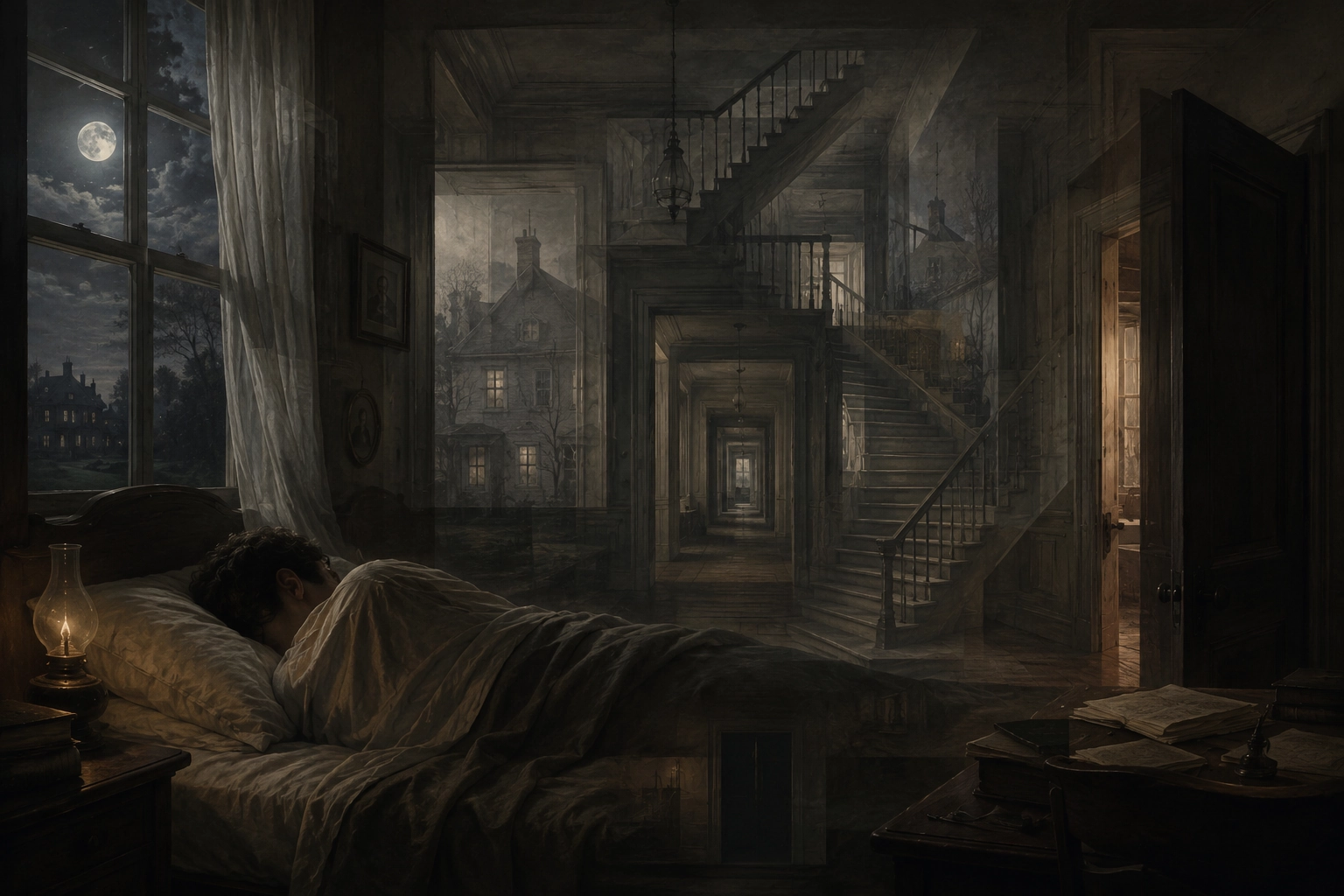
The house is among the most powerful images in dreams because it can contain nearly everything: safety, inheritance, imprisonment, childhood, secrecy, memory, class, family, desire, shame, and the private rooms of identity. In many recurring dreams, the dreamer returns to a house that is familiar but altered. There are rooms that were never there, staircases that descend too far, upper floors that feel abandoned, or a door that appears only in sleep.
The dream-house may be less a building than an arrangement of the self. It may ask, quietly, what has been stored away. Not always something terrible. Sometimes the hidden room contains grief. Sometimes tenderness. Sometimes anger. Sometimes an unlived life that has waited without accusation.
The corridor is different. A corridor is not a home and not a destination. It is passage without arrival. To dream repeatedly of corridors, tunnels, narrow streets, institutional hallways, or endless stairwells may suggest transition that has become prolonged. The dreamer moves, but does not arrive. The architecture itself seems to delay conclusion.
The exam dream belongs to a different order of anxiety. It returns to adults who have not sat in a classroom for decades because life continues to create invisible examinations. Work, love, public failure, family expectation, aging, and money can all become exam rooms. The dream asks: where do you still feel that your right to stand in the world depends on performance?
Dreams of the dead carry their own gravity. A lost parent may appear alive. A friend may return without explanation. A grandparent may sit at a table as though absence had been a small misunderstanding. These dreams should not be forced into easy certainty. They may carry grief, longing, guilt, blessing, memory, or the continuing presence of values learned from the dead.
To dream repeatedly of someone gone is not always to receive a message. Sometimes it is the heart discovering that love continues to need a language after the body has disappeared.
Memory, Stress, and the Theatre of Sleep
Dreams do not arise outside the body. They belong to sleep, memory, emotion, and the nervous system. A serious symbolic essay should not ignore this. Night images may feel ancient, but they also emerge from a living brain that is processing experience, threat, memory, expectation, sensation, and mood.
Some dreams become more vivid during stress. Some nightmares disrupt rest and leave the body alert long after waking. Some repeated dreams may be linked to anxiety, trauma, unresolved conflict, grief, or recurring pressure in daily life. None of this makes the symbolic reading less meaningful. It makes it more grounded.
The psyche does not choose between biology and meaning. It uses both.
A dream of being chased may coincide with a nervous system trained to expect danger. A dream of returning to an old house may appear when memory is active. A dream of failing an exam may emerge during periods of evaluation or shame. A dream of searching for someone may intensify during grief, loneliness, or a major change in attachment.
This is why recurring dreams should be approached with two forms of respect: respect for the symbol and respect for the sleeper. The image matters, but so does the quality of rest. The meaning matters, but so does whether the dream leaves a person exhausted, frightened, or unable to function.
Mystery should never become an excuse to ignore distress.
The Mythic Pattern Beneath the Personal Dream
Long before modern sleep research, dreams occupied a serious place in human culture. They appeared in myths, sacred texts, royal courts, healing temples, folklore, drama, and art. The night was not considered empty. It was treated as a borderland where the human being met figures, warnings, desires, ancestors, gods, monsters, and reflections of the self.
A modern reader does not need to accept every ancient belief in order to understand why repeated dreams feel mythic. Myth itself is built on return. The hero descends. The wanderer loses the path. The gate is guarded. The forbidden room waits. The dead speak. The monster follows. The bridge must be crossed.
Many recurring dreams resemble private myths because they place the dreamer inside a repeated symbolic trial. Always trying to arrive. Always trying to escape. Always searching for a room. Always standing before a door. Always hearing a voice from someone who is gone. Always losing the path at the same bend.
The dream may be personal, but its shapes are old because human questions are old.
Where do I belong? What follows me? What have I refused to see? What did I lose? What must I become? What waits behind the door?
The mythology of a dream should not be exaggerated into drama. The dreamer is not automatically a chosen figure in a cosmic script. Yet the symbolic imagination naturally borrows from ancient structures because those structures still fit the architecture of human fear and desire.
How Symbols Change While the Feeling Remains
Some returning dreams remain almost unchanged for years. Others evolve gradually. The house gains a new room. The corridor becomes brighter. The pursuer is farther away. The train still leaves, but the dreamer no longer panics. The dead person speaks less, or speaks with greater calm. The exam remains, but the dreamer notices a door out of the classroom.
These changes matter.
The most important detail in recurring dreams is often what stays the same. The second most important detail may be what finally changes. If the same dream has repeated for years, even a small alteration can suggest that the dreamer’s relationship to the underlying emotion is shifting.
A person may continue to dream of a childhood house, but one night enter the room that was always locked. Another may still be chased, but suddenly turn and look back. Another may miss the train but discover there is another route. Such moments should not be overinterpreted, but they deserve attention. The dream may not be solved; it may be moving.
When a dream changes, it may indicate that the psyche has found a new way to hold an old pressure. The fear may not have vanished, but it no longer organizes the entire scene.
A symbol is not conquered. It is approached until it begins to answer differently.
A Quiet Method for Reading the Dream
The worst way to approach a repeated dream is with violent certainty. “This means that.” “This proves that.” “This predicts that.” Such interpretations flatten the dream and flatter the interpreter. They may sound confident, but they rarely respect the complexity of the inner life.
A better method is slower.
If a dream returns, begin by recording it. Not beautifully. Not as literature. Just faithfully. Write what appeared, what happened, what emotion dominated, how the dream ended, and what was happening in waking life around the time it returned.
Over time, recurring dreams may reveal rhythm. Perhaps they return before decisions. Perhaps they return after conflict. Perhaps they appear when grief is postponed, when anger is swallowed, when responsibility becomes heavy, or when freedom comes close enough to be frightening.
| What to Record | Why It Matters |
|---|---|
| Date of the dream | Patterns may appear across seasons, anniversaries, or life transitions. |
| Emotional tone | The feeling is often more important than the plot. |
| Repeated image | The central symbol may carry the dream’s pressure. |
| Small changes | Transformation often appears first as variation. |
| Waking context | The dream may echo a present emotional demand. |
| Final image | Endings often show what the dream cannot yet resolve. |
This practice creates a small archive. It turns the dream from a haunting into material that can be held. The aim is not to force meaning from the dream, but to notice what it has been patiently arranging.
When the Dream Begins to Change
One of the quietest and most powerful moments in dream life occurs when the recurring dream changes its ending.
The door opens. The pursuer stops. The lost road leads somewhere. The dead person leaves without terror. The exam is unfinished, but the dreamer walks away. The house is still old, but light enters through the roof. These images may seem small when told aloud, yet inside the dream they can feel enormous.
The change does not always mean that an issue has been solved. Human life rarely resolves itself so neatly. But it may suggest that the dreamer has gained a new relation to the old feeling. The image no longer has exactly the same power. The fear may still exist, but it has lost its absolute authority.
Sometimes recurring dreams stop without ceremony. There is no final dream, no grand explanation. The image simply does not return. The inner theatre has closed because it no longer needs to stage the same scene.
At other times, the dream continues throughout life, but its tone softens. It becomes less like an attack and more like a weather pattern. Certain themes do not disappear because they belong to the whole arc of a person’s existence: belonging, mortality, guilt, desire, separation, responsibility, freedom, and the unfinished task of becoming oneself.
A lifelong dream is not always a prison. Sometimes it is a long conversation with a question large enough to accompany a life.
When to Seek Help Rather Than Interpretation
There is a point where interpretation is not enough.
If repeated dreams are terrifying, frequent, connected to trauma, damaging sleep, causing dread of going to bed, or interfering with daily life, they should be approached not only as symbols but as a mental health and sleep concern. A dream can be meaningful and still require support. A nightmare can be symbolic and still be harmful.
This distinction matters because aestheticizing distress can become another form of avoidance. Not every dark image needs to be admired. Not every recurring nightmare should be turned into a private mythology. Sometimes the wise response is practical: better sleep habits, professional guidance, trauma-informed therapy, or medical consultation when sleep is severely affected.
Lucifer Heritage is interested in symbols, but symbols do not replace care. Even recurring dreams deserve a practical response when they begin to damage rest, peace, or daily life.
The most serious interpretation may be the one that admits when the dream has crossed from mystery into suffering.
Symbolic Observations ✦
- A repeated dream is often attached to a feeling rather than a literal event.
- The setting may function as symbolic architecture: house, corridor, school, station, forest, road, room.
- The dream may return when a present situation touches an older emotional pattern.
- The most important detail may be what never changes.
- The second most important detail may be what finally changes.
- A recurring dream can be psychologically grounded without losing symbolic depth.
- Dream images should be read personally before they are read universally.
- Not every dream requires interpretation; some require patience, record, and respect.
- If the dream damages sleep or daily life, care matters more than symbolism.
- The dream may stop when the emotional charge behind it has changed.
The Dream as a Private Archive
To dream the same dream for years is to discover that the mind keeps more than memories. It keeps atmospheres. It keeps thresholds. It keeps unfinished rooms. It keeps the emotional weather of earlier selves long after ordinary narrative has simplified them.
This private archive does not open like a file cabinet. It opens through image.
A staircase that should not be there. A road under strange light. A classroom with unreadable questions. A house with one more floor than it had in life. A person long dead who looks at the dreamer without surprise.
Such images can feel sacred without requiring supernatural certainty. They remind us that the self is not only the person who answers emails, pays bills, makes plans, and performs competence in daylight. Beneath that practical surface, older material continues its quiet work.
This is why recurring dreams can remain so powerful. They are not simply repetitions of plot. They are repetitions of unresolved relation: to fear, to memory, to belonging, to grief, to judgment, to the hidden rooms of identity.
The dream returns because something within the image remains alive.
Not always wounded. Not always dangerous. But alive.
Conclusion: Why Certain Dreams Keep Returning
Certain dreams repeat for years because the human mind does not measure time only by calendars. It measures by emotional pressure. By what has not yet been mourned. By what has not yet been chosen. By what has not yet been spoken. By what has not yet been allowed to become conscious without disguise.
A recurring dream is not automatically a warning. It is not automatically a prophecy. It is not a cheap mystical sign demanding obedience. It is subtler, and therefore more serious.
It may be a memory wearing symbolic clothing. It may be anxiety returning to its oldest theatre. It may be grief searching for a face. It may be identity approaching a locked room. It may be the psyche asking the same question until the dreamer can finally hear its tone.
The task is not to panic before the dream, and not to worship it. The task is to meet it with disciplined attention. This is especially true of recurring dreams, because their power often lies not in spectacle, but in persistence.
To ask: what feeling returns here?
To ask: what in my waking life carries the same atmosphere?
To ask: what has changed in the dream, and what has never changed at all?
If the dream has followed someone for years, perhaps it has not come to imprison them in the past. Perhaps it has come because the past itself is still searching for a truer form inside the present.
The dream returns.
The image waits.
And somewhere in the quiet architecture of the mind, the dreamer is still learning how to enter.
Related Articles
The Symbolism of Houses in Dreams
A quiet exploration of hidden rooms, childhood corridors, family memory, and the strange architecture of the dreaming self.
Why Mirrors Feel Sacred and Unsettling
A symbolic reflection on mirrors, doubles, self-recognition, vanity, fear, and the old human anxiety of being seen clearly.
The Forest as a Symbol of the Unconscious
An atmospheric essay on forests in myth, fairy tale, dream life, and the shadowed regions of the inner world.
What It Means to Dream of the Dead
A calm meditation on grief, memory, unfinished love, and the figures who continue speaking in the private theatre of dreams.
The Door, the Gate, and the Threshold
A symbolic study of passages, forbidden rooms, initiation, hesitation, and the moment before transformation.
Further Reading & Sources
- Encyclopaedia Britannica — Dream
A broad reference on dreaming, its history, and its place in human thought. - Sleep Foundation — Why You Keep Having Recurring Dreams
Accessible sleep-health information on recurring dream patterns and common themes. - American Psychological Association — Nightmares in Adults
Psychological material on nightmares, sleep disruption, and treatment research. - Scarpelli et al. — What About Dreams? State of the Art and Open Questions
An academic overview of contemporary dream research and unresolved questions. - Sheaves et al. — Nightmares and Psychiatric Symptoms
A systematic review discussing nightmares, sleep, and mental health connections. - The British Museum — Morpheus
Museum context for the ancient figure associated with dreams and sleep. - The Metropolitan Museum of Art — Symbolism
Cultural and visual context for Symbolist art, dreamlike images, and inward vision. - Library of Congress — American Folklife Center Online
A portal into folklore archives and cultural memory collections. - JSTOR — Dreams and the Temporality of Consciousness
A scholarly source for thinking about dreams, continuity, emotion, and temporal experience.