July 19, 2026
The Symbolism of Candles Across Traditions
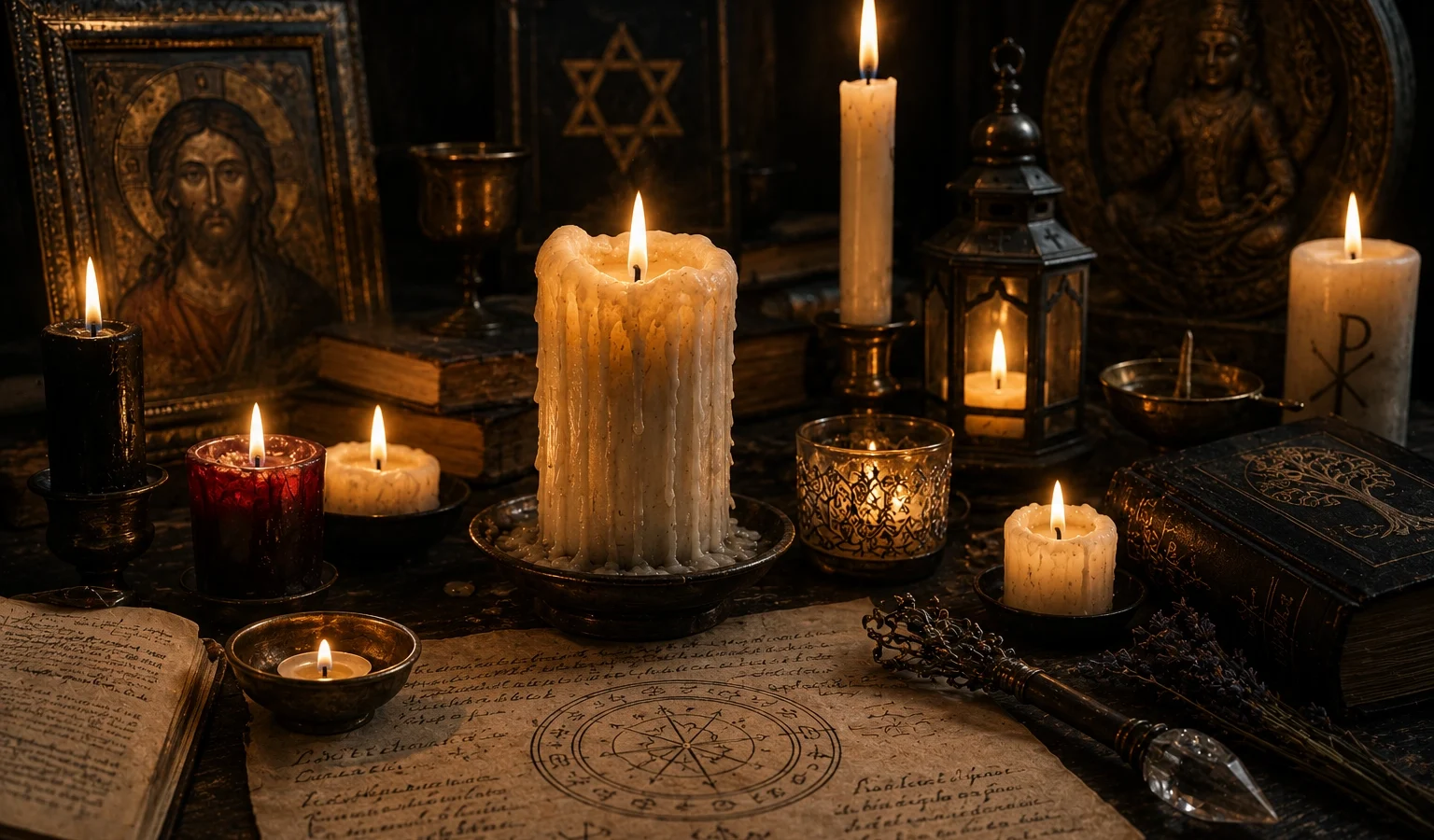
A candle is fire taught to remain in one place.
It does not spread across the floor or climb the walls. It does not become a hearth, a furnace, or a warning on the horizon. Wax contains it. The wick gives it direction. A small holder separates it from the table beneath.
Yet the flame never becomes entirely obedient.
It bends when a door opens. It shortens when the wick is poor. It brightens, gutters, smokes, and consumes the material that allows it to exist. The candle is controlled fire, but the control remains incomplete.
This tension lies near the heart of the symbolism of candles.
A candle brings something ancient and dangerous into human scale. Fire becomes small enough to carry through a corridor, place beside a bed, lift before an altar, leave near a photograph, or watch during a difficult hour. Its light is limited, but its limitation gives it emotional precision. It illuminates one table rather than the whole world.
Across traditions, candles and related ritual lights have accompanied prayer, sacred time, initiation, mourning, celebration, remembrance, domestic peace, public grief, and private reflection. They have marked entrances and endings. They have stood beside the living and the dead. They have represented divine illumination, human attention, continuity, and the fragile duration of a life.
But no single interpretation belongs to every flame.
A baptismal candle is not identical to a Shabbat candle. A memorial light is not identical to a decorative taper. A Buddhist butter lamp, a Hindu diya, an oil lamp, and a wax candle should not be flattened into one universal object merely because each carries fire.
The materials differ.
The traditions differ.
The meanings differ.
What unites them is not a secret doctrine of flame. It is the recurring human decision to give light a deliberate place.
A candle becomes powerful not because fire obeys the hand, but because the hand chooses what deserves to remain visible.
Fire Brought to Human Scale
Fire ordinarily resists boundaries.
It spreads toward available fuel. It alters whatever it touches. It gives heat, protection, food, destruction, visibility, and fear. A candle does not erase these qualities. It contains them temporarily within a narrow arrangement of wax and wick.
This makes the candle an unusually precise object of power.
Its power does not resemble domination.
It resembles concentration.
A large fire overwhelms attention. A candle gathers it. The eye follows the moving edge of the flame because the movement is alive but restrained. The candle creates a center without filling the entire room. Everything nearby becomes visible; everything farther away remains uncertain.
This relationship between illumination and concealment shapes candle symbolism across religious, domestic, artistic, and memorial settings. The flame does not abolish darkness. It negotiates with it.
That distinction matters.
Electric light often makes visibility immediate and nearly total. A switch removes much of the room’s uncertainty. Candlelight reveals selectively. It gives a face warmth while allowing the wall behind it to remain dim. It makes one page readable and leaves the shelves beyond in shadow.
This limited visibility can represent humility.
Human beings rarely understand an entire life, grief, tradition, or moral problem at once. Often they possess only enough light for the next honest observation. The candle gives physical form to that condition: not complete knowledge, but sufficient attention.
Its vulnerability matters too.
The flame can be extinguished by breath. The wax can collapse. The wick can drown in its own fuel. Power and fragility remain together.
The candle does not become meaningful despite its weakness.
It becomes meaningful through it.
The Material Body of the Candle
A candle gives light by becoming less of itself.
The flame rises while the wax descends. The object fulfills its purpose through gradual consumption. When the fuel is exhausted, the light ends.
This physical process has made the candle a natural symbol of duration and mortality. Time does not remain abstract while a candle burns. It becomes visible in softened wax, a deepening hollow, a shortening body, and the darkened curve of the wick.
It is tempting to turn this immediately into a sentimental lesson about sacrifice.
But the material image is more complicated.
Not every form of self-consumption is noble. Human beings can exhaust themselves through exploitation, fear, obligation, or the belief that their worth depends on endless giving. The candle should not become an argument that a person must destroy themselves to illuminate the lives of others.
The symbolism of candles is stronger when the material fact remains open rather than moralized too quickly.
The candle may represent mortality.
It may represent the cost of attention.
It may represent the transformation of matter into heat and light.
It may remind the observer that every visible act depends on resources that are not infinite.
The wick also matters.
Wax alone does not produce a stable flame. The wick draws melted fuel upward and gives fire a narrow path. Symbolically, it suggests structure. Attention requires form if it is to endure.
Feeling without structure disperses.
Devotion without practice becomes occasional desire.
Memory without preservation fades.
A ritual object becomes powerful when material, gesture, and meaning support one another.
Wax is the reserve.
The wick is the path.
The flame is the visible event.
Christian Candles and Received Light
Within Christian traditions, candles appear near altars, in processions, beside icons, during vigils, at baptisms, funerals, memorial services, and Easter observances. Their meanings vary according to denomination and context, but recurring themes include illumination, prayer, watchfulness, resurrection, divine presence, and transmitted faith.
The baptismal candle offers one of the clearest symbolic gestures.
In Catholic practice, it is lit from the Easter candle. The newly lit flame does not invent itself. It receives light from an existing source, while the original flame remains undiminished.
This gives the act a precise symbolic structure.
Light can be shared without becoming a smaller possession.
During the Easter Vigil, flame enters a darkened church and may be passed through the congregation. Darkness is not removed in one theatrical burst. The space changes gradually as one light becomes many.
The meaning carried by the ritual flame belongs to a specifically Christian language of baptism, death, resurrection, revelation, and communal faith. It should not be reduced to a generic statement that light means optimism.
The ritual is more exact.
Darkness precedes the flame.
One light becomes many.
The congregation does not merely observe the symbol.
It carries it.
Votive candles introduce another dimension: the continuation of attention. A person may light a candle, remain briefly, and then leave while the flame continues burning. The object does not literally pray, but it becomes the material extension of an act that the body cannot sustain indefinitely.
The person returns to ordinary life.
The flame remains for a while.
Jewish Candles and the Architecture of Sacred Time
Jewish candle practices demonstrate that light can organize time as powerfully as it organizes space.
Shabbat candles are lit before the beginning of Shabbat. They belong to the home, to peace, sanctity, delight, and the transition from ordinary labor into sacred time.
The room remains the same room.
The table remains the same table.
Yet the lighting marks a change in the quality of the evening.
This is one important dimension of the symbolism of candles: a flame can announce that ordinary time has opened into another form of attention.
Havdalah marks the opposite threshold. The ceremony accompanies the conclusion of Shabbat and the return to the working week. Its multi-wicked flame is not merely decorative. It belongs to a ritual of separation involving light, wine, fragrance, words, and the body.
Shabbat and Havdalah therefore frame sacred time with different forms of flame.
One welcomes.
One distinguishes.
One gathers the household into rest.
One accompanies the return to ordinary responsibility.
Hanukkah carries another particular language of light connected with dedication, remembrance, religious continuity, and Jewish identity. Its flames should not be absorbed into a vague universal idea of spiritual illumination.
Tradition gives the flame its grammar.
Sacred Flame Beyond the Wax Candle
An honest study of candle symbolism must recognize where the candle is not the correct object.
Many traditions use oil lamps, ghee lamps, butter lamps, torches, hearth fires, or continuously burning flames. Translating all of these automatically as candles may make comparison easier, but it erases material and cultural distinctions.
In Hindu worship, the diya is commonly an oil or ghee lamp with a wick. During arti, light may be moved before a deity as an offering. The gesture belongs to worship, reverence, presence, and the ceremonial perception of sacred light. The diya is not simply a wax candle under another name.
Within Buddhist traditions, lamps may appear as offerings associated with clarity, teaching, merit, awareness, and the dispelling of ignorance. Forms differ across regions and schools. Butter lamps and oil lamps carry their own material histories and ritual contexts.
These practices expand the study of ritual flame while also limiting careless generalization.
| Object or Practice | Material Form | Symbolic Emphasis |
|---|---|---|
| Christian baptismal candle | Wax candle lit from the Easter candle | Illumination, initiation, transmitted faith |
| Shabbat candles | Candles lit before the sacred day | Domestic peace, sanctity, sacred time |
| Havdalah flame | Multi-wicked candle or torch-like flame | Separation, transition, return |
| Hindu diya | Oil or ghee lamp with a wick | Offering, reverence, sacred presence |
| Buddhist ritual lamp | Oil, butter, or another lamp form | Clarity, teaching, offering, awareness |
| Memorial candle | Simple candle lit for the dead or absent | Witness, remembrance, continuity of names |
The resemblance between these forms is meaningful.
Resemblance is not identity.
A careful symbolic journal should allow traditions to remain distinct.
Candles Beside the Dead
A candle changes when it is lit beside death.
The same wax, wick, and flame that might accompany a meal enters another emotional order. It becomes vigil, witness, remembrance, mourning, and the visible admission that someone is absent.
A memorial candle does not reverse death.
It does not solve grief.
It does not prove a particular belief about what follows life.
Its dignity lies in refusing to let absence pass unnoticed.
This meaning extends beyond one religious tradition. Candles appear at graves, public vigils, private memorials, anniversaries, and sites of collective tragedy. They may be lit for one person or for thousands whose lives risk becoming abstract beneath the scale of history.
At Holocaust remembrance ceremonies, candle-lighting may accompany the reading of names and historical testimony. The flame becomes part of an ethical practice of memory. It does not beautify the event. It marks the responsibility to remember individual lives within overwhelming loss.
A public vigil reveals another quality of symbolic candlelight.
One small flame appears vulnerable.
Hundreds of flames create a community of witnesses.
The power does not come from brightness alone. It comes from repetition. Each person carries a separate light, yet the gathering makes the act collective.
A memorial candle does not claim that death has been defeated. It says that forgetting will not be allowed to complete the work of loss.
This is why memorial candles should be approached with restraint in visual culture. A candle beside a photograph, grave, or name carries real emotional history. It should not become an effortless prop for manufacturing sadness.
The flame deserves context.
The dead deserve more than atmosphere.
The Candle as an Object of Attention
A candle can focus attention because it is simple enough to watch and alive enough not to become static.
The flame changes continuously, but within a recognizable form. It gives the restless eye somewhere to remain. It slows the room without demanding silence by force.
This helps explain why candles accompany prayer, contemplation, vigils, meditation, reading, and private reflection. Their role is not always doctrinal. Sometimes the candle supports a condition of mind.
It marks that a certain interval has begun.
The phone is put aside.
The room becomes quieter.
A name is spoken.
A page is opened.
A question receives more time than ordinary life usually allows.
In this sense, the symbolic meaning of candlelight is closely tied to the discipline of attention. The object does not create sincerity automatically. It cannot force a distracted person into contemplation. But it can establish a boundary around the attempt.
This is the difference between a ritual object and a magical machine.
A magical machine is expected to produce an outcome.
A ritual object helps the participant enter a relationship with the moment.
The candle does not perform attention for us.
It makes inattention easier to notice.
Why Candles Become Objects of Power
An object of power does not need to contain supernatural force like a substance sealed inside it.
Its power may come from relationship.
A candle becomes powerful because human beings repeatedly place it at moments of consequence. Birth. Prayer. Rest. Marriage. Death. Return. Separation. Remembrance. The object gathers associations through use.
This does not mean every candle inherits every meaning.
A candle purchased for decoration does not automatically become sacred. A colored candle does not possess a universal emotional property. A flame placed beside another object does not charge it with guaranteed power.
The symbolism of candles becomes credible when four elements meet:
- Material: wax, wick, flame, heat, duration, and risk;
- Context: the religious, cultural, domestic, memorial, or personal setting;
- Gesture: who lights the candle, when, and for what purpose;
- Attention: the meaning consciously or communally held around the act.
Remove context, and the candle becomes generic atmosphere.
Remove gesture, and it becomes an unused object.
Remove attention, and the flame may remain beautiful but symbolically empty.
Repetition also matters.
A candle lit once may mark an event. A candle lit every year beside the same name begins to carry memory. A candlestick inherited through generations gathers the pressure of former hands. Wax marks, scratches, repairs, and habitual placement turn an ordinary object into a material archive.
Objects of power are not powerful because they escape human meaning.
They are powerful because human meaning has passed through them repeatedly.
The Danger of Universal Candle Meanings
Modern spiritual content often assigns fixed meanings to candles by color.
White for purification. Red for love. Green for money. Black for protection or banishment. Blue for peace. Purple for spiritual authority.
Such correspondences may be meaningful within a particular practice or modern occult system.
They should not be presented as universal law.
Candle symbolism cannot be reduced to a color chart detached from culture. A white candle may carry one meaning in a religious ceremony, another at a memorial, and no fixed symbolic meaning at all in an ordinary household.
Even the meaning of flame changes according to context.
It may signify divine presence.
It may mark the boundary of sacred time.
It may represent memory.
It may simply allow the participant to see.
Careful interpretation asks where the candle is, who lights it, what tradition surrounds it, what words accompany it, and what happens when the flame is extinguished.
The universal dictionary is attractive because it removes uncertainty.
But uncertainty is often where serious symbolic thought begins.
When Candle Symbolism Becomes Too Easy
A candle can make almost any image feel meaningful.
Place one beside an old book and the scene suggests study. Place one beside a skull and it suggests mortality. Place one before a mirror and it suggests self-examination. Place one near a photograph and it suggests memory. Place many around a figure dressed in black and the image immediately declares itself occult.
This visual efficiency is also a danger.
The candle becomes lazy shorthand.
It is repeated because it creates mood quickly, not because the subject requires it. The flame stops carrying attention and becomes proof that the image wants to be perceived as mysterious.
Lucifer Heritage should use the symbolism of candles more carefully.
One candle is often stronger than twenty.
The flame should have a reason to exist within the scene.
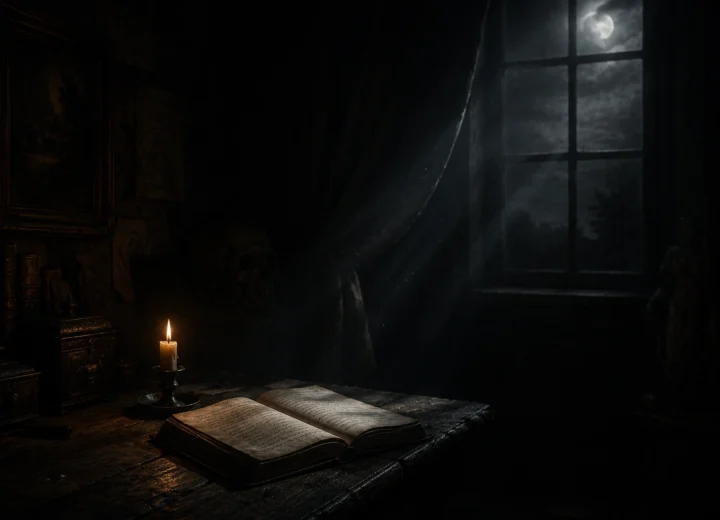
A candle beside a manuscript may indicate the labor of reading before electric light.
A candle beside a name may indicate remembrance.
A candle carried through a dark church may indicate transmission and passage.
A candle on a domestic table may indicate sacred time entering the home.
The object should not be asked to provide atmosphere on its own.
It should participate in meaning already present.
A Quiet Method for Reading a Candle Symbolically
When a candle appears in a ritual, artwork, dream, photograph, sacred space, or inherited household practice, begin with the object rather than a universal interpretation.
- Notice whether the candle is new, partly burned, nearly finished, extinguished, or still unlit.
- Ask who lights it and whether the act is private, communal, religious, memorial, or decorative.
- Observe what the flame illuminates and what remains outside its reach.
- Notice whether one flame stands alone or is transmitted to others.
- Consider what marks the beginning and ending of the act.
- Ask whether the candle represents presence, waiting, memory, sacred time, transition, or practical light.
- Distinguish the tradition’s own meaning from meanings added by modern aesthetics.
- Do not force a supernatural interpretation where context does not support one.
This method does not decode the candle once and for all.
It protects the symbol from becoming automatic.
For private reflection, one candle may be enough. Place it safely on a stable, heat-resistant surface. Decide what the moment is for: remembrance, gratitude, reading, reflection, or the marking of an ending. Keep the meaning precise. Allow the flame to remain part of the moment without treating it as an oracle.
Extinguish it deliberately when the interval is complete.
Never leave a burning candle unattended.
The purpose is not to make the object perform power.
The purpose is to recognize what kind of attention the object has helped create.
Symbolic Observations ✦
- The symbolism of candles begins with contained fire: powerful, useful, vulnerable, and never entirely obedient.
- A candle creates local visibility rather than complete illumination.
- Its diminishing wax connects the object with duration, mortality, and the material cost of light.
- Christian candles may signify illumination, resurrection, vigil, prayer, and transmitted faith.
- Jewish candle practices can mark sacred time, domestic peace, remembrance, separation, and identity.
- Hindu diyas and Buddhist ritual lamps should not be treated as interchangeable with wax candles.
- A memorial candle becomes a witness because it makes remembrance visible without claiming to reverse loss.
- The power of a ritual candle comes from material, context, gesture, repetition, and attention.
- Color correspondences are not universal laws and should be understood within specific traditions or modern systems.
- A candle becomes weaker as a symbol when it is used only as decorative proof of mystery.
The Flame That Remains Chosen
The symbolism of candles endures because the candle never becomes entirely abstract.
It remains physical.
Wax softens.
The wick blackens.
The flame responds to air.
Heat gathers above it.
Time becomes visible along the descending edge.
A candle may carry theology, memory, grief, domestic peace, initiation, sacred time, or private reflection, but it carries these meanings through an ordinary material body.
This is what gives the object dignity.
It does not illuminate everything.
It does not last forever.
It cannot protect itself from every movement of air.
Yet human beings continue to place candles where meaning needs a visible center.
Beside the newly baptized.
At the entrance to sacred time.
Near the names of the dead.
On a table prepared for return.
Within a darkened sanctuary.
Beside a page requiring another hour of attention.
The flame does not explain the tradition around it.
It does not replace belief, memory, responsibility, or action.
It offers something smaller.
A point of light.
A fragile duration.
A place for the eye to remain while the mind approaches what cannot be understood all at once.
The room is not conquered.
The darkness is not declared evil.
The candle stands between them.
And for as long as the wick can carry the flame, something chosen remains visible.
Continue Through the Archive
The Forgotten History of Candle Rituals
A historical exploration of household illumination, religious ceremony, vigil, sacred time, wax, tallow, and the long development of ritual flame.
Why Humans Attach Meaning to Ritual Objects
A philosophical essay on touch, repetition, memory, inheritance, and the human need to give invisible experience a material anchor.
The Emotional Meaning of Full Moon Rituals
A reflective study of lunar light, completion, release, memory, and ritual attention without promises of supernatural control.
The Emotional Meaning of Darkness in Human Thought
A symbolic reflection on fear, uncertainty, refuge, partial visibility, and the relationship between darkness and human attention.
The Symbolism of Silence in the World of Lucifer Heritage
A cornerstone essay on restraint, quiet, symbolic depth, and the refusal to turn mystery into theatrical occult spectacle.
Further Reading & Sources
- Encyclopaedia Britannica — Candle
A historical overview of candle materials and development, including early rushlights, wicked candles, tallow, beeswax, and modern waxes. - Encyclopaedia Britannica — Ceremonial Objects and Ritual Light
Context for candles, perpetual lamps, ceremonial illumination, and material objects used to extend prayer and sacred attention. - Vatican — Catechism: How Is Baptism Celebrated?
An official Catholic source explaining the baptismal candle lit from the Easter candle as a sign of illumination in Christ. - Vatican — Easter Vigil and the Paschal Candle
A reflection on the Paschal candle and the relationship between flame, truth, love, baptism, and resurrection. - Chabad.org — What Are Shabbat Candles?
A Jewish source on candle-lighting in welcoming Shabbat and creating peace and delight within the home. - Chabad.org — What Is Havdalah?
An explanation of the ceremony marking the separation between Shabbat and the ordinary week, including its multi-wicked flame. - Encyclopaedia Britannica — Diya
Background on the oil or ghee lamp used in Hindu domestic and temple worship and in ceremonial offerings of light. - The Metropolitan Museum of Art — The Five Offerings
A Buddhist ceremonial image in which the candle represents light among offerings connected with perception and the senses. - The Metropolitan Museum of Art — Paschal Candlestick
A museum object illustrating the material and liturgical importance of the large Easter candle in Christian worship. - United States Holocaust Memorial Museum — International Holocaust Remembrance Day
A remembrance resource documenting candle-lighting and the reading of names in honoring victims and preserving historical memory. - Lang et al. — The Role of Ritual Behaviour in Anxiety Reduction
An academic study examining ritualized action, perceived anxiety, physiological response, and the stabilizing structure of repeated behavior.