July 6, 2026
The Emotional Meaning of Full Moon Rituals
Full moon rituals can become quiet practices of reflection, release, emotional honesty, and symbolic attention beneath lunar light.
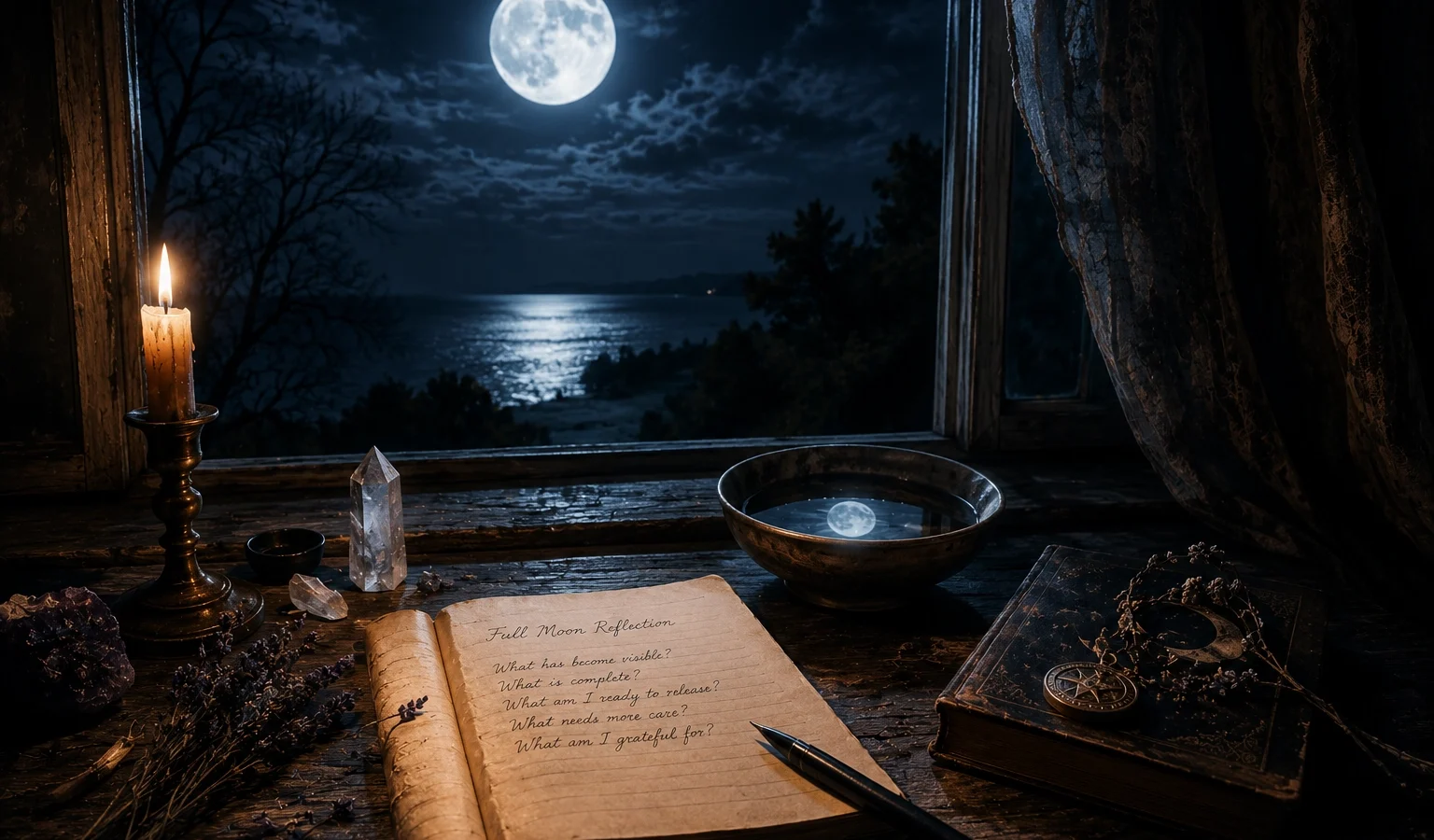
The full moon does not make the night empty.
It makes it visible.
A field changes beneath it. A window becomes a pale square. Water gathers a broken path of silver. Trees no longer stand as black masses only; their branches acquire edges, shadows, and a strange borrowed clarity. The world remains nocturnal, but it is not fully hidden.
This is the emotional territory of the full moon.
It belongs neither entirely to darkness nor to daylight. It does not expose the world with the authority of the sun. It illuminates indirectly, quietly, and from a distance. The light is real, but reflected. The landscape appears, but altered. Familiar things become readable in another language.
This is one reason full moon rituals have become so emotionally powerful in modern symbolic practice. The full moon offers an image of visibility without noise. It suggests completion, reflection, culmination, release, and the moment when something hidden becomes easier to see.
But the full moon should not be reduced to a magical button.
It does not guarantee transformation. It does not force destiny to obey. It does not cleanse a life by calendar alone. The moon does not perform emotional work on behalf of the person who looks at it.
Its power is quieter than that.
The full moon gives human beings a shape for attention.
It offers a recurring night when the mind may pause and ask: what has become visible now? What has reached fullness? What is asking to be released? What feeling has been gathering in the dark and now stands under enough light to be named?
A full moon ritual is not a command to the sky. It is a way of becoming honest beneath borrowed light.
Why the Full Moon Feels Emotionally Charged
The full moon is one of the most visually complete symbols in the night sky.
It appears whole.
Unlike the crescent, which suggests emergence, or the waning moon, which suggests decrease, the full moon carries the image of culmination. Something has reached its maximum visible form. The cycle has not ended, but it has arrived at fullness before beginning to diminish again.
This visual fullness gives the moon emotional force.
Human beings understand cycles through images. We mark beginnings, growth, height, decline, absence, and return. The moon gives these stages to the eye. It makes time visible without needing a clock.
This is why full moon rituals often focus on reflection, release, and completion. The full moon does not symbolize an empty beginning. It symbolizes a moment when something has gathered enough presence to be seen. A feeling. A pattern. A decision. A grief. A desire. A fatigue. A truth that was easier to ignore when it remained half-lit.
The emotional charge does not come from spectacle alone.
It comes from recognition.
The full moon looks complete, but it is still part of a cycle. Its fullness is temporary. Its brightness already contains the beginning of decline. This gives the image a quiet melancholy: even fullness cannot remain fixed.
The moon teaches completion without permanence.
The Moon as Reflected Light
The moon does not generate its own visible light.
It reflects the sun.
Symbolically, this matters.
Reflected light is not false light. It is received light. It travels indirectly. It softens the world rather than conquering it. It reveals without overwhelming. It allows the night to remain night.
This is part of the emotional depth behind lunar rituals. They often belong to indirect knowledge: what one realizes only after experience has been reflected upon; what one feels when the day’s performance has ended; what becomes visible not through force, but through distance.
Some truths cannot be seen under direct light.
Daylight can be too practical. It asks for action, decision, response, productivity, explanation. Moonlight offers another kind of visibility. It does not demand immediate usefulness. It allows thought to remain symbolic for a while.
This is why moonlit reflection can feel intimate.
The full moon does not interrogate.
It reveals gently enough for the person to keep looking.
Fullness, Completion, and the Emotional Peak
Many emotional processes have phases.
An unease begins faintly. A question grows. A relationship changes. A decision becomes heavier. A grief returns. A desire gathers language. A resentment becomes difficult to deny. A project reaches its limit. A pattern becomes too visible to ignore.
The full moon becomes a powerful symbol because it gives such processes a visible peak.
Not every feeling is ready to be solved.
But some feelings are ready to be seen.
This is where full moon rituals become emotionally useful. They can create a moment of deliberate attention around what has reached fullness in the inner life. The ritual does not make the feeling appear. It gives the feeling a place to stand.
A person may ask:
- What emotion has become too large to keep unnamed?
- What situation has reached a point of clarity?
- What part of my life feels full, heavy, complete, or excessive?
- What am I carrying that has already taught me what it needed to teach?
- What needs gratitude before release?
- What needs mourning before release?
The full moon is not only about release.
It is also about recognition before release.
To let go too quickly can become avoidance. The full moon asks first for visibility.
Why Rituals Gather Around Uncertainty
Ritual often appears where life refuses to become fully controllable.
Birth, death, illness, marriage, departure, harvest, war, grief, seasonal change, spiritual transition, and uncertainty have all attracted ritual forms. Human beings repeat gestures when ordinary language feels insufficient. They light candles, wash hands, place objects, speak names, keep vigil, mark calendars, return to certain rooms, and give visible form to invisible pressure.
This helps explain the emotional appeal of symbolic lunar practice.
The moon offers a predictable cycle inside an unpredictable life. It returns. It changes shape. It disappears and reappears. It becomes full and then begins to wane. Its rhythm gives the mind a structure without pretending that life itself can be fully controlled.
A ritual performed under the full moon may not change the external situation immediately.
But it may change the relationship to the situation.
It may slow the mind.
It may give grief a boundary.
It may give gratitude a form.
It may give a decision one quiet night of attention.
This is not supernatural certainty.
It is symbolic order.
Release Without Theatrical Drama
Modern spiritual language often speaks of release too easily.
Release the past. Release fear. Release what no longer serves. Release the old self. Release limiting beliefs. The phrases may contain truth, but repeated too often they can become polished emptiness.
Real release is rarely so clean.
Some things cannot be released because they still need to be understood. Some cannot be released because grief has not yet had room. Some cannot be released because practical consequences remain. Some cannot be released because they are not finished. Some should not be released at all; they should be repaired, defended, or carried differently.
This is why full moon rituals should not become emotional theatre.
Burning a paper does not automatically end a pattern.
Speaking a sentence aloud does not erase years of habit.
Placing an object in moonlight does not replace responsibility.
A mature ritual does not promise instant freedom.
It creates a threshold where one can admit what has become heavy.
Sometimes release begins not with letting go, but with finally naming what the hands are holding.
The Full Moon and Emotional Excess
The full moon often feels connected with emotional excess because it is visually excessive.
It is not a subtle moon.
It does not appear as a thin line, a hidden possibility, or a dark absence. It arrives as a complete disc, bright enough to alter the landscape. It draws attention because it cannot easily be ignored.
Symbolically, this makes it a useful image for feelings that have reached visibility.
Sadness that has become undeniable.
Anger that has gathered too much pressure.
Love that can no longer remain unspoken.
Fatigue that has finally exceeded pride.
Intuition that has stopped being a whisper.
This does not mean the moon causes these emotions.
The responsible reading is subtler. The full moon gives people a language for recognizing emotional fullness. It becomes an external image for an internal state.
In this sense, moonlit reflection may function as a mirror.
The moon outside is full.
The inner life asks what has also reached fullness.
| Full Moon Image | Emotional Association | Possible Reflection |
|---|---|---|
| Brightness in darkness | Clarity inside uncertainty | What can I finally see? |
| Roundness | Completion or fullness | What has reached its visible form? |
| Reflected light | Indirect knowledge | What do I understand only after reflection? |
| Temporary fullness | Impermanence | What cannot remain in this form forever? |
| Beginning of waning | Release, decline, letting go | What is ready to lessen? |
| Night visibility | Revealed hiddenness | What has been present but unseen? |
This table is not a magical code.
It is a way of reading the full moon as symbolic atmosphere rather than mechanical instruction.
The Difference Between Reflection and Manifestation
Lucifer Heritage should be careful with full moon language.
The modern internet often turns lunar symbolism into a vocabulary of manifestation, attraction, energetic portals, and guaranteed transformation. This is precisely where the meaning becomes cheaper.
The full moon does not need these promises.
Its symbolic force is strong enough without them.
A reflective approach is more mature than a commanding one. Instead of asking the moon to deliver an outcome, the person allows the full moon to mark a moment of attention. Instead of declaring that reality must obey desire, the ritual asks whether the desire itself is honest, proportionate, and still alive.
This changes everything.
Manifestation language often tries to control the future.
Reflection tries to understand the present.
A full moon practice becomes more meaningful when it belongs to reflection rather than demand.
The question is not: how do I force life to give me what I want?
The question is: what is now visible enough to be faced?
The Full Moon as a Mirror of Memory
Moonlight often feels old.
Not because the moon itself is a memory in the sentimental sense, but because moonlight changes the present into something slightly removed from ordinary time. A familiar garden, street, room, or window may appear as though it belongs partly to the past. The edges soften. The visible world becomes less practical and more remembered.
This is why the full moon often awakens memory.
People remember former nights. Lost places. Childhood windows. Conversations after midnight. Departures. Walks. Griefs. The faces of people who once stood under the same sky and are no longer present in the same way.
For this reason, lunar rituals can carry a memorial quality.
They may not be about future goals at all.
They may be about honoring what remains emotionally luminous in memory.
A person may light a candle not to summon change, but to acknowledge a loss. They may write a name. They may sit near a window. They may allow the moon to become a quiet witness to something that daylight asks them to carry too efficiently.
The full moon does not return the past.
It gives memory a surface of light.
Lunar Rituals and the Body’s Need for Repetition
The body understands repetition.
Morning routines, seasonal foods, annual dates, anniversaries, walks, songs, gestures, prayers, and small domestic acts all show how repetition gives life structure. A repeated action does not need to be dramatic to matter. Sometimes the repetition matters because it is modest.
The moon’s cycle offers a natural rhythm for reflection.
Not because every person must live by lunar time.
Not because the moon dictates inner life.
But because a recurring celestial image can help organize attention.
Full moon rituals may become meaningful when they are simple enough to repeat without performance. A page written every full moon. A candle lit. A walk taken. A question asked. A room cleaned. A letter not sent. A name remembered. A decision reviewed. A habit examined.
Such repetition can become a quiet archive.
Month by month, the person begins to see what returns.
The same fear.
The same longing.
The same exhaustion.
The same gratitude.
The same unfinished conversation with the self.
The moon becomes less a spectacle than a calendar of inner weather.
The Objects of a Full Moon Ritual
Objects often gather around rituals because emotion seeks material anchors.
A candle. A bowl of water. A notebook. A stone. A ring. A dried flower. A photograph. A key. A cup of tea. A piece of paper folded carefully and placed aside. None of these objects needs to be magical in the crude sense.
They matter because they hold attention.
In full moon rituals, objects can help the mind become more precise. A candle may mark presence. Water may suggest reflection. A notebook may hold language. A photograph may hold memory. A key may suggest access or closure. A stone may give heaviness to something too abstract.
But objects should not be overloaded.
A ritual table crowded with too many symbolic items may begin to feel theatrical rather than attentive. Lucifer Heritage should favor restraint: one or two objects, chosen with care, are often stronger than a display arranged for appearance.
The ritual object should deepen the moment.
It should not compete with it.
A Quiet Method for Full Moon Reflection
A meaningful full moon ritual does not need elaborate instruction.
It does not require expensive tools, dramatic language, astrological certainty, or promises of supernatural reward. It needs only a clear boundary of attention and enough honesty to avoid performance.
A quiet method may look like this:
- Choose a safe, calm place where the moon can be seen or simply remembered.
- Light a candle if appropriate and safe, or sit near a lamp if open flame is not suitable.
- Write one sentence: “What has become visible this month?”
- Write without forcing beauty or certainty.
- Name one thing that feels complete, heavy, or ready to lessen.
- Name one thing that should not be released yet because it still needs care.
- Sit for a few minutes without turning the ritual into a performance.
- Close the moment deliberately: extinguish the candle, close the notebook, or step away from the window.
This is not a spell for controlling life.
It is a method of symbolic attention.
The ritual is successful not when the future obeys, but when the present becomes more honest.
When Full Moon Rituals Become Too Easy
The full moon is visually beautiful, so it is easy to misuse.
A moonlit window, a candle, a black cloth, a bowl of water, a deck of cards, and a few silver objects can create instant atmosphere. But atmosphere without thought becomes decoration.
Cheap lunar symbolism turns the full moon into an aesthetic machine.
It repeats the same images: glowing moon, feminine silhouette, crystals, cosmic mist, “release what no longer serves,” and a promise that everything will change if the gesture is performed correctly.
Lucifer Heritage needs a more disciplined approach.
Full moon rituals should not be presented as guaranteed outcomes. They should not manipulate vulnerable people with promises of destiny, love, money, protection, or spiritual elevation. They should not imply that difficult emotional work can be replaced by a beautiful night photograph.
The stronger image is quieter.
A window.
A notebook.
A bowl of water.
A hand resting near the page.
The moonlight not as command, but as witness.
The ritual not as spectacle, but as a boundary around attention.
The Full Moon and the Ethics of Emotional Work
Ritual can help, but it can also become avoidance.
A person may perform a full moon ritual every month and still never make the necessary phone call. They may write about release but avoid setting a boundary. They may burn paper but continue the same pattern. They may seek atmosphere because action feels frightening.
This does not make the ritual worthless.
It makes honesty necessary.
Symbolic practice should not replace practical life. Reflection should eventually touch behavior. If a pattern is harmful, naming it under moonlight is only one beginning. If grief is overwhelming, ritual may accompany care, but it should not replace support. If anxiety becomes severe, a candle and a notebook may be meaningful, but professional help may also matter.
The emotional meaning of lunar ritual is strongest when the ritual remains connected to life.
Not fantasy.
Not performance.
Life.
Full Moon Rituals as Personal Archives
Repeated lunar reflection can become an archive.
A notebook kept across months may reveal patterns that the mind would otherwise miss. Certain words return. Certain fears repeat. Certain desires remain alive. Certain situations lose their force. A name that once appeared in every entry slowly disappears. A question that once felt impossible becomes ordinary.
This is where full moon rituals become especially interesting.
They do not only create moments of release.
They create records of change.
The page becomes a lunar margin.
Month by month, the person writes beside the cycle.
Not to prove that the moon caused the transformation.
But to notice that transformation has a rhythm.
In this way, the ritual becomes less about the sky commanding the self and more about the self learning how to keep witness with time.
Symbolic Observations ✦
- The full moon symbolizes visibility, culmination, reflection, and temporary fullness.
- Full moon rituals are most meaningful when they support attention rather than promise control.
- The moon’s reflected light suggests indirect knowledge and quiet recognition.
- Release should not be rushed; some things must first be named, mourned, repaired, or understood.
- Ritual can reduce emotional chaos by giving uncertainty a repeated form.
- The full moon can become a mirror for what has reached emotional fullness in the inner life.
- Lunar ritual objects should deepen attention, not create decorative excess.
- A simple notebook may be more powerful than an elaborate ritual table.
- The strongest ritual does not replace life; it clarifies how one must return to life.
- The full moon matters because it gives night enough light for hidden things to become visible without ceasing to be mysterious.
The Moon That Does Not Explain Everything
The full moon is powerful partly because it does not explain itself.
It appears.
It brightens the night.
It changes the room.
It gathers the eye.
It makes people remember that time moves in circles as well as lines.
But it does not tell the person what to do.
This restraint is important.
A mature symbolic practice does not demand that every object speak in commands. The moon can be meaningful without becoming an oracle. A ritual can be moving without becoming prophecy. A quiet night can matter without claiming to alter fate.
Full moon rituals endure because the human being still needs moments of visible pause.
The month fills with tasks, fears, habits, messages, work, fatigue, and unfinished conversations. Then the moon becomes full again, and the night offers one image of completion.
Not final completion.
Not perfect completion.
Only enough fullness to stop and look.
The Light That Allows Release
The emotional meaning of full moon rituals lies in their balance.
They stand between darkness and exposure.
Between memory and release.
Between ritual and ordinary life.
Between the need to hold and the need to let something lessen.
The full moon does not erase the dark. It gives it contours. It does not solve grief. It gives grief a night when it can be acknowledged. It does not make the future obedient. It makes the present more visible.
That is already enough.
A person sits near the window.
The notebook opens.
The candle burns low.
The moonlight does not speak.
The room becomes quiet enough for one honest sentence.
Something has reached fullness.
Something may now begin to wane.
And in that small act of attention, the ritual finds its meaning:
not to command the moon, but to stop hiding from what its light has made visible.
Continue Through the Archive
Why the Moon Became a Symbol of Transformation
A symbolic exploration of lunar phases, change, reflection, cycles, and the moon’s long relationship with human imagination.
The Forgotten History of Candle Rituals
A cultural and symbolic study of fragile light, attention, remembrance, sacred time, and the quiet difference between ritual and decoration.
Why Humans Create Rituals During Times of Uncertainty
A reflective essay on repetition, fear, order, and the human need to give form to moments when the future remains unclear.
The Emotional Meaning of Darkness in Human Thought
A philosophical reflection on fear, shelter, uncertainty, symbolic darkness, and the difference between shadow and evil.
Why Humans Attach Meaning to Ritual Objects
A calm study of objects, memory, touch, attention, and the human need to give invisible experience a physical anchor.
Further Reading & Sources
- NASA — Moon Phases
A clear explanation of the eight lunar phases, the Moon’s 29.5-day cycle, and why the illuminated portion changes from Earth’s perspective. - NASA — Daily Moon Guide
A practical lunar calendar and observation guide for tracking current moon phases and notable lunar events. - Encyclopaedia Britannica — Moon
A general reference on the Moon as Earth’s natural satellite, its physical characteristics, orbit, phases, and cultural importance. - Encyclopaedia Britannica — Lunar Phase
Background on the recurring changes in the Moon’s visible shape as seen from Earth. - Lang et al. — The Role of Ritual Behaviour in Anxiety Reduction
An academic study on ritual behavior, perceived anxiety, and physiological anxiety reduction. - Krátký et al. — Anxiety and Ritualization
A discussion of ritualized behavior, attention, anxiety, and the psychological structure of repeated action. - Grupe and Nitschke — Uncertainty and Anticipation in Anxiety
A major review on anxiety, anticipation, and the emotional pressure of threat uncertainty. - The Metropolitan Museum of Art — Isis and the Moon
Museum context on lunar symbolism, divine imagery, and the Moon’s role in ancient visual and religious imagination. - The Metropolitan Museum of Art — Artemis and the Deer
Museum context for Artemis, wilderness, classical imagery, and later symbolic associations that often connect the goddess with lunar imagination. - The Metropolitan Museum of Art — Moonlight in European Painting
Museum context for moonlit landscapes, atmosphere, night vision, and the emotional use of lunar light in visual art.